
The nation’s flight-safety umpire just said Trump’s planned 250-foot arch won’t foul Reagan National’s airspace.
Story Snapshot
- The Federal Aviation Administration (FAA) found no substantial adverse effect on Reagan National’s airspace.
- The agency requires red obstruction lights on the arch’s top as standard safety mitigation.
- Experts quoted by outlets still argue the arch adds complexity to a tight approach corridor.
- The FAA’s broader review mechanics explain how “tall” can be “safe” with conditions.
What the FAA actually decided
The Federal Aviation Administration’s feasibility study concluded the proposed structure would not cause a substantial adverse effect on airspace use or navigation facilities at Ronald Reagan Washington National Airport. The study did not flag harm to instrument or visual procedures and called for red obstruction lights on the arch’s top. That lighting step is a common requirement for tall objects near airports and signals pilots at night or in poor visibility.
An FAA spokesperson said the review found no adverse impacts to the airport’s operations. The finding addresses a key public worry: whether takeoffs, landings, or missed-approach routes would need to change. The answer, for now, is no. This places the arch in a familiar regulatory lane. A tall object can trigger scrutiny and still earn a green light if it does not materially reduce safety or force broad flight restrictions.
Why tall can still be lawful near busy skies
Federal rules set tripwires for height and proximity to airports. Those tripwires start evaluations; they do not end them. Structures over 200 feet or within protected approach surfaces get flagged for a deeper aeronautical study. The FAA then weighs runway geometry, altitude profiles, and pilot procedures. The agency only labels a structure a “hazard” if it affects a significant volume of operations or would exclude or restrict flights in a specific area.
This standard explains the current call. A 250-foot arch near Reagan National sounds risky on instinct. But risk in federal aviation law is not a vibe check; it is a procedure check. If a structure does not force changes to routes or minimums, and pilots can still fly published paths with known margins, the FAA can clear it with conditions. Lighting is the common, low-burden condition that protects at night without rewriting how airplanes arrive and depart.
What critics claim about the approach corridor
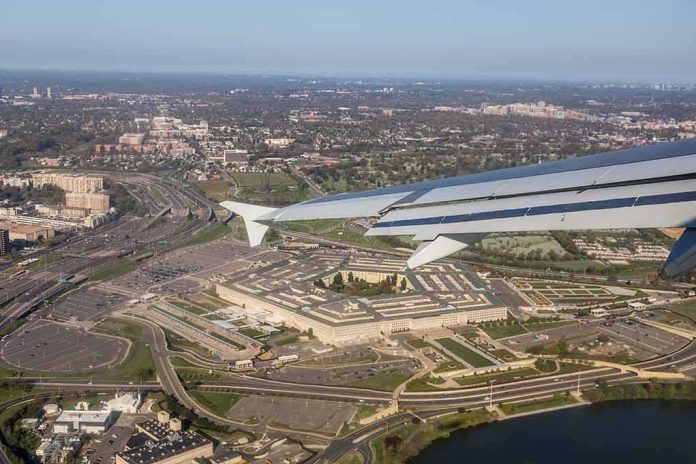
Newsrooms have featured pilots and analysts who say the arch would sit close to the north river approach path, where jets descend low along the Potomac. They argue this adds one more variable in a complex slice of national airspace. One analysis claimed the location intersects the corridor and could press on the forty-to-one clearance surface if built to the proposed height. Another report placed aircraft altitude near 492 feet in that segment, narrowing room for pilot error.
The Trump administration, always so concerned about "freedom" and "common sense," was perfectly happy to push a 250-foot arch just two miles from a main airport runway, where planes land every minute. Aviation safety experts, people who actually understand flight paths and risk,…
— frakmaga2025 (@FrakMAGA2022) September 17, 2026
These claims sharpen a fair question: where is the buffer? The FAA’s present answer is that published procedures hold with the arch in place, with lighting as mitigation. That aligns with the agency’s duty to judge real-world margins, not political noise. Calls to reject the project due to “complexity” read more like a general unease than a technical refutation. Complexity is normal in Washington’s airspace; compliance with safety procedures is the test that matters most.
What happens next and what to watch
The record shows the FAA’s finding came from an initial or intermediate study phase. The agency continues broader evaluation, including construction-phase issues like crane heights. A final “no hazard” or “hazard” letter, if issued, would lock in the determination and any conditions. Watch for three tells: the exact coordinates and elevation used, any tweak to approach or missed-approach minimums, and whether temporary cranes exceed the permanent height and need separate controls.
Transparency would help settle the argument. Publishing the full obstruction-evaluation file, including modeling of visual and instrument procedures at Reagan National, would let outside experts validate the margins. Until then, the clearest public fact stands: the FAA says the arch does not harm airport operations and requires red lights on top. That is not a political favor. That is how American aviation law measures and manages risk in cluttered skies.
Sources:
cbsnews.com, npr.org, cyprus-mail.com, reuters.com, wusf.org, nytimes.com, airinsight.com, cnn.com, govinfo.gov, fdotwww.blob.core.windows.net, faa.gov, americanbar.org