
A boycott billed as anti-Zionist hit Philadelphia streets and met a wall of flags, shoppers, and fury.
Story Snapshot
- Organizers named six restaurants and called for a boycott tied to owners’ support for Israel.
- Officials condemned targeting Jewish-owned businesses and warned it crossed a moral line.
- Counterprotesters packed sidewalks, waved Israeli flags, and urged people to “boycott the boycott”.
- The flyer’s “No business for Zionists” message drove the antisemitism charge and public backlash.
What actually happened on the ground
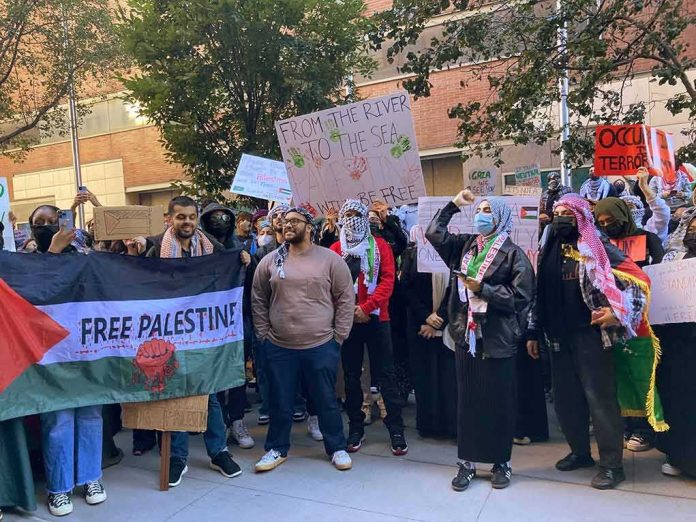
Pro-Palestinian cyclists and supporters rolled through Center City on a planned “boycott ride,” naming Mac Mart, K’Far Café, Huda, Goldie, Schlesinger’s, and Dizengoff. Organizers said they targeted owners who supported Israel, not Jews as a group, and they posted the route and rationale ahead of time. Crowds formed fast at each stop. Lines of customers spilled onto sidewalks. Pro-Israel counterprotesters hoisted flags and signs and urged people to buy from the restaurants, not shun them.
City leaders moved just as fast. Mayor Cherelle Parker said peaceful protest is protected, but singling out businesses because their owners are Jewish is unacceptable in Philadelphia. That statement set a clear line for the public debate. It also amplified the biggest problem for the organizers: the flyer language. “No business for Zionists” and “These Zionist establishments must go” landed like a hammer and shaped public perception before a single chant began.
The message that overpowered the march
Organizers called their effort anti-fascist and anti-Zionist. They said they oppose antisemitism and chose targets for political and charitable ties to Israel. But the flyer’s broad phrasing and the Kristallnacht eve timing gave critics a clean, potent frame: this was not about policy; this was about Jews. Jewish groups called it “Jew-hatred, plain and simple,” and told the city to answer a boycott with open wallets and full tables. Crowds did exactly that, blunting any claim of market pressure.
From a common-sense, conservative view, the line is bright. You can protest a government. You cannot paint a target on local shop doors because of who owns them. The chosen date poured gasoline on the charge. Kristallnacht marked the smashing of Jewish businesses. Holding a boycott ride on its eve forced people to think of broken glass, not nuanced policy debate. That is why the counterprotesters won the optics battle before the first receipt printed.
Claims, facts, and what still lacks proof
Reporters traced the organizers’ stated rationale to owners’ support for Israel and, in one case, fundraising for injured Israeli children after October 7, 2023. Those facts help explain why these six were named. They do not show the restaurants themselves funded war, made political statements as companies, or acted beyond their owners’ views. The record also does not prove every business on the list matched the same criteria, which leaves the selection open to charges of bias and inconsistency.
BOYCOTT FAILS: PHILADELPHIA RESPONDS TO ANTISEMITES
On November 8, something happened in Philadelphia that organizers of an anti-Israel protest hardly expected. Instead of a massive boycott of Jewish-owned restaurants, they were met with a crowded demonstration of solidarity… pic.twitter.com/i40txIzJfs
— VSurrie (@Vsurryhne) November 9, 2026
What the day did show was a strong official and civic response. The Pennsylvania Human Relations Commission denounced the targeting and spotlighted the flyer language. That single move locked in the narrative that this crossed from protest into discrimination. Major outlets echoed City Hall and community leaders, and their reports focused on antisemitism claims, counter-mobilization, and the scene outside each storefront, not on the organizers’ finer points.
Why the boycott fizzled in real time
Boycotts can move markets. Academic work shows they can hit a company’s value even without policy wins. But neighborhood restaurants are not public firms with share prices. Their “market signal” is butts in seats. On this day, the signal screamed the opposite of a boycott. Customers packed in, media cameras rolled, and counterprotesters framed the moment as a defense of neighbors, not a debate over the Middle East. The organizers left with attention, not leverage.
The lesson is simple and hard. If you want to persuade, aim at conduct, not identity. If your flyer reads like a test of who counts as a “Zionist,” you invite a moral and legal backlash, and you hand your critics the megaphone. Philadelphia showed that people will rally to protect local businesses when politics threatens to turn into a blacklist. That is not just optics. That is civic muscle memory at work.
Sources:
foxnews.com, nbcphiladelphia.com, newsweek.com, wdsu.com, stljewishlight.org, whyy.org, edition.cnn.com, cnn.com