

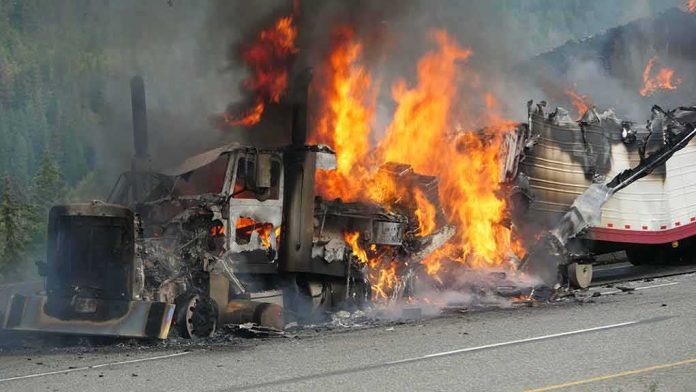
A single tanker swerved on Cairo’s Ring Road and turned rush hour into a wall of fire that killed at least 31 people.
Story Snapshot
- A fuel tanker crashed above Tunnel 10 in Warraq, igniting a deadly highway fire near Cairo.
- Egypt’s Health Ministry reported at least 31 dead and dozens injured.
- Officials said the privately operated tanker carried petroleum products when it veered and exploded.
- Ambulances rushed victims to multiple hospitals as cars and motorcycles burned on the road.
A tanker crash, an instant inferno, and a toll measured in minutes
Egyptian authorities said a fuel tanker carrying petroleum products veered off the Ring Road in the Warraq district above Tunnel 10 on Wednesday, November 25, 2026. The crash sparked a fire that spread fast and trapped drivers in traffic. The Health Ministry reported at least 31 people dead. The location matters. That stretch funnels commuters into and around greater Cairo. Gridlock gives a fuel fire victims and almost no escape routes.
The Petroleum Ministry said the vehicle was privately operated and hauling petroleum products when it left the roadway, crashed, and exploded. Flames jumped to nearby cars and motorcycles caught in the evening flow. Emergency crews sent dozens of ambulances and moved the injured to three hospitals, according to official statements cited by reporters on the ground. The number of injured varied in early counts, which is common in mass-casualty traffic fires as hospitals reconcile intake data.
What officials confirm, and what that tells us
The government’s death toll anchors the response and sets priorities for investigators. The Associated Press reported the Health Ministry’s count at 31, aligning with other major outlets. That figure, while tragic, helps direct resources for family notification, morgue capacity, and mental health support for survivors. Numbers in the first day can shift as authorities identify remains and confirm hospital outcomes, but the scale is not in doubt here.
Reporters with access to prosecution updates described widespread vehicle damage as the fire ran along the roadway. That picture fits standard fuel-tanker dynamics. When a tanker ruptures, fuel can pour downhill, find low points, and flash with heat or sparks. Even a few seconds of spill can create a sheet of flame. Drivers in lanes boxed by barriers often cannot turn or reverse. That choke point explains how a single crash became a mass-casualty event so fast.
Why this stretch of road, and why it matters now
The Ring Road is Cairo’s pressure valve and its bottleneck. Commuters, delivery trucks, and provincial traffic all mix there. That means hazardous cargo rumbles beside packed family sedans every day. When a tanker loses control, the margin for error is thin. The location above a tunnel and near barriers can turn a crash into a trap. The Warraq segment has limited shoulders and heavy merges, which complicate driver choices in a split second.
Egypt detains driver suspected of causing Cairo fuel tanker crash and inferno that left 31 dead https://t.co/J6dt1V4Moy #FoxNews
— Greg Gibbons (@GregGibbon53629) November 26, 2026
American conservative values point to two priorities after tragedies like this: accountability and competence. Egyptians deserve to know who owned the truck, whether the operator met safety rules, and if the driver had the proper training. Clear rules on routing, time-of-day limits, and vehicle inspections save lives without smothering commerce. That balance is not theory. It is the difference between a scare and a mass funeral on a weekday evening.
Lessons from tanker fires that policymakers can act on
Traffic agencies around the world reduce tanker risks in three proven ways. First, route and schedule hazardous loads away from dense choke points during peak hours. Second, demand rigorous vehicle and pressure-vessel inspections, with instant sidelining for defects. Third, enhance barriers, drains, and foam systems at known hazard spots, including tunnels and tight interchanges. Egypt’s broader road-death burden makes these steps urgent and practical rather than aspirational policy talk.
World Health Organization profiles have long flagged Egypt’s heavy road toll, driven by speed, vehicle mix, and infrastructure stress. That history does not explain this single crash, but it shows how a normal commute can become deadly when a high-risk vehicle fails. The Ring Road crash fits a known pattern where one breach can cascade across dozens of cars in moments. When officials finish the investigation, the fixes should be clear and measurable, not simply mournful statements.
What comes next for families and investigators
Authorities will map the path of the tanker, test components, and review video for the trigger. Hospitals will finalize injury lists and cause-of-death records. Insurers and prosecutors will look at the operator’s maintenance and training files. The goal is simple: prove what failed and prevent a repeat. The public has a right to see those steps and the names responsible for safety. Candor and follow-through build trust after a night of fire and loss.
Grief should not be the final headline. A safer Ring Road is the only worthy answer to 31 lives cut short. That means naming the failures, upgrading the rules, and enforcing them every day traffic moves under the Cairo sun. When the next tanker rolls past Tunnel 10, drivers should know the state learned, acted, and will not accept another wall of fire.
Sources:
upi.com, us.cnn.com, en.wikipedia.org, nytimes.com, emro.who.int