

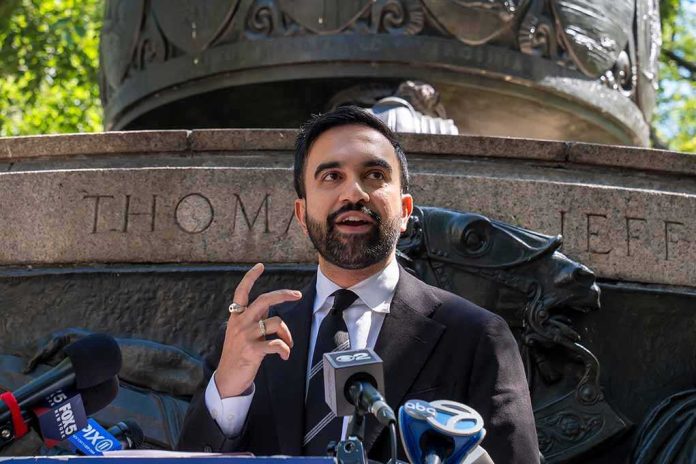
New York City wants to pay families up to $500 a month to let a relative fresh out of Rikers Island move back in with them.
Quick Take
- Mayor Zohran Mamdani’s 88-page Close Rikers plan would grow the Kinship Reentry Housing Program from 50 families to 300.
- The city would spend $3.55 million this year and $7.1 million a year after that on the expanded program.
- About 100 of the people housed under the program have serious mental illness or substance use problems.
- City Council members from both parties are pushing back, calling it reckless spending with no clear safety rules.
What The Plan Actually Proposes
The Kinship Reentry Housing Program is not brand new. It started in 2021 and is run for the city by the Osborne Association, a nonprofit group. Families who take in a relative coming home from Rikers or state prison get roughly $500 a month for up to a year, plus help with money management, therapy, and case navigation. Mamdani’s plan would take that small pilot and multiply it sixfold, folding it into his broader strategy for shutting down Rikers by 2032.
The stated goal sounds reasonable on its face. People leaving jail without a stable address are far more likely to end up back behind bars. One review of reentry research found recidivism risk jumped 35 percent for people released with no housing lined up. Family reunification, in theory, keeps people connected and watched over instead of drifting into shelters or the street.
The Math Nobody Has Finished Yet
Here is where the plan gets shaky. The city has not said what the $500 payment becomes once the program balloons to 300 families, nor has it broken down how much of the $7.1 million goes to direct cash versus therapy, staffing, and overhead. Taxpayers are being asked to trust a bigger number attached to a program whose basic price tag per family still is not fully public.
There is also no public eligibility checklist. What crimes disqualify someone? Who screens the household for safety? What happens if a placement turns violent or someone relapses? The plan does not say, and that silence matters more as the program scales from dozens of families to hundreds, including people with serious mental illness or substance use disorders.
City Council Members Are Not Buying It
David Carr, the Council’s Republican minority leader, called the expansion “another reckless use of taxpayer money on a social experiment that could go horribly wrong.” Republican Councilwoman Joann Ariola put it bluntly: “New Yorkers are paying for crime twice — first for the offense and then again to pay for these programs.” Even Democratic Councilman Phil Wong broke ranks, asking why families should be paid to house their own relatives at all.
NYC is expanding a program that pays families $500 a month to house relatives coming home from Rikers.Under Mayor Zohran Mamdani’s Close Rikers plan, the Kinship Reentry Housing Program (run by the Osborne Association) is set to grow from 50 families to 300. The city is putting… pic.twitter.com/E4WxJe2MF2
— Freemason (@STARFORCEHH) November 23, 2026
That bipartisan skepticism is worth sitting with. This is not a case of partisan reflex. A Democrat, a Republican leader, and another Republican councilwoman are all asking the same basic question: where is the proof this works, and where is the money actually coming from, in a city that claims to be broke every budget cycle.
Closing Rikers Depends On Programs Like This Working
Mamdani’s broader plan hinges on shrinking the jail population from around 6,600 people down to about 4,100 by 2032. Housing programs like Kinship are supposed to help absorb some of that drop by giving people somewhere to go besides a cell. But the city’s own reporting admits it has not shown how many jail beds this specific program would actually free up, or whether 300 family placements even come close to meeting that target.
Good Intentions Still Need Proof
Supporters point to internal numbers claiming 90 percent of participants report better family relationships and only two instances of reoffending. Those figures, if accurate, sound encouraging. But they come from the program’s own administration, not an independent audit, and a sample of 50 families tells us little about how the same model holds up at 300. Before taxpayers fund a sixfold expansion, they deserve outcome data, not just a plan’s self-description.
None of this means family-based reentry housing is a bad idea in concept. Stable housing genuinely correlates with lower recidivism, and keeping families together has real value. But good intentions do not excuse vague eligibility rules, unclear payment amounts, and a lack of independent evaluation. New Yorkers are being asked to write a much bigger check before anyone can show the first check actually worked.
Sources:
thegatewaypundit.com, nypost.com, yournews.com, matzav.com, bluestatebluesnews.com