

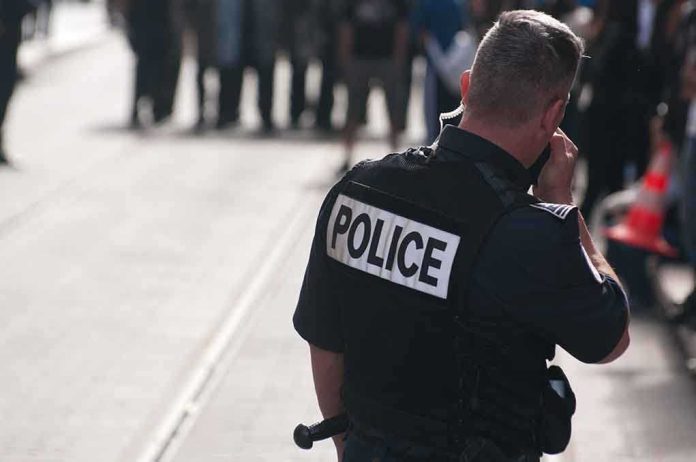
Britain’s new police “faith toolkit” tells female officers to weigh “cultural factors” before speaking to Muslim men—and that single line lit the fuse.
Story Snapshot
- National Police Chiefs’ Council issued guidance on faith-sensitive policing
- Islam section urges modest dress and care with opposite-sex contact
- Nigel Farage calls it proof of “two-tier policing” and wants it scrapped
- Debate centers on respect versus equality under one standard
What The Official Guidance Actually Says
The National Police Chiefs’ Council released a National Faith Toolkit to guide officers when they enter religious homes and venues. The document aims to reduce friction and improve cooperation. In the Islam section, it states that “cultural factors should be considered when interacting with the opposite sex,” and advises modest dress, care around sex-specific areas, and limiting dog presence in mosques and some Muslim homes. The toolkit frames these points as practical steps, not orders that override law or safety.
The guidance also covers other faiths. It gives simple do’s and don’ts to avoid needless offense. The intent is to help officers get key facts faster and keep control of tense scenes. It does not say a suspect can refuse a lawful order. It does not bar a female officer from leading a call. It does not tell police to ignore crime. It states that officers should use judgment while maintaining lawful authority.
The Charge Of Two-Tier Policing
Nigel Farage blasted the toolkit as proof of “institutional two-tier policing” and said officials should pull it and fire those who wrote it. He argues that instructing women to weigh cultural rules around men rewards sexist norms and softens equal treatment under law. Media reports echoed this view and pointed to lines on modest dress, opposite-sex speech, and dog use as special favors for one group, not equal standards for all.
Critics also said the Islam section runs longer and more detailed than other faith entries, which they take as more proof of tilt. Some framed the package as a symbol of a broader trend that chills speech on Islam while tolerating sharper attacks on Christianity. These are pointed claims. They do not dispute the toolkit exists; they argue it sends the wrong signal about whose rules set the tone when police arrive.
Respect, Authority, And What Works In The Field
Studies on police legitimacy point to a tight link between fair treatment and public cooperation. Research with British Muslims found that people help police more when they feel respected and heard, even in tough contexts like counterterrorism. Procedural justice often predicts willingness to call in tips, share details, and accept outcomes, sometimes more than fear of crime or raw effectiveness does. That line of evidence explains why leaders chase respect cues in first contact.
The National Police Chiefs’ Council (NPCC) is facing fresh accusations of two-tier policing over the extent to which British police officers are being advised to accommodate Islamic religious customs whilst carrying out their duties.
The National Faith Toolkit, developed in… pic.twitter.com/LhcjFgRIb5
— Stef Costello Spode (@StefSpodeUK) November 28, 2026
Good tactics still need clear guardrails. Respectful contact should never become a veto on normal policing. Equality before the law is not a slogan; it is the spine. The toolkit’s defenders can make the case if they show two things on the ground: no loss of lawful authority, and faster cooperation that solves real cases. If those metrics move, the public can judge results, not vibes. If not, the policy reads like culture over law, which offends common sense.
How A Conservative Lens Sorts The Trade-Off
Policing should be even-handed, firm, and polite. That mix is not soft; it is stable. A calm officer can remove shoes in a mosque without removing a badge. But any guidance that nudges women to “be careful” speaking to men risks sending the wrong cue. The burden cannot shift onto female officers to tiptoe around male offense. The standard should be simple: one law, one chain of command, one voice—delivered with basic manners that help close the case faster.
Commanders can correct the optics with three fixes. First, write a bright-line sentence atop every section: legal powers outrank all custom, always. Second, state that female officers have full authority to lead any task, anywhere, and that adjustments are optional and situational. Third, publish results. If this guidance raises voluntary compliance, reduces complaints, and improves evidence yields, show the numbers. Taxpayers earned proof, not lectures about sensitivity.
The Real Test Arrives At The Doorway
Front doors are where theory dies. A female constable knocks. A man objects. The right answer is crisp: we respect your space, and we will do our job. If a quick swap to a male interviewer speeds a witness interview without cost, make it. If a suspect stonewalls to game the system, end it. The toolkit should help officers spot which is which. That line keeps respect as a tool, not a leash, and keeps the law the same for everyone, everywhere.
Sources:
redstate.com, timesofindia.indiatimes.com, telegraph.co.uk, openyls.law.yale.edu