

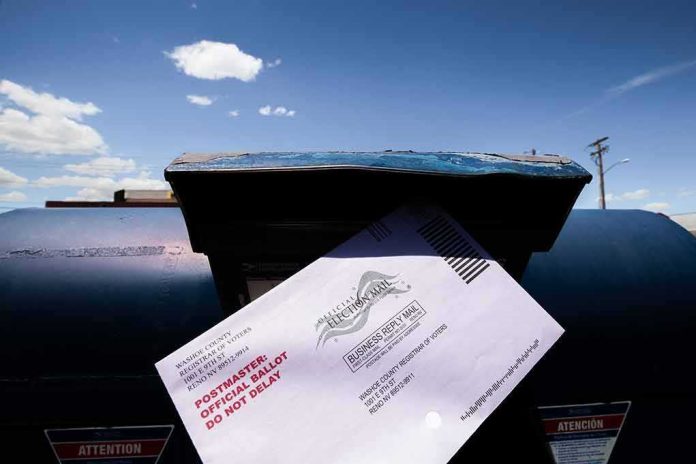
One overworked mail carrier allegedly tossed about 300 primary ballots into a church dumpster—and the case now tests public trust more than any courtroom can.
Story Snapshot
- A federal grand jury indicted a former Utah letter carrier for dumping mail, including about 300 ballots.
- Prosecutors say the ballots were for Eagle Mountain voters ahead of Utah’s June 23, 2026 primary.
- The defendant pleaded not guilty; officials say he denied any political motive.
- Mail-ballot fraud remains very rare, but single cases shape public views out of proportion.
What Prosecutors Say Happened And Why It Matters
The United States Department of Justice says a former United States Postal Service letter carrier in Utah discarded mail that included roughly 300 mail-in ballots addressed to registered voters for the June 2026 primary. A federal grand jury returned an indictment, unsealed in Salt Lake City, charging the carrier with unlawful secretion, destruction, and delay of mail. Officials say the ballots were part of a delivery route in Eagle Mountain and ended up in a church parking lot dumpster soon after the shift began.
The government’s claim is simple and serious: ballots never reached voters because a trusted carrier allegedly threw them away. The charge fits a long-standing federal rule that every piece of mail is protected. This is not a policy debate over ballot rules; it is a basic integrity case about moving mail from point A to B without tampering. The facts alleged are specific, time-stamped, and tied to a defined route and event window.
The Defense And The Narrow Dispute
The defendant pleaded not guilty. Officials at a press event said he told investigators he did not mean to toss any ballots and had no political motive. Accounts of the interview suggest he said he tried to discard advertisements to lighten his workload and made a bad mistake. He is no longer with the Postal Service. A not-guilty plea is a right, and the government still must prove its case beyond a reasonable doubt.
The lack of a stated political motive does not change the legal stakes. Federal law does not ask why the mail was dumped; it asks whether it was dumped at all. From a common-sense view, intent matters for character, not for the voter who never got a ballot. If the Justice Department proves the timeline and the contents, the case is about duty and trust more than ideology.
What This Case Does And Does Not Prove About Mail Voting
This case shows one weak link can disrupt delivery in one neighborhood. It does not show that mail voting is broadly unsafe or that widespread fraud is common. Research reviewed by the Brookings Institution found a vanishingly small share of all mail ballots are fraudulent over many years and many states. That pattern holds across different datasets and election cycles. Rare does not mean never, but it does mean policy should target chokepoints, not scrap the system.
Mail voting depends on a simple promise: the ballot sent to a voter will actually reach the voter.
Federal prosecutors say former Utah postal worker Damon Matai Seei threw away mail assigned for delivery on June 3, including about 300 ballots for Eagle Mountain residents before… pic.twitter.com/fMPD58nZJF
— Dan Holbrook (@DanHolbrook) September 23, 2026
Conservative values point to two parallel truths. First, protect the chain of custody with tough enforcement and simple, auditable steps—scan events, route-level accountability, and fast alerts when election mail goes missing. Second, avoid panic laws that burden honest voters more than they deter the rare bad actor. The Postal Inspection Service and local clerks can pressure-test routes, stage spot checks near ballot drops, and tighten staffing at crunch times without undermining vote-by-mail for law-abiding citizens.
Fix The Human Factor: Practical Steps That Work
Supervisors can flag election-mail trays at the start of a shift and require dual sign-offs when carriers load them. Real-time barcode scans can ping a route manager if a ballot tray does not register street-level movement by a set time. Clerks can send text alerts to voters when their ballot leaves the plant, then again when it hits the route, so missing segments stand out fast. These are light-touch controls that raise certainty without slowing delivery.
The Bottom Line For Voters
One person’s alleged misconduct does not define millions of lawful mail ballots. Swift charges signal that tampering meets real punishment, which is how a free system polices itself. Voters should still track their ballots using state tools, report non-delivery, and request replacements when needed. Officials should keep the focus on prevention and proof. That balance—firm security, easy voting—is not flashy policy, but it keeps faith with every citizen who plays by the rules.
Sources:
spectrumlocalnews.com, justice.gov, nbcnews.com, local10.com, about.usps.com