
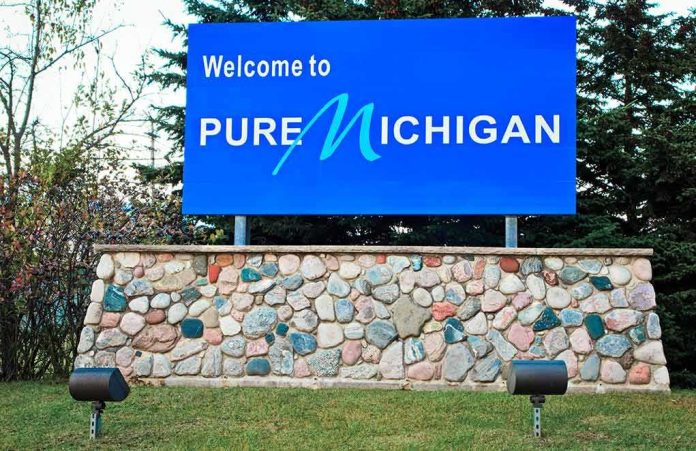
Michigan just elected the nation’s first Muslim senator, and he wasted no time declaring his state the capital of an entire ethnic community.
Quick Take
- Abdul El-Sayed defeated Mike Rogers to become the first Muslim ever elected to the United States Senate.
- He won with over 2.5 million votes, taking 52.5 percent statewide against Rogers’s 45.5 percent.
- At an Arab-American summit, El-Sayed called Michigan “the capital of Arab America.”
- Conservative commentators Erika Kirk and Mark Levin publicly condemned the phrase as divisive.
- Population data show California actually has more Arab-American residents than Michigan, though Michigan has a higher concentration.
A Historic Night Changes Michigan Politics
Abdul El-Sayed, the son of Egyptian immigrants, beat Republican Mike Rogers in Michigan’s 2026 Senate race. The Associated Press called him the first Muslim American ever elected to the chamber. He pulled in over 2.5 million votes statewide, winning by roughly seven points according to the certified results reported by major outlets. It was a decisive, not a narrow, mandate.
National Public Radio noted El-Sayed’s victory speech included Arabic, a small but symbolic detail that signaled where his campaign drew energy. His win got framed almost instantly as a breakthrough for the Democratic Party’s progressive wing, not just a local upset. That framing matters, because it set the stage for what he said days later at a gathering built specifically around Arab-American political identity.
The Senator-Elect’s Own Words at the Summit
On November 6, 2026, El-Sayed addressed the Connect Arab American Empowerment Summit, an event hosted by the Arab America Foundation. He told the crowd, “Michigan proved that Arab America is America, too,” then went further, calling his state “the capital of Arab America.” The line was not an offhand slip. It was a deliberate framing delivered to an audience built around that exact identity.
The trouble is nobody defines what “capital” actually means here. Does it mean the most people, the highest percentage, the most mosques and cultural centers, or simply the loudest political voice? El-Sayed never said. A statewide election win proves political success. It does not, on its own, prove Michigan outranks every other state in Arab-American population or cultural weight.
Pushback From the Right Comes Fast and Loud
Erika Kirk responded directly on social media, writing, “There is no ‘Arab America.’ There is only the United States of America”. Her argument cuts to a core conservative principle: elected officials represent one united country, not a patchwork of ethnic nations stitched together under one flag. Treating “Arab America” as a real place, even rhetorically, invites every other group to carve out its own political turf next.
Mark Levin went further, calling El-Sayed “a cocky little bastard with grand designs” and accusing him of running a jihadi-style agenda rather than serving ordinary Michigan voters. Other conservative critics made a simpler point. A senator’s job is representing every constituent in the state, Arab, non-Arab, Muslim, Christian, or otherwise. Elevating one ethnic identity to statewide branding sidelines everyone else who voted for him too.
One week of Shawarma Law!
Meeting Senator Elect Abdulrahman El-Sayed was personal for me. So much of his story resonates with my own. Growing up Arab American, navigating identity and belonging, and finding purpose in public service and community. Different journeys, but a… pic.twitter.com/XmimqP3LnT
— Omar Kurdi عمر كردي (@omarkurdi20) November 9, 2026
What the Population Numbers Actually Show
Here is where the “capital” claim runs into real trouble. One widely cited population compilation lists California with 344,369 Arab Americans compared to Michigan’s 218,643, even though Michigan’s share of its total population, 2.15 percent, is higher than California’s. By raw headcount, California wins. By concentration, Michigan wins. Those are two different contests, and El-Sayed never said which one he meant.
Older Census-era research found a similar split. Historical data on Metro Detroit, covering Wayne, Oakland, Macomb, and Washtenaw counties, found the region held the nation’s largest Arab-American population as of 2007, ahead of greater Los Angeles. So depending on the year, the boundary lines drawn, and whether you count total people or percentage share, either state can claim the title. That is not proof of fraud. It is proof the phrase “capital of Arab America” is a political slogan, not a measured fact.
A Pattern Bigger Than One Speech
Dearborn’s history as an Arab-American hub is real and well documented, built over a century through Ford-era industrial jobs and generations of family migration. That history earns Michigan a legitimate place in any conversation about Arab-American life in this country. But a legitimate place is not the same as an exclusive crown, and voters deserve leaders who build coalitions across every community rather than branding their whole state as belonging to one.
Sources:
lifesitenews.com, cnn.com, usatoday.com, apnews.com, abcnews.com, worldpopulationreview.com, cambridge.org