
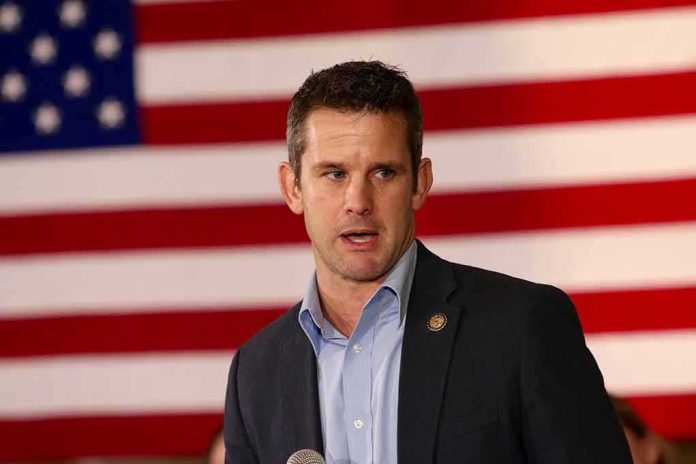
A former congressman reportedly wagered on whether President Biden would pardon him—and now federal regulators want to see the receipts.
Story Snapshot
- Regulators are examining Kalshi trades tied to Adam Kinzinger in late 2024 and early 2025.
- The wagers reportedly involved his own potential pardon and broader Biden pardons.
- Kalshi alerted the Commodity Futures Trading Commission and ran its own review.
- Kinzinger admits the trades and denies using inside information.
What regulators are probing and why it matters
Politico, CNN, and Bloomberg reported that the Commodity Futures Trading Commission is examining trades made by a Kalshi account linked to Adam Kinzinger, with activity in December 2024 and January 2025. Those months sat right before President Biden left office, when any final pardons were still in play. The reported markets included whether Kinzinger would receive a pardon and whether Biden would issue preemptive pardons. That framing alone raises flags about self-interest and possible access to sensitive information.
The Hill reported that Kalshi notified the Commodity Futures Trading Commission and conducted an internal review of the account and trades. The outlet quoted a Kalshi source who called the review routine, a term that sounds calming but admits something in the flow tripped the system’s alarms. The Yahoo Finance summary noted Kalshi’s policies against trading on events where you are a direct participant, and reminded readers that the Commodity Futures Trading Commission bars use of material nonpublic information.
What Kinzinger says and what the rules say
Kinzinger acknowledged placing the pardon-related bets and said he believed they followed Kalshi’s rules at the time. He said he had been out of office for two years and had no inside information about pardons. He said he never spoke with anyone near the White House about a pardon decision. He framed the activity as small-scale, with less than $1,000 traded and about $823 in profits across roughly 25 transactions, most of them losers.
That account sets up the core test. The Commodity Futures Trading Commission has said insider trading is illegal in prediction markets, just like in other markets it oversees. The law does not ban trading based only on having a strong view; it targets trades made with material nonpublic information or a duty-bound relationship to the event. The agency’s recent advisories and enforcement posture show it will pursue self-referential trades when links to the event create an unfair edge.
The evidence gap and what would settle it
The public record rests on unnamed sources rather than filings or account records, which leaves key facts untested in daylight. The fastest way to close that gap is straightforward. Investigators can pull Kalshi onboarding and funding records to confirm account ownership. They can line up trade timestamps against any private communications. They can review the rulebook and terms that applied in December 2024 and January 2025 to judge whether self-referential trading was barred then. Those steps would show if this was careless, compliant, or crooked.
🇺🇸Federal regulators are probing former Rep. Adam Kinzinger for betting on Kalshi that Joe Biden would pardon him, a wager he won after Biden issued the preemptive pardon in his final hours.
Kinzinger put down $669, pocketed $823, and insists he had no insider knowledge and… pic.twitter.com/HQeuk2Hfzy
— NewsForce (@Newsforce) September 30, 2026
Common sense says markets work only if the rules are clear and enforced. Conservative readers know the standard: one set of rules, applied equally, with no special deals for insiders. If a public figure bet on his own pardon, that invites scrutiny. If he lacked nonpublic information and followed posted rules, the record should show that. If not, the Commodity Futures Trading Commission should say so and act. Sunlight beats spin. The system needs receipts, not vibes.
What this means for prediction markets
Prediction markets keep testing the line between public insight and private edge. The Commodity Futures Trading Commission has repeated that event markets fall under familiar anti-fraud and anti-manipulation rules. It does not require perfect parity of information. It does demand fair play and bans trading on stolen or privileged facts. Platforms like Kalshi promise surveillance and guardrails, and they earn trust only when they flag activity like this and cooperate with regulators.
Bottom line and what to watch next
Three facts hold for now. First, federal regulators are looking at pardon-related trades tied to Adam Kinzinger during the final Biden weeks. Second, Kalshi flagged the activity and ran a review. Third, Kinzinger admits he placed the trades and denies any inside track. The rest is paperwork. Watch for confirmation of account ownership, a clean timeline of orders against public news, and any explicit rule that governed self-bets at the time. The answers will write the ending.
Sources:
thegatewaypundit.com, cnn.com, bloomberg.com, finance.yahoo.com, politico.com, law.cornell.edu