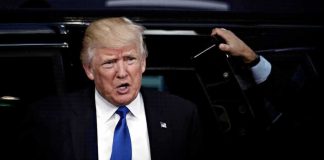

Two men are dead, neither was the original target, and President Trump is demanding Immigration and Customs Enforcement (ICE) get back on the road anyway.
Story Snapshot
- ICE suspended most vehicle stops after agents fatally shot two men in Texas and Maine within six days of each other in July 2026.
- Neither victim was the person agents were originally looking for, and neither shooting was recorded on body cameras.
- Trump publicly pushed back on the suspension, calling traffic stops one of ICE’s most important enforcement tools.
- The Maine shooting marked at least the ninth fatality since the start of Trump’s mass deportation campaign.
Two Dead, No Cameras, and a Policy in Conflict
ICE directed its agents to suspend most vehicle stops nationwide on July 14, 2026, after two fatal shootings in less than a week. An agent shot and killed a man during a stop in Houston, Texas. Six days later, agents shot and killed Joan Sebastian Guerrero in Biddeford, Maine. Guerrero was legally authorized to work in the United States and was not the person agents were looking for. Neither shooting was captured on body cameras.
That last detail matters. Congress approved $20 million in funding for ICE body cameras. A former Department of Homeland Security (DHS) secretary had pledged a national rollout. Yet when both shootings happened, the agents involved were not wearing them. DHS says deployment was delayed by a government shutdown and ongoing negotiations. Three separate investigations are now underway into the Maine shooting alone, involving the DHS Inspector General, the Federal Bureau of Investigation (FBI), and the Maine Attorney General. No determination of justified force has been made.
Trump Pushes Back on His Own Agency’s Decision
Hours after the suspension was announced, Trump posted on Truth Social praising ICE officers and arguing the agency must keep using traffic stops. “We CANNOT give up one of their most important and effective tools,” he wrote. Homeland Security Secretary Mark Wayne Mullin had ordered the pause, with sources saying it would be temporary and followed by new training. Trump’s public statement directly contradicted that posture, putting his own administration in an awkward spot in real time.
This is not a small internal disagreement. Trump has made mass deportation the centerpiece of his second term. Former acting ICE director John Sandweg, who ran the agency under President Obama, said the pressure to hit arrest numbers has pushed agents into vehicle stops far more often than in past administrations. “They’re not as well-versed and trained compared to a city patrol officer,” Sandweg said, adding that vehicle stops were never part of ICE’s core mission. Under prior administrations, ICE typically made arrests at prisons and jails, not on roadsides.
A Pattern That Predates Both Shootings
The Maine and Texas deaths did not come out of nowhere. ICE agents have been responsible for five fatal shootings while firing on vehicles since Trump took office, according to Sandweg. The Maine shooting pushed the total number of fatalities connected to the administration’s immigration sweeps to at least nine. A watchdog group, American Oversight, documented a 353% increase in DHS use-of-force incidents during just the first two months of the Trump administration, with ten documented reports of force against citizens and noncitizens in early 2025.
🚨 PRESIDENT TRUMP DOUBLES DOWN: ICE MUST RESUME TRAFFIC STOPS, “We CANNOT give up one of their most important and effective crime fighting tools!” pic.twitter.com/hq1yAhHrU7
— Q47(PATRIOTS) (@Patriots47Q) July 15, 2026
The Supreme Court gave the administration legal room to expand these stops. In a 6-3 decision in September 2025, the court allowed ICE and Border Patrol to resume sweeps in the Los Angeles area after lower courts had blocked them. Justice Brett Kavanaugh wrote separately that race can be a relevant factor when an officer develops suspicion of illegal presence. Civil rights groups immediately warned that ruling opened the door to racial profiling. The underlying lawsuit is still moving through the courts.
The Training Gap No One Wants to Talk About
The core tension here is straightforward. ICE agents are immigration investigators, not street patrol officers. City police spend months learning how to handle traffic stops safely, how to read a driver’s body language, how to position a vehicle, how to de-escalate. ICE training on vehicle stops has been inconsistent at best. American Oversight has been pressing for ICE’s full use-of-force training materials through public records requests, and what has emerged so far raises serious questions about whether agents are prepared for the split-second decisions a roadside stop demands.
Trump is right that traffic stops can produce immigration arrests. The Supreme Court has given the legal green light. But the facts on the ground, five fatal vehicle-stop shootings, two victims who were not even the intended targets, no body camera footage, and a 353% spike in use-of-force incidents, suggest the problem is not legal authority. It is execution. Resuming stops without fixing the training gap and deploying cameras first is not tough enforcement. It is a liability waiting to happen again.
Sources:
mediaite.com, cbsnews.com, noticias.foxnews.com, youtube.com, deseret.com, post-gazette.com, wwno.org, axios.com, americanoversight.org, bbc.com, journalrecord.com, livemint.com, time.com, japantimes.co.jp, wtop.com, americanimmigrationcouncil.org, immigrantjustice.org, english.elpais.com, chicagotribune.com, immigrantdefenseproject.org, cliniclegal.org, facebook.com, acaciajustice.org, en.wikipedia.org