

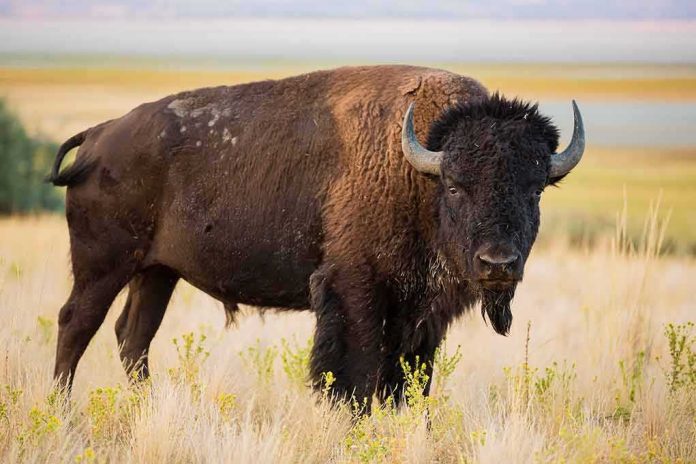
A bison can turn a casual Yellowstone photo stop into a violent lesson in seconds.
Quick Take
- Yellowstone National Park says visitors must stay at least 25 yards from bison and other wildlife, except bears and wolves, which require 100 yards.
- The park also says bison have injured more people in Yellowstone than any other animal.
- Wildlife experts and the Centers for Disease Control and Prevention link most bison injuries to people getting too close, often while ignoring warning signs.
- The viral headbutt video fits a long pattern: the danger is not mystery, but contact, crowding, and bad judgment.
Why This Bison Story Hit So Hard
The video got attention because it captured the oldest Yellowstone rule in the harshest way possible. Bison look slow and calm until they are not. Yellowstone says they can run three times faster than humans, and that visitors should never approach one for a photo. That warning is not a suggestion. It is the park’s answer to years of injuries, close calls, and a steady stream of tourists who misread a wild animal as if it were livestock.
🇺🇸 A tourist was seriously injured after a bison tossed him several feet into the air in Yellowstone National Park. The dramatic attack was captured on video. pic.twitter.com/8b5V9wUC7V
— Planet Report HQ (@PlanetReportHQ) July 12, 2026
The timing also matters. Yellowstone has kept repeating the same message because the same mistake keeps happening. The National Park Service says people must stay 25 yards away from bison, elk, and deer, and 100 yards away from bears and wolves. Yellowstone Forever says ranger warnings keep piling up year after year, including thousands for people who get too close to wildlife. That is the quiet truth behind every viral clip: the park is not being dramatic. It is being repetitive because the risk is real.
The Rule Is Simple. The Consequences Are Not.
The 25-yard rule exists because bison are unpredictable at close range. Yellowstone says a bison may bluff charge, bob its head, paw the ground, bellow, or raise its tail when it feels crowded. Those are not cute quirks. They are warning signs that a charge may follow. The park tells visitors to back away at once, not stand their ground. For a big animal that can move faster than a person expects, a few extra steps can be the difference between a close look and a hard hit.
The Centers for Disease Control and Prevention found the same pattern in injury reports. In its review of Yellowstone bison encounters, the agency said most injured people had approached the animals, and the injuries happened during the busy spring and summer months. Yellowstone’s own safety guidance says bison have injured more people in the park than any other animal. That combination of data and park policy points in one direction: the main danger is usually not a bison hunting people. It is people pressing too near.
🚨 A bull bison launched a tourist 8 feet into the air at Yellowstone National Park after suddenly charging while the man walked with his grandson.
The shocking attack, captured on video by photographer Mike MacLeod, left the tourist seriously injured#Yellowstone #sstvi pic.twitter.com/z8ri1BFahE
— GlobeUpdate (@Globupdate) July 12, 2026
What the Viral Clip Really Shows
Viral wildlife clips often invite the wrong question. People ask whether the animal was angry enough, or whether the park should have done more. The stronger question is simpler: was the person too close? Yellowstone’s safety rules and the injury record suggest that proximity drives the danger in most cases. That does not make every incident identical, but it does make the lesson plain. Wild animals do not care about camera angles, and they do not owe anyone a safe performance.
There is also a practical side that gets lost when shock takes over. Yellowstone asks visitors to keep children close, stay alert, and move away if an animal comes within the 25-yard zone. It also warns drivers not to honk or crowd bison on the road. Those details matter because they show how ordinary these incidents can become. Most people do not plan to break the rules. They simply drift too near, one step at a time, until a calm scene turns into a body-check from an animal built like a tank.
Why Common Sense Still Fails Here
Yellowstone has spent decades teaching the same lesson because human nature keeps fighting it. A big animal in open space feels less dangerous than a bear in the woods. That instinct is wrong. Bison are large, fast, and easily provoked when people crowd them. The park’s message is not complicated, and that is part of the frustration. This is not a puzzle with hidden variables. It is a distance problem, and the solution is to stop treating wildlife like a backdrop.
Sources:
thegatewaypundit.com, oldfaithfulrvpark.com, yellowstonesafari.com, pmc.ncbi.nlm.nih.gov, mountainjournal.org, yellowstone.org