
President Trump warned Americans this week that losing power would trigger a border crisis bigger than anything Spain has seen, a claim that revives one of his most consistent political themes.
Quick Take
- President Trump says the country faces an “invasion” worse than Spain’s migration crisis if Republicans lose office.
- He formally declared the southern border an invasion under the Constitution in Proclamation 10888, signed his first day back in office.
- The nation’s top general told the Senate the country was not facing that kind of threat, contradicting the president’s framing.
- Courts and fact-checkers have repeatedly challenged the legal and factual basis for calling migration an invasion.
A Warning Rooted In A Formal Declaration
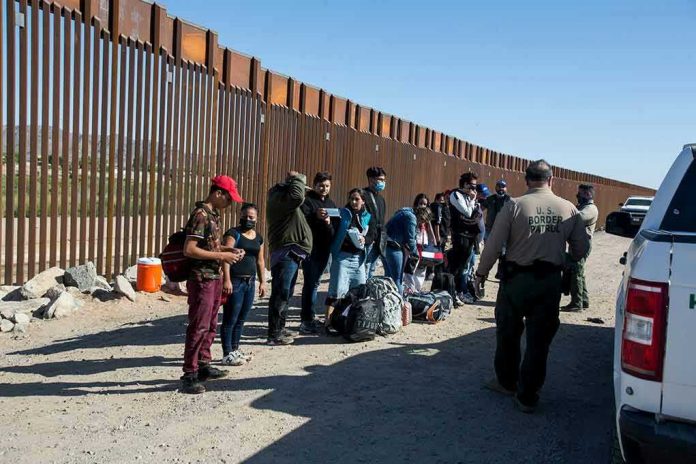
President Trump’s comparison to Spain is not a throwaway line. It builds on a legal claim he made official on his first day back in the White House. Proclamation 10888, signed January 20, 2025, states that “the current situation at the southern border qualifies as an invasion under Article IV, Section 4 of the Constitution of the United States.” That single sentence gave him the legal hook to suspend certain entry rules and treat illegal crossings as a constitutional emergency rather than a policy dispute.
The word “invasion” carries real weight in the Constitution. It appears in a clause meant for foreign armies crossing state lines, not migrants seeking asylum. By using that word, President Trump gave his administration extra legal room to move fast on deportations and border shutdowns, arguing that emergency powers reserved for actual invasions now apply to migration itself.
A Message He Has Repeated For Years
This is not new rhetoric for President Trump. He used similar language during his 2024 convention speech, calling it “the greatest invasion in history” at the southern border. Fact-checkers at the time noted the claim did not match arrest and crossing data from federal border agencies, though that did not stop the phrase from becoming a campaign staple.
Political researchers say the “invasion” framing goes back further than his current term. The Atlantic traced similar language to anti-immigrant rhetoric from more than a century ago, long before President Trump entered politics. Critics argue the word choice matters because it shapes how voters see migrants, not as people navigating a broken system, but as an armed threat storming the country.
Pushback From His Own Military Leadership
The claim has not gone unchallenged inside the government. During a Senate hearing in June 2025, retired Lieutenant General Dan Caine, then Chairman of the Joint Chiefs of Staff, told lawmakers the country was not experiencing the kind of foreign-directed threat President Trump described. Caine said he did not see evidence of a coordinated, state-sponsored invasion effort at the border.
That kind of contradiction from a top military officer carries weight. It does not mean illegal crossings aren’t a real problem worth solving. It means the specific word “invasion,” with its constitutional and military implications, is doing more political work than factual work. Conservatives who care about border security should want the strongest, most accurate case possible, not one a top general has to walk back.
Courts Have Weighed In Too
Legal analysts note that courts have pushed back on the invasion theory multiple times when the administration tried to use it to justify expanded power, including efforts tied to deporting alleged gang members without standard due process. Reporting on the Tren de Aragua case found judges skeptical that migration alone meets the legal bar for an invasion under the Constitution.
Supporters of President Trump’s approach argue that even if the legal definition is disputed, the underlying concern is legitimate. Illegal crossings, cartel activity, and strained local resources are real and documented problems. The disagreement isn’t over whether the border needs stronger enforcement. It’s over whether “invasion” is the right constitutional word for it, or a political tool to unlock emergency powers faster than Congress would normally allow.
What The Spain Comparison Really Signals
By invoking Spain, President Trump is pointing to Europe’s own migration strain as a preview of what he says awaits America without continued Republican control. Spain has indeed faced sharp increases in migrant arrivals in recent years, giving the comparison some real-world grounding even as critics debate the scale comparison to the United States.
The bigger political question is whether voters respond to the warning as a serious policy forecast or as campaign-season heat. Given how often President Trump has used invasion language since at least 2019, this latest version fits a long, consistent pattern rather than a new alarm. Voters have heard this warning before and will judge it against what actually happens next at the border.
Sources:
pbs.org, youtube.com, bbc.com, wsws.org, propublica.org, nbcnews.com