
A federal fugitive raid in a quiet Louisiana neighborhood ended with a Deputy U.S. Marshal dead, a wounded suspect in custody, and more questions than answers about how American law enforcement now does its most dangerous work.
Story Snapshot
- A Deputy U.S. Marshal was shot and killed serving a fugitive warrant in Alexandria, Louisiana.
- Federal Bureau of Investigation (FBI) officials immediately labeled the shooting an “assault on a federal officer.”
- Neither the marshal’s name nor the suspect’s identity or underlying charges have been released to the public.
A deadly warrant service on a quiet road
On a normal weekday afternoon in Alexandria, Louisiana, law enforcement converged on a home on Rutland Road with a clear mission. Federal authorities say members of the United States Marshals Service Violent Offender Task Force, along with Rapides Parish Sheriff’s Office detectives, came to arrest a wanted fugitive around 3 p.m. Within moments of their arrival, gunfire erupted. A Deputy U.S. Marshal was shot and killed at the scene, and the suspect retreated into the home, triggering a standoff with local, state, and federal officers.
A Deputy U.S. Marshal was killed while serving an arrest warrant in Alexandria, Louisiana, during a fugitive operation. The suspect is in custody, and the FBI is leading the investigation. The core facts are confirmed by multiple law enforcement agencies, while many operational…
— Lucky Mendez (@lucky_mendez3) July 14, 2026
The U.S. Marshals Service quickly confirmed the worst: one of their deputies from the Western District of Louisiana had died in the line of duty while serving an arrest warrant on a fugitive in Alexandria. The suspect, according to federal authorities, shot and killed the marshal during the attempt to serve the warrant. Rapides Parish officials say the suspect then engaged officers in a standoff before being wounded, arrested, and taken to a local hospital. From the government’s perspective, this was a textbook example of how fast a “routine” fugitive operation can turn into a fatal ambush.
What officials say happened and what they will not say
Official statements are clear on some points and strikingly silent on others. The FBI’s New Orleans field office is leading the investigation and has characterized the shooting as an “assault on a federal officer,” setting a strong legal framing from the outset. The U.S. Marshals Service, Louisiana State Police, Rapides Parish Sheriff’s Office, and Alexandria Police all acknowledge the deputy’s death and confirm the suspect is in custody. Yet authorities have not released the marshal’s name, the suspect’s name, or the underlying reason for the arrest warrant. For a public used to quick answers, that blackout invites both patience and suspicion.
Local reporting adds critical texture. Neighbors describe hearing gunshots “within seconds” of officers arriving on Rutland Road. That detail matters. It suggests there was almost no time for long negotiations at the door or a drawn-out verbal clash before bullets flew. However, there is already confusion over how long the standoff lasted. Rapides Parish described a “lengthy” standoff, while one local outlet reported it lasted about three hours. Other accounts mention closer to an hour. These mismatched timelines may be innocent reporting errors, but for skeptical citizens, they feed doubts about how tightly the story is being controlled.
Risk, sacrifice, and accountability in fugitive operations
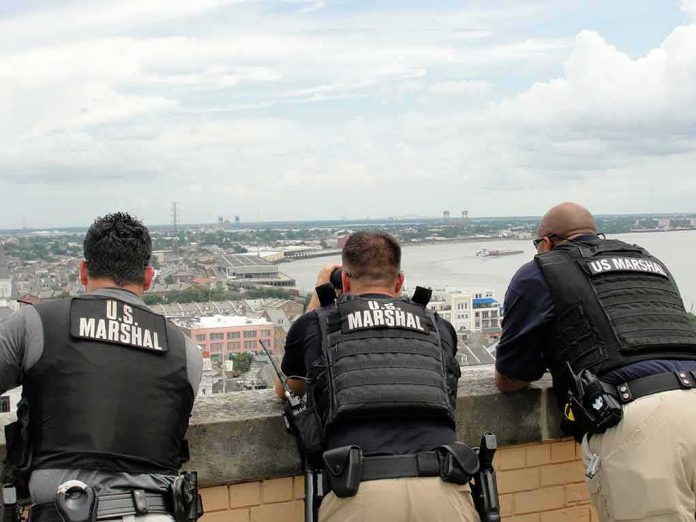
To understand why this case is emotionally loaded, especially for conservative Americans who strongly back law enforcement but also demand honesty from government, you have to see it in context. The Marshals Service itself honors hundreds of line-of-duty deaths going back to the 1790s. Recent research shows that deputy marshals and task force officers are regularly killed while trying to make arrests. Serving warrants on fugitives is, by nature, high-risk. These men and women knock on doors knowing the person inside may be armed, desperate, and determined not to go back to prison.
🔴 U.S. Marshal killed serving arrest warrant in Louisiana; suspect in custody
A deputy U.S. Marshal was shot and killed Monday while serving an arrest warrant on a fugitive in Alexandria, Louisiana, approximately 95 miles northwest of Baton Rouge. The shooting occurred at about… pic.twitter.com/d9oPaE2wt0
— NewsTongue (@NewsTongueX) July 14, 2026
At the same time, investigative reporting over the past decade has raised hard questions about how U.S. Marshals task forces operate. One major review found that these teams often act like local police but with more violence and less outside accountability. Arizona, for example, has seen at least ten marshal-involved shootings since 2015, with eleven people killed. The Justice Department also rarely punishes marshals after controversial shootings. Many conservatives will see a tension here: we want strong, fearless policing against real violent criminals, but we also want transparency and consequences when government power is misused.
The missing facts that keep this story unresolved
This Louisiana case sits right on that fault line. On one hand, the core facts are not in serious dispute. A Deputy U.S. Marshal was shot and killed while doing his job. The suspect fired on officers, was injured, and is now in custody. The FBI is treating it as a criminal assault on a federal officer. On the other hand, nearly all of the details that would allow ordinary citizens to judge the event for themselves remain hidden. Without the marshal’s name, we cannot see his record of service or even honor him properly in public debate. Without the suspect’s name or the warrant, we cannot know if he was wanted for a violent crime or for something far less serious that escalated out of control.
This lack of information is not a minor issue. It means the public must either fully trust federal agencies or wait in the dark. For many Americans, especially on the right, trust must be earned. They remember other cases where initial law enforcement narratives later fell apart under scrutiny. At the same time, they respect the courage of officers who confront danger so citizens do not have to. Those two instincts clash here. Until body camera footage, forensic reports, and full warrant details emerge, this story remains half-told: a clear sacrifice by a federal officer, a clear crime by a suspect, and a fog of government silence resting over everything else.
Sources:
thegatewaypundit.com, abcnews.com, cbsnews.com, audacy.com, facebook.com, en.wikipedia.org, latimes.com, usmarshals.gov