
Saudi Aramco’s chief says the world’s oil safety net is “scarily thin,” and the reason points straight to Hormuz and fast-shrinking stockpiles.
Story Snapshot
- Aramco’s Amin Nasser warned oil buffers are “scarily thin” and the system is straining.
- He linked pressure to the Strait of Hormuz, saying relief waits on a full reopening.
- He said almost 3 billion barrels of supply were lost and 1 billion released from stocks.
- The International Energy Agency (IEA) confirms big draws and a 400 million barrel emergency release.
The warning in London and what it actually means
Saudi Aramco Chief Executive Officer Amin Nasser told an energy forum in London that the global oil supply cushion is “scarily thin.” He said the system is already straining, and pressure will persist until the Strait of Hormuz fully reopens. Those words matter because Aramco sits at the center of global flows. When the largest oil company’s leader says the buffer is near-empty, traders and governments listen, and they check their own tanks twice.
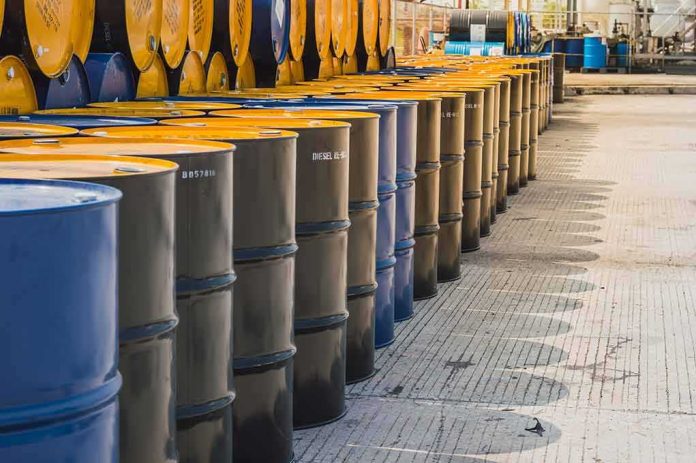
Nasser did more than wave a red flag. He attached numbers. He said the conflict drained almost 3 billion barrels of supply and forced a release of about 1 billion barrels from storage to keep refineries running. He also said what remains in storage is not all usable in practice, and rebuilding inventories could take up to two years after Hormuz fully reopens. That timeline implies tight markets even after the shooting stops and the ships move again.
What independent data supports, and what it does not
The International Energy Agency reported that observed global inventories stood at more than 8.2 billion barrels in January 2026, the highest since 2021, before large spring and summer draws hit the system. The IEA also said member countries agreed on March 11 to make 400 million barrels from emergency reserves available to the market. Those facts align with Nasser’s core point: stocks got used hard to plug a war-sized hole, which thins the buffer even if headline levels once looked high.
Counterpoints exist. Reuters highlighted analysis that combined government and commercial stocks could still cover a sizable supply gap for many months, and that major inventories remained in China, Europe, Japan, and South Korea. Analysts also noted prices stayed below “panic” levels, suggesting a tight but functioning market. Those views carry weight. But they do not refute that stockpiles were being drawn down at speed; they argue the buffer is not yet exhausted. Both can be true.
Why Hormuz is the hinge for the rest of 2026 and beyond
The Strait of Hormuz is the world’s narrow oil valve. When traffic slows or stops, oil on water falls, barrels back up in the wrong places, and refineries chase the right grades. Governments then tap emergency reserves to smooth the shock. The IEA’s coordinated 400 million barrel release proved that playbook again. Nasser’s claim that pressure lasts “until Hormuz fully reopens” tracks with this history. Logistics, not just field capacity, sets the market’s heartbeat in a chokepoint crisis.
For policy and markets, that means two things. First, visible inventories are not the same as available barrels at the right port, in the right quality, at the right time. Second, rebuilding the cushion takes longer than draining it. If it truly takes up to two years to refill after Hormuz normalizes, then any fresh shock—storms, strikes, sabotage—hits harder and faster. That is the risk Nasser flagged. It is less about tomorrow’s price and more about next month’s margin for error.
How to read the numbers without getting spun
Three facts deserve priority. Governments opened the taps from emergency reserves on a historic scale. Observed stocks peaked early in the year and then drew down sharply as the crisis deepened. Aramco’s boss says what remains accessible is thin and slow to rebuild. Skeptics cite remaining buffers and stable-enough prices. A common-sense read: the tank is not empty, but the spare can in the trunk is lighter, and the road ahead still runs through a narrow pass.
What this means for consumers, investors, and leaders
Households care about pump prices and job security. A thinner buffer means prices can jump on smaller shocks. Investors care about cash flows and downside risk. Tight cushions raise volatility and reward firms with storage, shipping, and flexible refining. Leaders care about stability. The conservative take is simple: plan for resilience. Rebuild strategic reserves prudently, secure supply chains, and keep chokepoints open through deterrence and diplomacy. Hope for calm, but stock the pantry while you can.
Sources:
insiderpaper.com, za.investing.com, investing.com, businesstimes.com.sg, linkedin.com, iea.org