

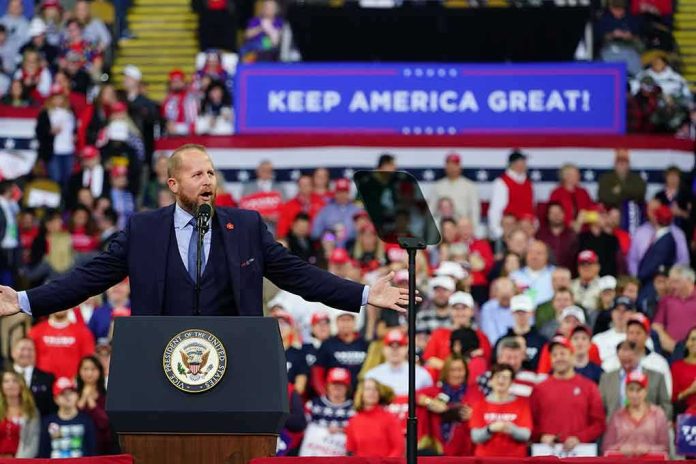
Trump promised $5,000 checks tied to tariffs and growth, daring critics to prove the math wrong while voters do the kitchen-table tally.
At a Glance
- Trump says every U.S. adult would get $5,000, funded by tariffs and faster growth.
- Vice President JD Vance backed tariffs as the revenue engine for the checks.
- Analysts say the price tag nears $1.2–$1.35 trillion and would need Congress.
- Democrats call it an illegal bribe; some experts say the pledge is likely legal speech.
What Trump Pledged, How He Says It Gets Paid
President Trump told crowds that Democrats “took your money,” and that his team will “give it back” as a $5,000 “dividend” to every adult. He tied funding to tariff revenue and “tremendous” economic growth. The White House signaled private-sector investment commitments could also help. Vice President JD Vance echoed tariffs as the key source. Trump contrasted his plan with Democrats, saying they cannot replicate it because they “don’t do tariffs”.
Reporters pressed for details. Trump did not release bill text, an agency score, or a rollout calendar. Outlets reported that any such checks would require Congress to act. House leadership also pointed to the need for legislation. The administration framed the payments as a one-time reward tied to tariff policy. That claim mirrors earlier “tariff dividend” talk that aimed at $2,000 per person, which never reached mailboxes, according to prior coverage.
The Price Tag Versus Tariff Receipts
Independent estimates put the total cost around $1.2 to $1.35 trillion if every adult qualifies. Analysts noted recent tariff collections fall far short of that figure. Even with optimistic growth assumptions, the math looks tight without deep spending cuts, new taxes, or added borrowing. Critics argue the numbers do not match the revenue. Supporters counter that tougher trade policy plus a hotter economy could close the gap and turn a profit for households.
Common sense asks two questions: how much cash goes in, and how much goes out? If tariffs raise prices at home, households pay some of that cost at the store. A “dividend” could feel like relief yet still recycle money that families already paid through higher prices. Many fiscal hawks on the right want hard ledgers, not slogans. They will demand a line-by-line plan that shows receipts, payment timing, and what gets cut to keep the deficit from swelling.
Legality Fights And The Line Between Pitch And Pay
Democratic leaders labeled the pledge a “bribe,” arguing that federal law bars payments meant to sway votes. Election law experts quoted across outlets said the promise likely falls under protected political speech unless tied to a direct quid pro quo. The sharper legal edge would come only if officials tried to issue checks before the election to influence voting. That has not happened. Any program would still require a bill that clears the House and Senate.
Republican reaction was mixed. Some embraced the populist frame of a tariff rebate as justice for workers. Others flagged cost, timing, and process. The Speaker signaled Congress would have to pass a law, which keeps power where the Constitution put it. That stance aligns with conservative values: spend within means, respect separation of powers, and avoid open-ended entitlements dressed up as windfalls.
Rhetoric, Receipts, And What Voters Should Watch Next
Trump’s charge that Democrats “stole” from citizens has rhetorical punch but no cited audit trail or court finding in the reporting. Voters should separate moral claims from money flows. The core test is simple: show the cash flow. Produce the tariff and growth projections. Release the bill text with pay-fors. Put the numbers in the sunlight so taxpayers can judge trade-offs. If the plan rests on private investment pledges, disclose the letters and legal path to household checks.
Two open loops now decide the story. First, do tariffs and growth throw off enough surplus to fund $5,000 per adult without pushing up deficits or prices? Second, will Congress even entertain a stand-alone payout tied to trade policy rather than a broader budget deal? Until those answers land on paper, the idea sits between political promise and fiscal program. Adults who budget every month will demand the same from Washington—show your work, then cut the check if the math holds.
Sources:
youtube.com, abcnews.com, finance.yahoo.com, reuters.com, thecentersquare.com, bostonglobe.com, clarionledger.com, apnews.com, fortune.com