
A decorated active-duty Air Force major walked onto the Capitol steps, held a sign, and ended up in handcuffs.
Quick Take
- Major Jason Watson was arrested during a peaceful protest calling for Donald Trump’s impeachment, removal, and conviction.
- Supporters say he engaged in nonviolent civil disobedience and spoke as a citizen with a constitutional duty.
- Military guidance says service members generally cannot wear the uniform at political rallies or demonstrations.
- The clash is bigger than one arrest; it pits free speech claims against strict military rules on political activity.
What Happened on the Capitol Steps
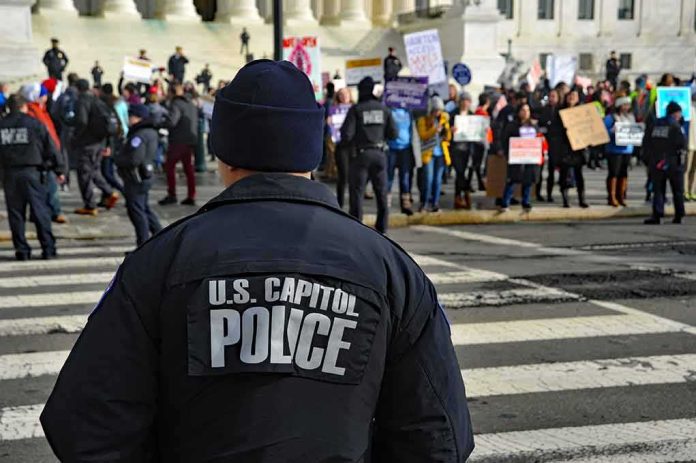
Free Speech For People says Major Jason Watson, an active-duty United States Air Force officer, was arrested after standing on the Capitol steps with a sign calling for Trump to be impeached, removed, and convicted. The same statement says Watson joined a press event with the Removal Coalition and urged Congress to support articles of impeachment. Reuters also reported that Watson was arrested at the Capitol while calling for Trump’s impeachment.
The public image of the event is stark. One side sees a military officer using peaceful protest to demand accountability. The other sees a service member crossing a bright line by turning a political rally into a uniformed statement. That tension is why the arrest spread so fast. It also explains why the debate quickly moved from the steps of the Capitol to the rules that govern every service member in public life.
Why the Uniform Matters
Air Force guidance says service members must not wear the uniform at political demonstrations, and they should avoid any action that links the military to partisan activity. Army guidance, which reflects broader Defense Department limits, says service members can take part in some political activity, but not in uniform. The federal uniform rules in the Code of Federal Regulations also set limits on when and how members of the armed forces may wear the uniform.
That is the heart of the legal and cultural fight. Watson’s allies frame the protest as protected civil disobedience and say his service record gives weight to his warning. Critics do not need to prove bad motives to make their case. They only need the regulation. On that point, the public record is not blurry. Military rules on political demonstrations are strict for a reason: the armed forces depend on discipline, neutrality, and clear lines between duty and politics.
The Free Speech Argument and Its Limits
Watson’s supporters argue that he was speaking as a citizen and acting on conscience, not staging a threat. Free Speech For People described the act as nonviolent civil disobedience and said Watson urged peaceful protest until Congress acted. That framing matters because the public often treats civil disobedience as noble when the cause feels urgent. But within the military, noble intent does not erase uniform rules. The question is not only what he said. It is also where he stood and what he wore.
Active-duty U.S. Air Force Major Jason Watson was arrested on July 1, 2026, on the steps of the U.S. Capitol after publicly demanding the impeachment of President Donald Trump and Vice President JD Vance. Wearing his military uniform, he held a sign that read "Impeach. Convict.…
— 🇺🇸Yooper🇺🇸 (@Yooperhomestead) July 1, 2026
That is why this story has a hard edge. The military gives service members speech rights, but it also limits how they use them in public. Watson’s case lands right on that fault line. If his protest is treated as protected political expression, it strengthens the idea that an officer can speak forcefully without surrendering his oath to the Constitution. If the regulations control, then the arrest becomes a warning shot to every uniformed dissenter watching from the sidelines.
Why This Story Hit a Nerve
Watson’s arrest attracted attention because it combined three powerful symbols: the uniform, the Capitol, and Trump’s impeachment fight. That mix almost guarantees a political storm. Supporters can point to a long American tradition of dissent in uniform, while opponents can point to the plain text of military rules. The facts are simple. The meaning is not. A man in uniform made a political statement in the most visible place in Washington, and the system answered immediately.
That is why the story will not fade quickly. The central issue is not whether Watson cared about the Constitution. It is whether an active-duty officer can publicly demand a president’s removal while wearing the authority of the military on his sleeve. The available sources show a real arrest, a real protest, and real uniform restrictions. What remains contested is where duty ends and dissent begins.
Sources:
yahoo.com, instagram.com, facebook.com, aetc.af.mil