
A U.S. general has landed in Caracas to run a relief mission that could shape Venezuela’s next chapter as much as its disaster response.
Quick Take
- Maj. Gen. Kevin J. Jarrard arrived in Caracas to oversee U.S. earthquake relief support.[6]
- The interim Government of Venezuela formally requested U.S. help after the June 24 earthquakes.[6]
- SOUTHCOM says it is backing State Department-led relief work with aircraft, logistics, and search and rescue support.[6]
- The public facts are narrow, but the political meaning is wide.[6][12]
What SOUTHCOM Says Is Happening
U.S. Southern Command says Jarrard is the senior U.S. official on the ground in Venezuela. The command says he arrived in Caracas on June 25 to oversee Department of War support for earthquake relief.[6] It also says the mission will move response teams, equipment, and humanitarian aid into affected areas. The official description is careful, but it leaves many practical questions unanswered.
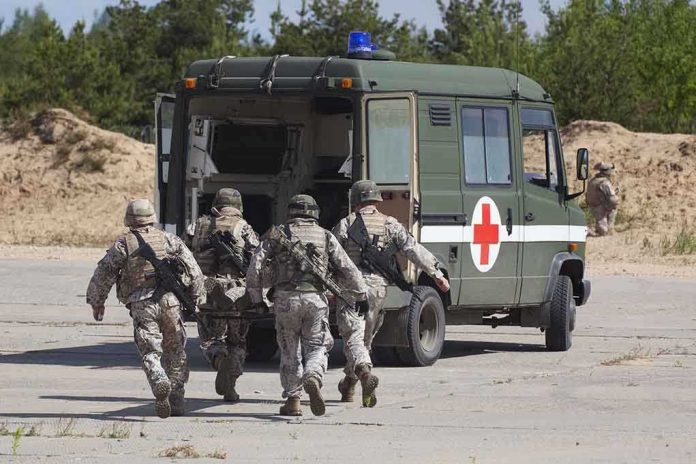
SOUTHCOM says assigned forces will use fixed-wing and rotary-wing aircraft for mobility, damage checks, and aid delivery.[6] The command also says it is supporting relief operations led by the Department of State and working with partners. That wording matters. It places a military command inside a civilian-led relief effort, which can speed logistics while also inviting scrutiny about scope and control.
Why This Mission Carries Political Weight
The immediate trigger is the earthquake disaster, but the backdrop is impossible to ignore. Venezuela sits inside a long history of tense U.S. involvement in Latin America. Major research sources note that U.S. intervention in the region has often been tied to strategic interests, not just aid.[10][12] That history does not prove bad faith here. It does explain why even a rescue mission can draw suspicion fast.
The government line is straightforward: an interim Venezuelan government asked for help, and Washington is answering that request.[6] That is the strongest fact in the public record. It gives the mission a lawful and humanitarian frame. It also gives supporters a simple argument: when a government asks for disaster help, the fastest available relief should not be slowed by politics.
What the Public Record Still Does Not Show
The release does not publish the actual request from Venezuela, so the terms of that request remain unknown.[6] It also does not name the Venezuelan officials or agencies working with Jarrard on the ground.[6] That gap matters because named counterparts often reveal whether a mission is tightly coordinated or loosely connected. For now, the public only gets broad language about “partners” and “support.”
U.S. Marine Corps Maj. Gen. Kevin J. Jarrard arrived in Caracas in the evening of June 25th, and is the senior SOUTHCOM official on the ground in Caracas currently.
U.S. Southern Command (SOUTHCOM) to support
ongoing earthquake relief efforts in Venezuela.SOUTHCOM Commander… pic.twitter.com/th1D15Y0uh
— Kagan.Dunlap (@Kagan_M_Dunlap) June 26, 2026
The release also gives no numbers on aid delivered, people reached, or search and rescue missions completed.[6] It does not give a timeline for departure, handoff, or mission end. That absence leaves room for speculation, and speculation is where foreign policy stories usually get twisted. A mission that begins as emergency aid can quickly become a symbol of something larger if the facts stay thin.
The Human Stakes Behind the Headlines
Reporting cited in the research says the twin earthquakes killed at least 235 people.[5] That number may change as more information comes in, but it already signals a severe disaster. In a crisis like this, airlift, heavy logistics, and medical movement can save lives quickly. That is the strongest practical case for U.S. military involvement. Speed matters when roads fail and hospitals are overloaded.
At the same time, the optics are delicate. A senior U.S. military official in Caracas will trigger old memories in Venezuela and across the region. Some outlets will see a rescue story. Others will see strategic pressure in humanitarian clothing. Both reactions are predictable. The real test is whether U.S. forces stay focused on relief, keep clear limits, and hand control back as soon as local systems can carry the load.
What to Watch Next
The next useful facts will be simple ones: who Jarrard meets, what aid arrives, where it goes, and when it stops. Those details will show whether this is a fast disaster response or the start of a longer presence. For readers who care about common sense, the standard is plain. If U.S. forces are there to help, the mission should be transparent, brief, and measurable.[6][12]
Sources:
[5] Web – RELEASE: SOUTHCOM Leadership Arrives in Venezuela to …
[6] Web – Senior US military official lands in Venezuela to oversee quake …
[10] Web – Made by Maduro: The Humanitarian Crisis in Venezuela and US …
[12] Web – The United States stands with the people of Venezuela following …