

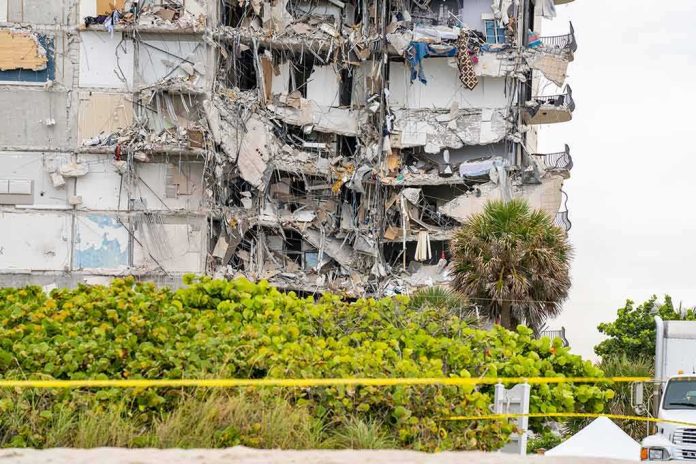
The most unsettling images from the 7.8 earthquake in the southern Philippines are not the collapsing facades, but the quiet, dust-filled rooms where ceilings, walls, and lives all cracked at once.
Story Snapshot
- A powerful offshore 7.8 quake struck near Mindanao, killing dozens and injuring hundreds in and around General Santos City and Sarangani.
- Destruction inside buildings ranged from fallen ceilings and shattered glass to full structural collapse during normal daily activities.
- A local tsunami of about three feet hit nearby coasts, damaging at least one coastal community and triggering regional alerts.
- Early videos from schools, shops, and offices show how “ordinary” buildings can become lethal in less than a minute.
What Actually Happened When The Ground Turned Violent
An offshore magnitude 7.8 earthquake struck off the coast of Mindanao, in the southern Philippines, centered near Maasim town in Sarangani province.[1] The shaking hit Monday morning local time and spread across the region, toppling residents out of bed in General Santos City, disrupting workdays, and igniting a chain of emergency alerts up and down the Pacific Rim.[1][2] Within hours, casualty reports climbed into the dozens, with more than 200 people injured, many of them inside damaged buildings.[1][2]
The raw power of the quake translated quickly into physical destruction. Reporters on the ground and regional outlets describe multiple buildings in General Santos City suffering serious structural damage, with “a few” reported collapses.[1][2] Video segments show interiors strewn with ceiling debris and broken fixtures as people run for exits, sometimes in darkness as power fails. One widely shared clip shows a commercial building interior filling with dust as tiles, lights, and interior walls give way during the violent shaking.
Inside The Buildings: Where The Real Terror Played Out
The most revealing footage comes from inside schools and offices, where everyday spaces suddenly turned hostile. Associated Press video documents a school building with cracked walls, fallen masonry, and debris across classrooms after the quake, matching reports that part of a school structure collapsed during a ceremony as the tremor hit.[2] Another clip from inside a different building shows fixtures swinging, interior walls failing, and terrified occupants scrambling as chunks of ceiling crash around them.
These images line up with official accounts that most injuries occurred “in damaged buildings,” which means the real story is not just outside rubble piles but interior structural failure.[1] For older readers who remember California’s Northridge earthquake or Japan’s Kobe disaster, the pattern looks familiar: non-ductile concrete, heavy ceilings, and weak connections do not forgive sudden lateral movement. From a common-sense perspective, you cannot separate casualty numbers from the everyday design decisions baked into these structures decades earlier.
Tsunami, Landslides, And A Region On Edge
The quake’s offshore epicenter ensured that the threat did not end with shaking. A tsunami about one meter, roughly three feet, struck nearby Philippine coasts, with a 1.4-meter wave recorded off Kiamba in Sarangani.[1] Broad tsunami warnings went out for coastal areas of the Philippines and nearby countries, triggering evacuations to higher ground and halting business along parts of the shoreline.[1][2] Smaller tsunami waves were measured as far as Indonesia, Palau, and even southern Japan before the threat was declared over hours later.[1]
On land, the quake set off at least one deadly landslide in Sarangani province that killed villagers in a rural community.[1] That detail matters because it underscores that destruction inside buildings is only one piece of a larger risk picture. When you put critical infrastructure, hillside communities, and dense coastal cities in a tectonically active zone, every strong quake becomes a stress test. The aftermath across the south—damaged bridges, disrupted utilities, cracked roads—shows how quickly routine daily life can unravel.[1]
Why Early Numbers Shift, But The Core Story Holds
Initial reports varied, with some outlets citing at least 19 deaths and others raising the toll to at least 32 as rescue efforts continued.[1][2] That kind of early discrepancy is standard in major disasters, especially where communication lines are strained and rescuers are still digging through damaged structures. Conservative readers should see this not as media conspiracy but as the messy reality of real-time reporting from chaotic, dangerous environments.
Shops and buildings were damaged, some with broken signs and glass, others reduced to piles of concrete and rubble in General Santos, after a powerful 7.8 earthquake rocked Philippines' Mindanao Island #Philippines #earthquake #damage #debris pic.twitter.com/EhR8vzfkYA
— WION (@WIONews) June 8, 2026
Across sources, though, the fundamentals do not move: an offshore magnitude 7.8 quake, centered near Sarangani; dozens killed; more than 200 injured; building collapses and internal destruction; and a measurable local tsunami affecting nearby coasts.[1][2] Video from inside buildings ties the statistics to human experience—children sheltering in classrooms, workers sprinting past collapsing ceilings, shoppers dodging falling glass. Those short, shaky clips are not outliers; they are the visual proof of what the numbers already say.
Sources:
[1] YouTube – Destruction seen inside building in Philippines after 7.8 magnitude …
[2] Web – Magnitude 7.8 earthquake strikes off the coast of the Philippines, …