
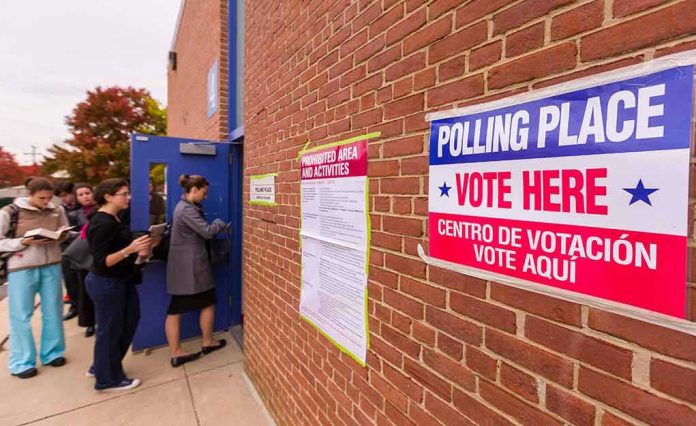
On a primary election morning in Northern Virginia, voters walked up to a locked door where they expected democracy to be open for business.
Story Snapshot
- A voter registration office used as a polling place in Alexandria was closed on primary day, surprising arriving voters.
- Locals said the voting site had been moved a few blocks away to Lyles-Crouch Traditional Academy.
- Virginia law requires polls to be open from 6 a.m. to 7 p.m., and voters in line at closing must be allowed to cast a ballot.
- The incident highlights how small changes in polling locations can feel like big threats to voter trust and fairness.
A quiet office, a closed door, and confused primary voters
The Gateway Pundit report describes an early visit to a voter registration office in Alexandria, Virginia, that had previously served as an election day polling site. On this primary morning, the building was closed, with no active voting inside. Voters who expected to walk in and cast a ballot instead met a locked door and unclear answers. For ordinary citizens who took time off work or drove across town, that kind of surprise hits hard.
Local residents told the reporter that the polling location had been moved just a couple of blocks away. They named the new site as Lyles-Crouch Traditional Academy, an elementary school in Alexandria. The precinct captain reportedly explained that the office closure was connected to construction activity. So this was not a full shutdown of voting in the area. Instead, the official story said the vote was still happening, just in a different room in a different building nearby.
What Virginia law expects on election day
Virginia election law sets a simple promise for voters: polls open at 6:00 a.m. and close at 7:00 p.m. Anyone who is in line at 7:00 p.m. must be allowed to vote, even if the process takes longer. State guidance and local election offices repeat the same rule for primary and general elections, to make sure citizens know when they can show up. That clear schedule is a basic guardrail. It gives working families a window they can plan around, and it keeps government from quietly shortening voting hours.
When a familiar polling place is suddenly dark, the key legal question is not just “Was this building closed?” but “Did voters still have a real place to vote between 6 and 7?” Common sense and conservative values line up here. The right to vote means a real, reachable polling location with honest notice, not a shell game where the address keeps moving. If voters lose time driving to a closed site and never make it to the new one, the paper promise of open polls from 6 to 7 does not feel like much of a promise.
Relocation, construction, and the fine print of election rules
Virginia’s rules recognize that buildings change, schools close, and offices undergo construction, so polling locations sometimes must move. Guidance for election officials warns that they cannot change a polling place within 60 days before a general election, which shows how serious the state treats last minute shifts. Local bodies in other Virginia communities have held formal votes to relocate precincts when schools shut down, making the change part of the public record rather than a surprise on election morning.
From a conservative, common sense view, that kind of transparent process is exactly what citizens should expect. When an election office closes for training or construction, law calls for notice on the county or city website and in public places. Voters should not have to rely on rumor in the parking lot or chase social media posts to figure out where their ballot box moved. When officials handle relocation as a quiet administrative detail, they forget that for citizens, these details are the whole game.
Confusion, “disenfranchised” voters, and what people can do
Across Virginia, similar episodes have led voters to say they felt “disenfranchised” when a polling site was closed or threatened, even when the stated reason was security or safety. In Northern Virginia, the state once sent more than 30,000 voters mailers with the wrong polling place, forcing local officials to clean up the mess and calm furious residents. In past elections, civil rights groups have warned about fake phone calls that falsely told voters their polling location had changed, calling it an effort to suppress the vote.
Virginia does give voters tools when something seems wrong. The Department of Elections offers complaint forms, phone hotlines, and email addresses for citizens who believe their rights were violated. Guides urge voters to stay at the location, call voter protection hotlines, or reach out to state officials if they are turned away. That process matters, but it is a backup, not a replacement for competent planning. Healthy elections should not rely on angry voters fixing problems on the fly.
Why this small story hits a national nerve
This Northern Virginia episode taps into a deeper national fight over polling place closures and relocations. Some national reports describe long term patterns of reduced polling sites, especially in areas with minority voters, framed as threats to the right to vote. Others point to how past federal enforcement actions or local budget choices have led to fewer locations, longer lines, and more frustration. These larger debates provide the backdrop that makes every closed door on election day feel less like a simple mistake and more like part of a trend.
American conservative values mix two strong instincts here. First, defend election integrity with clear rules, honest administration, and equal access for every legal voter. Second, demand basic competence from government, so a citizen is never left guessing where to do something as important as voting. A polling site in Alexandria that quietly moves a few blocks might be a minor paperwork change for officials, but for the voter who hits a locked door on primary morning, it feels like democracy itself was not where it said it would be.
Sources:
thegatewaypundit.com, elections.virginia.gov, law.lis.virginia.gov, vote.arlingtonva.gov, nbcwashington.com, vpm.org, fxbgadvance.com, blackenterprise.com, wjla.com, youtube.com, civilrights.org, thevotingnews.com, cha.house.gov, reddit.com