

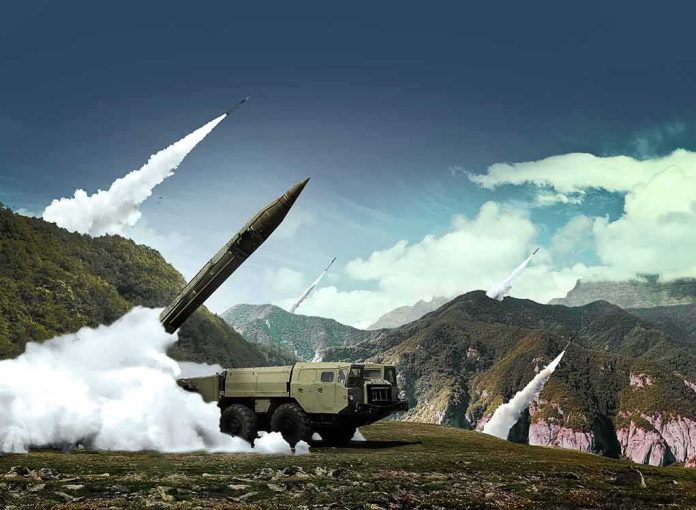
North Korea staged a slick test of a “new” missile and flashed on-screen data to sell it as hypersonic.
Story Snapshot
- State media said Kim Jong Un oversaw a launch of a new weapon with major significance.
- Photos showed a screen labeled “Hwasongpho-11Ma-1” with speed, altitude, and range figures.
- South Korea tracked two short-range ballistic missiles from the Wonsan area.
- Analysts say maneuverability, not speed alone, defines hypersonic capability.
What Pyongyang Showed And Claimed
North Korea’s state outlet reported a “successful test” of a new system and cast it as a leap in war readiness. The release said Kim Jong Un attended, with photos of him at a control room. Captions framed the system as “of great significance.” A monitor in the images carried the label “Hwasongpho-11Ma-1 flight trajectory.” The on-screen data showed about 2,146 meters per second, 35.8 kilometers altitude, and a 908.2 kilometer range, all presented as proof points.
The staging aimed to do more than inform. It aimed to persuade. The camera lingered on conical, finned payloads that look like a glide vehicle to a casual viewer. The graphics added scientific sheen. The message for audiences at home and abroad was clear: this is modern, this is fast, and this is ready. The specifics beyond the label and numbers were thin in the text report, which did not spell out propulsion, guidance, or thermal protection details.
What Outside Trackers Saw
South Korea’s military detected two launches from near Wonsan and described them as short-range ballistic missiles. That track fits a pattern of rapid tests meant to stress allied defenses. Reuters reported the first projectile was identified as a ballistic missile, and presumed to be in the Hwasong-11 family. That assessment challenges the idea that this was a proven glide system, at least based on what allied radars recorded that day.
Analysts have long warned that the word “hypersonic” gets abused. Many ballistic warheads hit hypersonic speeds. The key is whether the vehicle can maneuver at those speeds to avoid defenses. That requires advanced materials, precise control, and solid tracking. Reuters earlier noted that experts pin hypersonic status on maneuverability, not raw speed. That standard matters here, because Pyongyang highlighted speed figures, not verified maneuver data.
Reading The Photos And The Numbers
Conical, finned shapes can be real clues or stage props. Some warheads use fins for modest steering, known as maneuverable reentry vehicles. A true glide vehicle rides a different flight profile and turns across long distances after booster separation. The single image of a trajectory line and a speed figure does not confirm that behavior. A credible case would cite radar-tracked lateral maneuvers or thermal profiles consistent with sustained glide. The public record offered neither so far.
🇰🇵 Kim watches a new hypersonic test
North Korea has tested a new hypersonic missile and, for the first time, showed flight data for a missile labeled Hwasong-11B-1.
Pyongyang said it flew for 446.1 seconds, reached 2,146 m/s (about Mach 6.3), peaked at 35.8 km and covered…
— KEASEA07 (@Wildshit07) September 22, 2026
North Korea’s message discipline is tight. When the regime wants shock, it puts Kim in the shot and flashes data on screens. That does not make the claim false. It makes the claim unverified. Prudence says accept what multiple systems agree on and flag what they do not. Multiple systems saw missiles. Only Pyongyang said hypersonic. Until allied telemetry or debris backs a glide claim, this looks like an upgraded short-range ballistic missile dressed in modern branding.
Why This Still Matters For U.S. Allies
Short-range missiles that are faster to field and harder to intercept still change risk. North Korea has improved solid-fuel boosters and launch tempo. Even a maneuverable reentry vehicle strains Patriot batteries and complicates defense planning. Allies must assume growth in accuracy and salvo size. The right response is boring and firm: better sensors, tighter fire control networks, more interceptors, and clear red lines backed by real costs. Deterrence works when it is visible, credible, and repeatable.
How To Sort Hype From Breakthrough Next Time
Look for three things before calling it hypersonic in the military sense. First, independent radar plots that show lateral maneuver after peak altitude. Second, infrared tracking that supports a glide profile and thermal loads beyond a normal reentry arc. Third, debris or materials that handle high heat and dynamic pressure. If one of those appears from allied reporting, upgrade the threat. If not, keep the label tight and the defenses ready. That is common sense and good security.
Sources:
internazionale.it, abcnews.com, reuters.com