

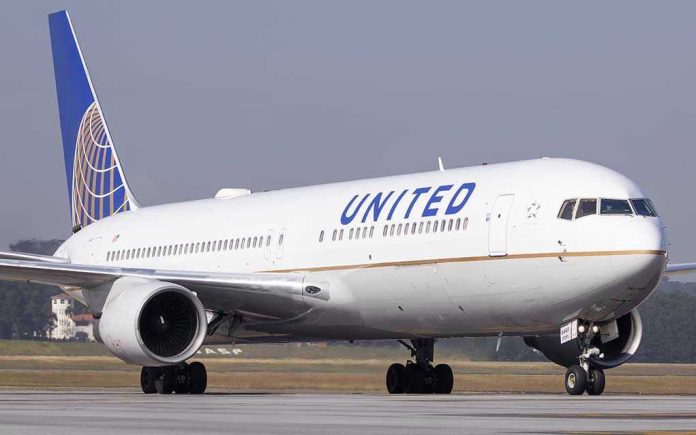
A 75-year-old man’s confused walk toward a cockpit on a routine United hop from Chicago to Minneapolis turned into a full-blown “hijacking scare,” and how that happened tells you a lot about modern air travel, media panic, and our muddled view of mental health versus real security threats.
Story Snapshot
- United Flight 2005 diverted to Madison after repeated attempts to reach the cockpit triggered a security alert.
- Five off-duty officers and the crew subdued a 75-year-old passenger as air traffic control discussed a possible hijack.[1][2][3]
- Local authorities later described the man as confused and in a mental health crisis, and no charges were initially filed.
- The gap between “hijack scare” headlines and the unresolved facts exposes how quickly narratives harden in the air-safety era after September 11.
How A Short-Hop Flight Turned Into A National Headline
United Airlines Flight 2005 was supposed to be the definition of uneventful: a Boeing 737-900 shuttling 147 passengers and six crew from Chicago O’Hare to Minneapolis–Saint Paul on a Friday evening.[1][2] Midway through the flight, crew reported a passenger disturbance and air traffic control began hearing something no controller takes lightly: multiple attempts to breach the cockpit door.[1] That phrase alone is enough, in the modern rulebook, to justify an immediate diversion.
The captain pointed the jet toward Dane County Regional Airport in Madison, Wisconsin, where it landed safely around 9 p.m. local time.[1][2] Federal Aviation Administration officials later said the crew diverted specifically after reporting a disruptive passenger.[1] United’s public line stayed narrow and clinical: the aircraft landed to “address a security concern with an unruly passenger” and then continued on to Minneapolis once the individual was removed.[1][2][3] That sparse statement left a big vacuum for speculation.
Inside The Cabin: A Struggle At 35,000 Feet
Details of what happened in the aisle do not come from a glossy press release, but from radio traffic captured and replayed by local television in Wisconsin and national outlets.[1][2][3] A crew member is heard describing the man making “multiple attempts to try to breach the cockpit” before being restrained, adding that he was finally seated and “flanked with law enforcement officers on either side.”[1][2] Off-duty officers on board stepped in, a reminder that when something goes wrong in the air, there is no 911 dispatcher sending backup.
Dane County Sheriff’s Office deputies boarded after landing and took the passenger into custody, removing him from the plane while the rest of the cabin stayed put.[1][2] Federal Bureau of Investigation officials said agents responded to the diversion and confirmed that a subject was detained by local authorities before passengers continued their journey.[3] No injuries were reported, which matters: from a safety perspective, the crew did exactly what training demands—secure the cockpit, neutralize the unknown, and get the airplane on the ground.
Hijacking Scare Or Medical Emergency In The Sky?
Madison authorities later painted a very different portrait than the early “hijack attempt” chatter implied. Television broadcasts from ABC and CBS, drawing on local officials, described the 75-year-old as confused and in the midst of a mental health crisis rather than a calculated attacker. Police told CBS they were not pursuing criminal charges, citing those mental health concerns. The man was never publicly named, and no complaint or indictment appeared in the days after the diversion.[1][2]
Nothing in the Federal Bureau of Investigation’s careful statement asserted motive; agents confirmed only detention and an ongoing review.[3] That is where the tension lands for anyone who values both security and due process. Conservative common sense says you protect the cockpit first and sort out intent later; it also says you do not casually brand a confused senior as a hijacker without evidence. The public record at this point proves the behavior and the diversion, not a terrorist plot.
Why These Incidents Always Feel Bigger Than The Facts
This flight followed a now-familiar pattern. Operational safety judgments in aviation must come before motive determinations because the cost of guessing wrong about a cockpit breach is measured in lives, not inconvenience. Controllers reportedly discussed the possibility of a hijack while the event unfolded, which helps explain the intensity of the response. Once that word hangs in the air, though, media outlets and social accounts race to attach it to the story, even as investigators speak in more cautious terms.[2][3]
🇺🇸⚡️- United Airlines Flight 2005, Chicago to Minneapolis, has diverted after an attempt to breach the cockpit. The flight diverted safely and the passenger has been arrested. pic.twitter.com/1OXIvsccvn
— War Updates (@WarUpdates) May 31, 2026
The result is a narrative whiplash. Headlines and social clips frame a “hijacking attempt” or “cockpit breach,” while later coverage quietly adds that the man was in a mental health crisis and likely will not be charged.[2] Some readers see that as proof authorities overreacted; others see the absence of charges as soft treatment in an age of rising air-rage. Both reactions miss the point. The system did what it was designed to do after September 11: treat any cockpit-directed behavior as an immediate threat, then de-escalate when facts allow.
Sources:
[1] Web – Commercial Flight from Chicago Makes Emergency Landing at Wisconsin …
[2] Web – United Flight Diverted After Passenger Allegedly Attempts Cockpit …
[3] Web – Passenger tried to enter cockpit? Why a United Airlines flight was …