
A Belgian bus driver saved 16 children’s lives in the span of a few minutes — and the full story of why those children were ever in danger at all remains unsettlingly unresolved.
Story Snapshot
- A school minibus broke down on a rail crossing in Veldegem, Belgium, and was struck by a train, killing four people including two children
- The bus driver evacuated all 16 children on board before the train hit, a decision that almost certainly prevented a mass casualty event
- Belgium’s rail infrastructure manager reported that crossing barriers were closed and warning lights were red at the moment of impact
- The mechanical cause of the bus breakdown has not been identified, and no official accident report has been publicly released
A Driver’s Decision in the Seconds That Mattered
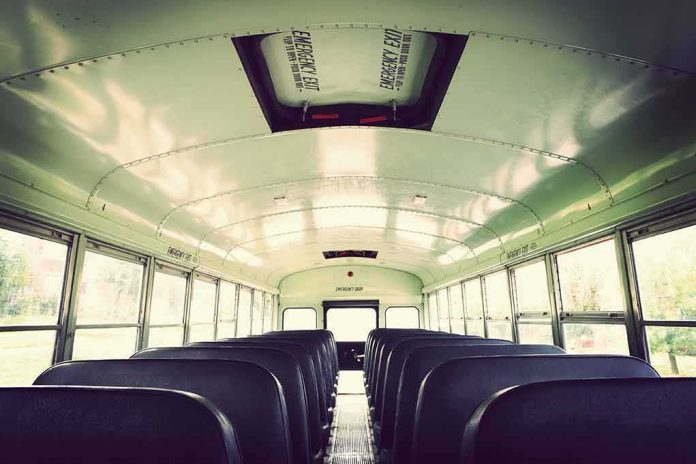
The minibus broke down directly on the Koning Albertstraat level crossing in Veldegem, Belgium, trapping the vehicle in the path of oncoming rail traffic. The driver did not freeze. He escorted all 16 children off the bus and away from the crossing. Minutes later, a train traveling from Bruges obliterated the vehicle. Every child survived. Four other people did not, including two children whose presence at the scene has not been fully detailed in early reporting. [1]
That driver’s response deserves recognition, but it also raises the question every safety investigator will be asking: why was a minibus carrying schoolchildren able to become stranded on an active rail crossing in the first place, and what sequence of failures allowed a stationary vehicle to remain there long enough for a train to reach it? [2]
What the Crossing Data Reportedly Shows — and Why It Complicates Everything
Belgium’s rail infrastructure manager, Infrabel, stated that crossing barriers were down and warning lights were active and red at the time of impact. If that account holds under forensic review, it shifts the central question from whether the crossing protection system worked to why the minibus was on the tracks despite functioning barriers. One possibility is that the bus crossed legally and then stalled before it could clear. Another is that the sequence of barrier activation and bus entry overlapped in a way that trapped the vehicle. Neither conclusion is established yet. [1]
The train crew reportedly initiated emergency braking before impact, which means the train operator saw the hazard and responded. That detail matters because it removes one potential layer of negligence from the equation. It also confirms that the collision was not a result of inattentiveness on the rail side, at least based on early accounts. What it does not answer is whether the braking distance available at that crossing, at that train speed, was ever sufficient to stop in time. [3]
The Mechanical Failure at the Center of the Investigation
The bus company confirmed that the cause of the breakdown has not been identified. That single sentence carries enormous investigative weight. A stall caused by a mechanical defect is a different liability picture than a stall caused by driver error, road conditions, or a vehicle that had documented maintenance problems. Belgian transport safety authorities will need the vehicle’s full maintenance history, the post-crash mechanical inspection, and the onboard event data before any responsible causal conclusion can be drawn. [1]
JUST IN: Four killed after school minibus collides with train in Belgium.
Tragic crash in Buggenhout as vehicle crossed tracks with barriers down. 🔥 pic.twitter.com/2KCjPvcZBv— Infooze (@infoo_ze) May 26, 2026
Around 100 passengers were aboard the train at the time of the collision. All were evacuated safely, though one passenger was treated for shock. [5] The scale of what could have happened, a fully loaded commuter train striking a bus full of children with no prior evacuation, is the kind of outcome that rail safety bodies across Europe use to justify the unglamorous work of crossing audits, barrier maintenance schedules, and signal timing reviews. This incident will almost certainly accelerate that conversation in Belgium.
Why Blame Attribution Before the Evidence Is In Would Be a Mistake
Rail crossing collisions consistently turn out to be multi-factor events. European and North American railway safety bodies rarely assign single-point blame in these cases because the data almost always reveals overlapping failures — a vehicle problem here, a timing gap there, a maintenance log that raised a flag nobody acted on. The emotional weight of child fatalities creates enormous public pressure to identify a villain quickly. That pressure is understandable and entirely human. It is also the enemy of accurate investigation. [1]
The facts on record right now support one clear conclusion: a bus driver made a fast, correct decision under pressure and saved 16 lives. Everything else — why the bus stalled, whether the crossing system performed as designed, whether the train had adequate stopping distance, and who bears legal responsibility for the four deaths — remains open. Investigators in Belgium have the tools to answer those questions. The public should let them finish the work before the narrative hardens around incomplete facts. [2] [3]
Sources:
[1] Web – Broken Down School Bus Evacuated Minutes Before Being Hit By …
[2] YouTube – Video shows moments train clips school bus full of kids
[3] Web – School bus hit by train – several dead in horror accident – Bluewin
[5] YouTube – Sleepy Belgian town rocked by bus crash tragedy