

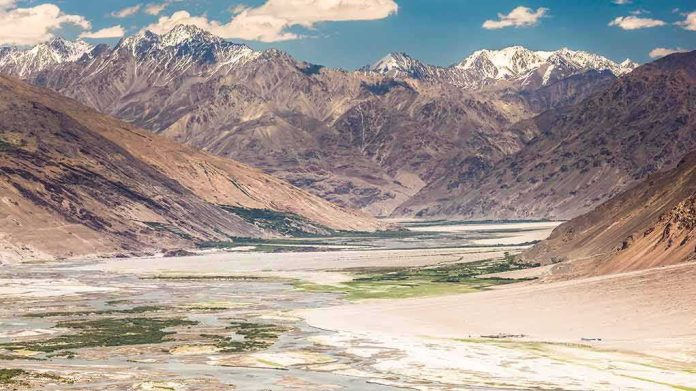
A wall of ice, rock, and river tore through Nepal’s high valleys, killing hundreds and sweeping more than a thousand people off the map in minutes.
Story Snapshot
- Nepal police reported hundreds dead and more than 1,300 missing across the Nepal–Tibet border region.
- A glacier-and-rock collapse plunged into the Lhende River system, unleashing a violent flood wave.
- Villages, bridges, roads, and power projects were destroyed or washed away along the valley.
- Rescue teams raced the clock as officials tracked foreign tourists among the missing.
A Sudden Collapse, A Raging River
On August 26, near Nepal’s border with China’s Tibet region, the lower part of a glacier gave way. Ice and rock crashed onto the valley floor and into the Lhende River, driving a fast, high wall of water and debris downstream. Nepal police and disaster officials counted the dead as bodies surfaced along the river bends. Hundreds remained missing as the surge swept through roads, villages, and worksites strung along the narrow Himalayan corridor.
Early alerts tied the chaos to an earthquake felt around the same time. The United States Geological Survey later said the seismic pulse likely came from the collapse itself, not a separate quake, which matches what glaciologists saw in fresh satellite images. Survivors described trucks, homes, and shops disappearing in seconds. Seasoned teachers and traders who knew the river said they had never seen a surge move like this in their lifetimes.
Counting Losses In A Split Landscape
Nepal police gave rolling updates as crews reached shredded villages and stranded roads. Tallies rose through the day, reflecting more recovered bodies and new reports from families. Nepal’s tourism officials said hundreds of tourists were unaccounted for, including many foreign nationals who had traveled the border valleys for trekking and trade. The flood’s footprint cut across two countries, which complicated counts and slowed the work of matching names to locations.
The river system carried wreckage through multiple districts. Crews found snapped bridges, twisted guardrails, and crushed vehicles on gravel bars normally used by farmers and transporters. Power and road projects sat in the flood path and suffered direct hits, adding to debris loads and isolating towns that depend on a single road in and out. Helicopters scouted breaks in the road network while army units and police worked up from both ends of the blocked corridors.
What Drove The Disaster
Geologists pointed to an ice-rock avalanche that slammed into the river and converted potential energy into a flood wave. The mix of snow, ice, rock, and saturated soil multiplied the force, then tore loose more banks, trees, and structures as it ran down-valley. The timing of the seismic signal, paired with satellite snapshots, supported this “collapse-first” sequence. That account replaced the first-day talk of a triggering earthquake and now frames the main scientific finding.
Himalayan valleys breed compound disasters. Steep slopes, warming ice, and narrow gorges create high-risk conditions where a slide can turn into a flood within minutes. The region has seen multiple high-mountain surges tied to glacier failures, landslides, and glacial lake bursts, and the pattern fits what Nepal and its neighbors have faced over recent years. This event followed that script, only at a scale that crushed roads, erased neighborhoods, and strained rescue lines across a border.
Rescue, Risk, And The Road Ahead
Rescuers focused on time, terrain, and triage. Swift-water hazards, fresh slope cracks, and unstable riverbanks limited ground access. Where roads were gone, responders moved by foot or air, then ferried survivors to field posts. Authorities prioritized family reunification, tourist tracking, and body identification to bring order to a fast-moving scene. One brief caution remains: casualty numbers in the first 48 hours in the Himalayas often shift as crews reach new areas and reconcile lists.
🚨🇳🇵 BREAKING — NEPAL: A catastrophic landslide and flash-flood disaster has left hundreds dead and more than 1,300 people missing, including dozens of Americans.
🌊 The disaster was initially linked to a 4.4-magnitude seismic event, but updated assessments indicate the flooding…
— Nova Intel (@intel_nova) August 27, 2026
The practical lesson aligns with common sense and conservative prudence. Build in ways that assume nature will test every line we draw on a map. Diversify access, harden bridges at choke points, and keep infrastructure out of obvious runout zones where possible. Keep early-warning ties between science teams, police, and tourism desks tight, so a single collapse upstream can trigger alerts downstream within minutes. The human cost here argues for action before the next cliff lets go.
Sources:
facebook.com, reuters.com, bbc.com, aljazeera.com, abcnews.com