
Two bombs turned a Damascus street into a fireball just minutes after Emmanuel Macron’s motorcade rolled away, raising a sharp question the headlines rushed to answer: botched assassination, or brutal reminder of who really lives with the risk.
Story Snapshot
- Two explosive devices detonated near Macron’s Damascus hotel, injuring 18 but not touching his convoy.
- Macron was already at the Syrian Presidential Palace, and his team says he did not even hear the blasts.
- Syrian officials insist the devices went off outside the French security perimeter, while experts suspect Macron’s visit was the real prize.
- No group has claimed responsibility, leaving media to frame the story as an “assassination attempt” without hard proof.
Blasts on a diplomatic doorstep, but not quite a direct hit
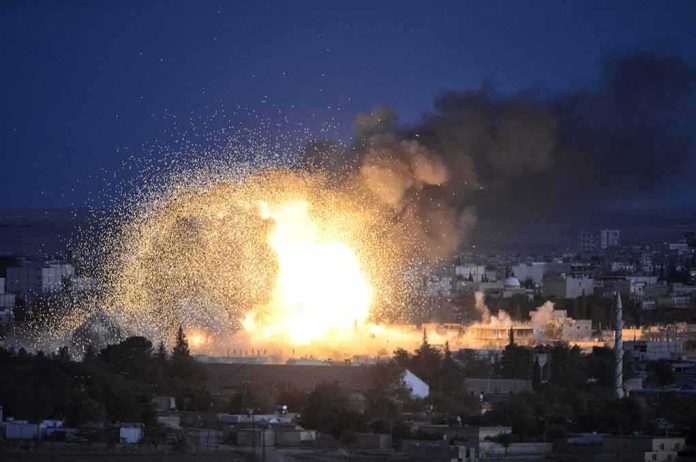
The core facts are not in doubt. Two bombs exploded near the Four Seasons Hotel in central Damascus, where French President Emmanuel Macron had spent the previous night during a high‑risk visit to Syria’s capital. The blasts hit a busy stretch between the tourism ministry and the national museum, right by one of the city’s most secure and symbolic zones. Syrian authorities say 18 people were wounded, including four police officers, but no deaths have been confirmed. For ordinary Syrians on that street, this was not a theory about geopolitics. It was shrapnel, smoke, and a scramble for ambulances.
Macron, though, was not on that street. By the time the first device went off, his convoy had already left the hotel and reached the Syrian Presidential Palace for talks with President Ahmed al‑Sharaa. The French presidential palace said that Macron was safe, would continue his visit, and, strikingly, had not even heard the explosions. A Reuters journalist with the press pool reported no disruption or visible commotion around the French events that morning. For security planners, that is the definition of a “contained” incident. For the people bleeding on the pavement, it likely felt anything but contained.
How close is “near” when you are a head of state?
Reports agree the bombs were close to Macron’s hotel, but not all “near” is equal. Syrian officials say the devices were planted in a parked vehicle and a garbage bin on a main road near the Four Seasons. BBC analysis of video placed the blasts roughly 125 meters from the hotel entrance. Syria’s Interior Ministry claimed the explosives detonated as security forces tried to neutralize them, and stressed the site was outside Macron’s security perimeter. That phrasing matters. It tells Syrians and the world: the regime did not lose control of its inner circle, only of a busy street nearby. From a conservative, common‑sense perspective, this reads like a government eager to say, “We had the important part covered.”
Security experts quoted by Al Jazeera see it differently. They argue that the devices appear timed and placed along roads Macron’s convoy used, suggesting the French delegation was the intended target, even if the execution failed. This view feeds the “attempted assassination” headline Western outlets jumped on—dramatic, clickable, and emotionally charged. But it rests on inference, not on hard forensic evidence or a claim of responsibility. So far, no group has stepped forward to say, “We tried to kill the French president.” In the world of political violence, that silence is loud.
Media drama versus the thin record of facts
Look at what we actually have on the record. Macron’s team says he was safe, did not hear the blasts, and kept his schedule. Syrian officials list injured civilians and police, describe improvised explosive devices in a car and a bin, and say they blew while bomb squads worked. There is video of fire and smoke, and of a second blast near an ambulance already on scene. What we do not have is a named suspect, a manifesto, or a forensic report tracing who built the devices and why. Despite that, much of the press framed the incident as Macron “escaping” an assassination attempt. That language is not neutral. It inflates a still‑unclear act of terror into a direct attack on a Western leader. It also leaves readers with the impression of certainty where there is only probability. For readers who value evidence and clear standards of proof, that should set off alarms.
Syrian state media has its own credibility problem. Reports lean on unnamed “security sources” to explain device placement and timing, but rarely provide verifiable details. In a country with a long record of propaganda and information control, anonymous officials do not inspire blind trust. Yet in this case, no Western government or major outlet has produced contrary hard evidence. The result is a frustrating gap: one side offers an unverifiable but specific story, the other side offers suspicions and scenarios, not documents.
Why ambiguity is not an accident in modern conflict
The Damascus blasts fit a broader pattern of political violence in today’s conflicts. The United Nations notes that most deadly attacks now occur in unstable states, often at the hands of non‑state actors who mix ideology, crime, and opportunism. Many such attacks never carry a public claim of responsibility. That ambiguity is useful. For regimes, it allows blame to float between foreign enemies and “terrorists,” while sidestepping questions about security failures. For Western media and analysts, it leaves room to push dramatic narratives—like “Macron targeted”—that heighten a sense of chaos and justify more caution, more spending, and sometimes more intervention.
#Syria | The Syrian Interior Ministry says the two explosive devices were planted only a short time before they were discovered in the area. Surveillance cameras covering the site are the primary source of evidence in the ongoing investigation. Officials also say CCTV footage… pic.twitter.com/WQeKIhVVgq
— Basha باشا (@BashaReport) July 7, 2026
Research on political leaders and conflict shows that leaders often gain staying power when they appear strong against threats from the outside. A leader who walks calmly into a meeting after bombs explode down the road projects resolve, even if his motorcade never faced real danger. That image can be useful both at home and abroad. The real losers, as usual, are the bystanders who get caught in the blast but barely appear in the storyline. Common sense and basic decency point to a simple standard here: weigh the lives and evidence at the scene more heavily than the spin from either palace or newsroom.
Sources:
townhall.com, cbsnews.com, cnn.com, aljazeera.com, instagram.com, facebook.com, nbcnews.com, youtube.com, ktvz.com, ucdavis.edu