

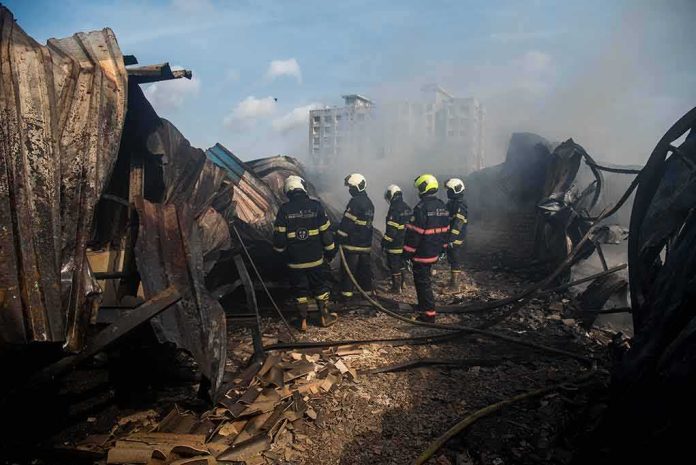
A fire raced through the powder-pressing line at an Italian munitions plant near Rome, then an explosion shook the town—and no one was hurt.
Story Snapshot
- A fire and explosion hit the KNDS Ammo Italy plant in Colleferro on August 13, 2026.
- No injuries were reported; workers evacuated or sheltered safely, officials said.
- Investigators are probing the cause; the company says it is too early to conclude.
- Reports point to the powder-compaction area as the likely origin of the blast.
What happened at the Colleferro plant
Italian emergency services rushed to the KNDS Ammo Italy facility in Colleferro, about 40 kilometers southeast of Rome, after a fire and then an explosion shook the site on August 13. Local officials reported fear across the area but no casualties. The Lazio regional president said the priority was public safety while crews secured the scene. Wire and regional coverage aligned on the core facts and timing, keeping the focus on response and safety perimeters.
Company representatives stated that on-site teams were assessing damage and reviewing the sequence of events. They stressed that it was too early to confirm the cause. Italian media noted that prosecutors in Velletri opened an inquiry, as is routine after an industrial blast with national-security ties due to the plant’s defense role. The lack of reported injuries stood out given the nature of the facility and the risks with energetic materials.
Where investigators are looking first
Multiple outlets cited the powder-pressing or powder-compaction department as the likely origin point. That focus tracks with how many factory accidents start during mixing, compaction, or heating phases where energy builds in fine powders. Process upsets, friction, or static can flash into fire and trigger a pressure event. Global safety literature classifies these “unplanned explosions” as a known hazard class in munitions manufacturing and storage, especially around sensitive process steps.
Early consensus around the compaction line does not prove a fault mode. It simply narrows the search to a zone where dust, binders, metal parts, and pressure meet. Investigators will look for scorch patterns, deformation, and residue that signal ignition points. They will check logs for temperature, pressure, and alarms. If the blast knocked out sensors, they will rely on physical forensics. This is standard for serious incidents in sites that handle propellants and explosives.
Why no injuries in a high-risk facility
Reports indicated workers on shift evacuated or sheltered in hardened areas before or during the event. That outcome suggests drills, barriers, and distance rules did their job. Modern plants separate people from process lines using reinforced rooms, remote operations, and blast venting. When such controls work, they turn a possible mass-casualty event into a property-loss incident. The public record to date says this appears to be the case in Colleferro, and that aligns with good safety design.
A fire triggered a huge explosion at the KNDS Ammo Italy ammunition factory in Colleferro, near Rome.
Officials said no injuries were reported. Now the question is how a munitions plant ended up sending a mushroom cloud over the city. pic.twitter.com/hTRvbQIfPV
— Voyte (@voyteapp) August 15, 2026
Italy’s prosecutors opened an inquiry soon after the blast. That move is normal due to the defense supply chain and the need to preserve evidence. Several reports said authorities had not presented proof of sabotage or a deliberate attack at that time. The working assumption in public reporting remained an industrial accident until facts show otherwise. That approach matches common sense and the way major accident probes proceed worldwide.
What comes next and why it matters
Expect a tight review of the compaction line: maintenance records, operator steps, batch quality, and static control. Investigators will map the fire path and test debris. They will ask how a local fire grew into an explosion and whether blast venting functioned as designed. If findings show a process failure, the fix will be engineering controls and stricter discipline. If the cause was external, authorities will say so. Until then, facts, not theories, should lead.
The lesson for policymakers and plant managers is simple. Energetic materials demand layers of protection that assume human error and rare upsets. Training, spacing, housekeeping, and hard barriers buy time when things go wrong. The data record on industrial disasters is blunt: explosions are the most lethal class of accidents on industrial sites. Designing for failure, not hope, is how you keep workers and neighbors safe when seconds count.
Sources:
planet-today.com, kyivindependent.com, unionesarda.it, csb.gov, apps.dtic.mil