
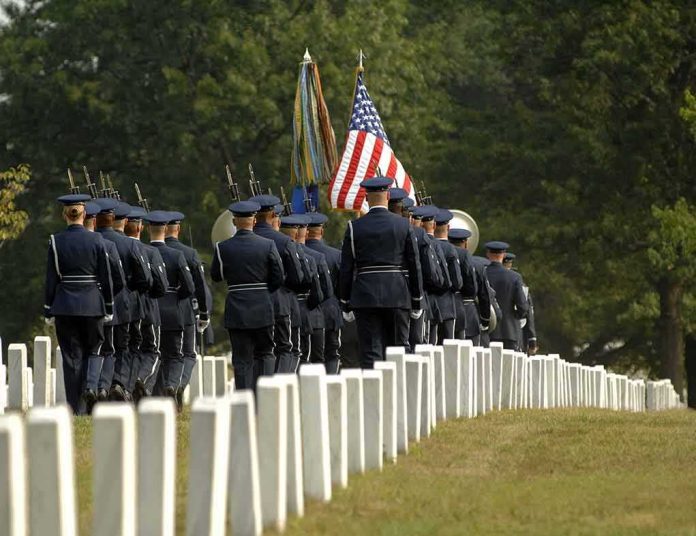
After 84 years, a World War II prisoner of war is coming home with a name, a story, and a flag on his casket.
Story Snapshot
- The Defense POW/MIA Accounting Agency identified Pfc. Bernard F. Sweet through multiple forensic methods.
- Researchers tied his case to a documented common grave at Cabanatuan POW camp.
- Modern DNA work and classic records solved what war chaos hid for decades.
- Repatriation delivers the promise: bring every American home when possible.
What Happened And Why It Matters
The Defense POW/MIA Accounting Agency said it accounted for Private First Class Bernard F. Sweet, a World War II prisoner who died in 1942 in the Philippines. The agency linked him to a common grave at the Cabanatuan prison camp using burial records and later lab analysis. The case moved from a wartime cemetery to scientific review and now to a flight home for burial with honors. This is the system working as designed, even if it takes generations to finish the job.
The Army’s repatriation pipeline is direct. Investigators research unit history and burial maps. Teams recover remains. Specialists test bone and tooth samples. They check dental charts, bones, and DNA against family references. They match likely identities and then rule out others. Only when lines of evidence converge do they name the fallen. That disciplined method has brought nearly one thousand World War II Americans home since the 1970s, beyond the vast postwar returns already achieved.
How They Identified Sweet
American records show seven sets of remains recovered from Cabanatuan’s Common Grave 701 after the war. The Defense POW/MIA Accounting Agency disinterred those remains in 2020 for new testing. Analysts used dental comparisons, skeletal study, and DNA to separate and identify individuals, then linked the profile to Sweet. This path fits the agency’s standard playbook: build a web of proof until names and remains align with strong confidence and no credible alternatives left standing.
Modern casework relies on a blend, not a single silver bullet. Labs extract DNA when possible. They compare teeth and bones to service records and health films. They test ideas against maps, rosters, and camp logs. They write down what the evidence includes and what it excludes. That is how today’s teams crack cases that baffled earlier generations. The Defense Department’s own training and field practice underscore that multi-source convergence is the norm, not the exception.
The Science In Plain English
Think of the lab as a three-part puzzle. First, historians trace where a service member likely died and where a body likely went. Second, recovery teams document the site and bring remains to the lab. Third, scientists compare what they see and test what they can. Dental work can be decisive when charts exist. Bones show age, stature, and healed injuries. DNA, when viable, ties remains to living kin. When all three agree, the case stands on solid ground.
The Japanese ship sank off the coast of the Philippines in 1944 while carrying hundreds of American POWs. Recovering their remains has been impossible—until now. https://t.co/4YbmbDXjYJ via @WSJ #POW #WWII #USA 🦅🇺🇸
— Matthew Lance 🇺🇸🦅🐘🐙🔴 (@LlMatthew) July 30, 2026
Sweet’s journey shows why patience and record-keeping matter. Wartime graves were often hurried and shared. That chaos led to commingled burials and unknown headstones. Today’s teams revisit those graves with better tools and a slower clock. They pull apart sets that never should have been together. They test, re-check, and confirm. The same approach has solved other Cabanatuan and Pacific cases in recent years and sent families the call they waited a lifetime to receive.
Honor, Proof, And Public Trust
Some readers ask for the full lab file and the DNA math. They want the identification memo, the match odds, and chain-of-custody logs. That instinct is fair. But the core claim here does not rely on a single dramatic test. It rests on converging records, named grave context, and standard Defense Department laboratory methods. The pattern of past successes, and the agency’s conservative thresholds, align with common-sense values: verify carefully, name the fallen, and bring them home.
Sources:
military.com, idahostatesman.com, propublica.org, youtube.com, offutt.af.mil