
The scream, witnesses say, cut through the winter air at Coogee before anyone even saw the blood.
Story Snapshot
- A 35-year-old woman was mauled about 100 feet off Coogee Beach and left fighting for life
- Lifeguards, bystanders, and an off-duty doctor staged a frantic rescue as a shark alarm cleared the water
- Officials shut beaches and rolled out helicopters and drones, raising questions about risk and overreaction
- The attack exposes a hard truth: rare dangers still force tough choices about freedom, fear, and personal responsibility
The calm morning that turned into a fight for life
Saturday at Coogee Beach began like any other busy winter swim. Regulars slipped into the water, families watched from the sand, and lifeguards kept quiet watch on the flags. Then, just after 11 in the morning, a 35-year-old woman swimming with two others was hit by what witnesses describe as a “large shark,” roughly 100 feet offshore.[2] A cloud of blood spread in the water as the reality of the attack sank in.[2]
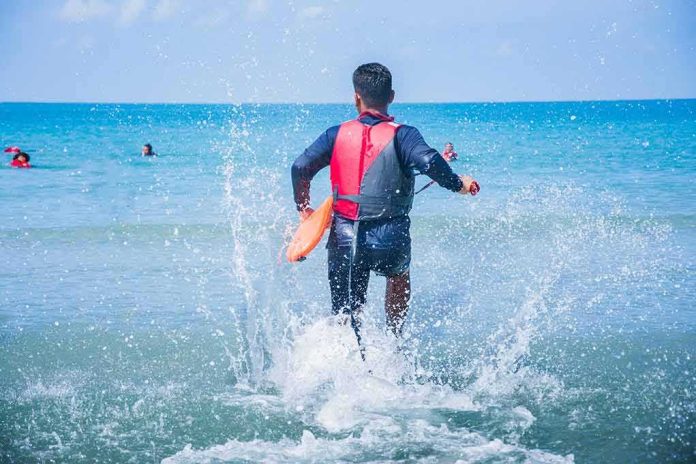
The first rescuer to reach her was a lifeguard on a paddleboard, who found her too weak to climb on. He grabbed her arm and dragged her toward shore while other swimmers and board riders rushed to help.[2] An off-duty doctor on the beach saw the scene, ran to the waterline, and started working on her wounds as soon as they reached the sand.[2] People nearby watched in shock while sirens and a shark alarm blared over the loudspeakers.[5]
Inside the rescue: blood, tourniquets, and a race against time
On the sand, the scene shifted from panic to controlled chaos. The woman had severe injuries to her leg and arm, with one thigh wound about a foot wide and bone exposed, according to the doctor who helped treat her.[2] Police and paramedics arrived quickly, applied pressure and tourniquets, and started giving blood products to keep her alive before transport.[3] She was described as semi-conscious and breathing, but in a critical condition and needing extensive surgery.[1]
Authorities cleared nearby Coogee Oval to allow a rescue helicopter to land, then airlifted her to a major Sydney hospital.[1] Emergency services later said she faced long, complex operations on her limbs.[2] For locals, the speed and scale of the response were both reassuring and chilling. This was not a drill or a minor bite. This was the nightmare scenario every coastal city quietly trains for, hoping it never comes.
How one attack shut down miles of coastline
Police and surf lifesaving officials moved fast once they confirmed a serious shark attack. Coogee Beach was cleared and closed, and nearby beaches from Bondi to Maroubra were also shut to swimmers for at least 24 hours while helicopters and boats searched the area.[1][6] Social media clips show almost 6,000 people kept out of the water as the red and yellow flags came down and “beach closed” signs went up.[7]
Surf lifesaving leaders also ramped up aerial monitoring. They announced extra drone flights over Bondi and Bronte to scan for sharks, on top of 14 locations statewide already using drones that day.[1] Coogee itself did not have a drone on patrol at the time of the attack, a detail now certain to feature in budget and policy debates. For families on the sand, though, the message was simple: stay out of the water, at least for now.
A rare danger, a loud alarm, and a hard policy choice
The Coogee mauling comes during what local media call a “spate” of shark attacks across Australia this year, several of them fatal.[1][2] That broad pattern helps explain why officials slam beaches shut after a single incident. Shark attacks are low-frequency but high-consequence events. One severe bite is enough to end a life, or change it forever. Politically, no mayor or minister wants to be the one who “kept the beach open” after a warning sign.
Woman critically injured after shark mauling at Sydney beach; the 35-year-old suffered serious leg and arm injuries in the attack at 11:15am off Coogee Beach, say police #Sydney https://t.co/vbqYe5jwoR pic.twitter.com/rlMoTe7mHG
— Gulf Today (@gulftoday) June 13, 2026
Skeptics counter that at Coogee, all we know so far is one serious attack and no clear pattern of repeated incidents at that exact spot. Early reports could not even agree on the shark species, though at least one lifeguard later described a white shark about 11 feet long.[2] From a common-sense, conservative view, that tension matters: emergency closures and extra patrols right after the attack make sense; turning rare fear into permanent rules is another question.
Freedom, risk, and what this means for everyday beachgoers
For everyday Australians, the lesson of Coogee is not “never swim again.” It is that nature does not read safety signs, and there is no such thing as zero risk in the ocean. Swimmers can choose to stay between the flags, avoid dawn and dusk, and pay attention to alarms and closures. Government can use targeted tools like drones and patrols in known hotspots instead of blanket bans that punish everyone for freak events.[1]
What happened to that 35-year-old woman is tragic and very real. But smart policy in a free society cannot be written in pure panic. The path that fits both common sense and conservative values is clear: take the attack seriously, honor the heroism of the rescuers, improve tools that work, and still trust adults to weigh risk for themselves when the red flag comes down and the surf opens again.
Sources:
[1] Web – WATCH: A shark alarm blares across a popular beach in Australia after …
[2] Web – Woman mauled by shark off Sydney beach grabs onto a …
[3] Web – Woman in critical condition after shark attack at Sydney’s …
[5] Web – A woman is in a critical condition after being bitten by a …
[6] YouTube – Woman fighting for life after shark attack at Sydney’s …
[7] YouTube – Shark Attack At Coogee Beach Leaves Swimmer Fighting …