
The Trump administration’s bold move in Venezuela has left the world questioning the future of international law and sovereignty.
Story Snapshot
- U.S. captures Venezuelan President Nicolás Maduro and assumes control over Venezuela.
- Trump declares a U.S. administrative takeover to ensure democratic transition.
- Operation sparks international condemnation and geopolitical tensions.
- Unprecedented U.S. intervention sets a controversial precedent in foreign policy.
U.S. Military Operation in Venezuela
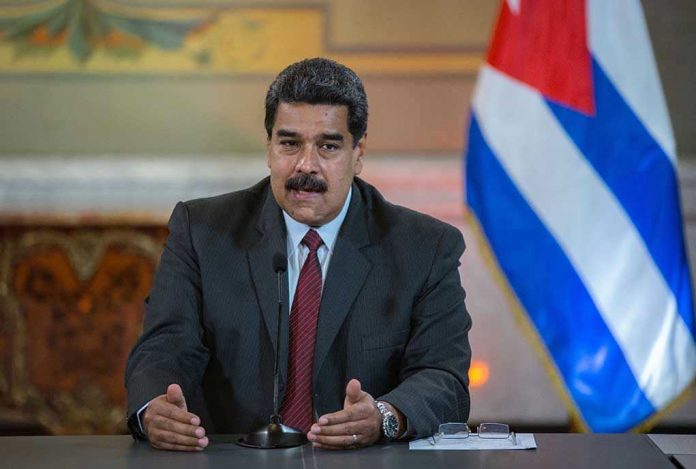
A U.S. military operation in the early hours of January 3, 2026, resulted in the capture of Venezuelan President Nicolás Maduro and his wife. President Donald Trump announced the operation, stating that the U.S. would control Venezuela until a safe and proper government transition could occur. The move is framed as a necessity to curb narcotics trafficking and prevent authoritarian succession, but it has raised significant international concerns. Trump’s decision represents a unique assertion of U.S. power in Latin America.
The military intervention followed extensive U.S. military build-up in the Caribbean, targeting vessels linked to narcotrafficking. Prior to the operation, the U.S. had placed a bounty on Maduro and seized Venezuelan oil tankers. These actions culminated in the capture of Maduro, altering power dynamics in the region. By deploying senior officials as viceroys, the U.S. asserts administrative control, a move that has been both criticized and supported by different stakeholders.
Geopolitical Tensions and Stakeholders
The U.S. intervention in Venezuela has not gone unnoticed on the global stage. Russia and China, key geopolitical adversaries, condemned the operation, warning of potential retaliatory actions. U.S. allies, including the U.K. and Trinidad and Tobago, have distanced themselves from the attack, highlighting the controversial nature of the intervention. Venezuelan Vice President Delcy Rodríguez, reportedly cooperating with the U.S., adds another layer of complexity to the unfolding situation.
Domestically, reactions are mixed. Some Venezuelans view the U.S. intervention as a path to democratic reform, while others decry it as a violation of national sovereignty. The operation has sparked protests and celebrations, reflecting the divided opinions within the country. Meanwhile, opposition leader María Corina Machado, who supported the U.S. actions, stands as a potential successor to Maduro, although Trump has expressed doubts about her leadership capabilities.
Impact and Long-Term Implications
The ramifications of the U.S. intervention extend beyond Venezuela. The military occupation represents a bold assertion of U.S. influence in the Western Hemisphere. This action not only challenges international norms but also risks escalating tensions with major powers like Russia and China. The operation sets a precedent for future U.S. interventions, with Trump and Secretary of State Marco Rubio hinting at similar actions in Cuba. The control over Venezuela’s resources, particularly oil, underscores longstanding U.S. interests in the region.
International condemnation of the operation is widespread. Venezuela’s government accused the U.S. of violating the United Nations Charter, arguing that the intervention breaches principles of state sovereignty. The operation’s justification, primarily based on narcotics trafficking, is disputed by DEA data, which does not list Venezuela as a significant trafficking hub. These inconsistencies raise questions about the U.S.’s motives and the legitimacy of its actions.
Uncertain Future and Expert Analysis
The future of Venezuela under U.S. control remains uncertain. The timeline for withdrawal and transition to a new government is undefined. Trump’s refusal to specify a successor to Maduro adds to the ambiguity. The operation’s long-term success depends on navigating complex geopolitical landscapes and addressing the concerns of both domestic and international stakeholders. The intervention’s impact on regional stability and U.S. foreign policy will be closely monitored in the coming months.
Experts highlight the operation’s potential to reshape power dynamics in Latin America. While some view the intervention as a necessary measure for regional stability, others criticize it as a resource grab and a violation of international law. The operation’s success will hinge on the U.S.’s ability to manage the transition effectively and address the broader geopolitical implications. As the situation evolves, the world watches closely, hoping for a resolution that respects Venezuela’s sovereignty and fosters democratic governance.