
A Navy warship locked onto its own fighter jets, and in the seconds before the missiles hit, one American pilot had to decide whether to trust the system or his own instincts.
Story Snapshot
- A Navy warship misidentified U.S. fighter jets as enemy missiles and opened fire, triggering a near-fatal friendly-fire crisis for the pilots involved.
- The incident exposed how compressed timelines, cluttered sensors, and imperfect identification systems can turn advanced warships into accidental threats to their own side.
- Investigations and past mishaps show a repeating pattern: when technology, doctrine, and human judgment clash, aircrew usually pay the highest price.
- Conservative scrutiny focuses on accountability, realistic training, and resisting blind faith in complex systems that still depend on fallible humans.
How a Warship Turned on Its Own
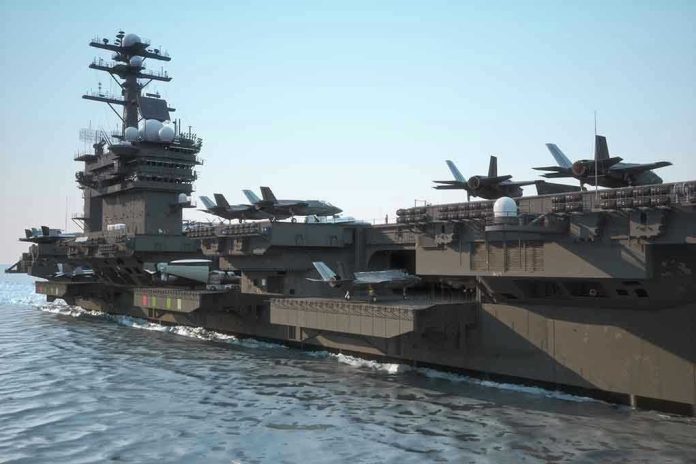
The basic facts are stark: a U.S. Navy warship tracking what its crew believed were incoming enemy missiles instead targeted U.S. fighter jets operating in the same battlespace, then fired live weapons at them. The pilots suddenly saw their own side’s missile warnings light up, a scenario they trained for in theory but never expected to face in reality. One pilot, later describing his life flashing before his eyes, had only seconds to outthink a machine built to kill anything it labeled a threat.
Events like this never hinge on a single bad decision. Shipboard combat systems aggregate radar returns, data links, and IFF signals into a single air picture, then push human operators toward rapid fire-or-don’t-fire choices under enormous pressure. When that air picture is cluttered by hostile launches, friendly patrols, and partial information, tracks moving at fighter-jet speeds can be misread as sea-skimming missiles. At the console, the difference between a friendly Hornet and a hostile cruise missile may come down to seconds of ambiguity and one watch team’s risk tolerance.
Patterns Written in Earlier Mishaps
Past Navy and joint-force mishaps show how often friendly fire grows from the same soil: rushed identification, overconfidence in sensors, and an assumption that high-tech systems will sort out the chaos. Investigations into earlier aviation losses linked to carrier mishaps and deck operations already revealed cracks in safety culture and risk management aboard deployed strike groups, from maintenance errors to procedural shortcuts under deployment strain. Those findings pointed to systemic pressure that does not disappear once aircraft leave the deck and enter contested airspace.
"A Navy warship mistook US fighter jets for enemy missiles and opened fire. The targeted pilot saw his life flash before his eyes." – Business Insider #SmartNews https://t.co/dNb1P7mXRD
— Chris Silas (@Silas18Chris) December 5, 2025
Broader analysis of naval warfare warns that the Navy’s most dangerous adversary is not always a foreign fleet but institutional complacency about its own complexity. Conservative observers see a familiar pattern in which Washington’s appetite for exquisite, automated defenses outpaces the investment in basic seamanship, airmanship, and brutally realistic training. When a ship misidentifies its own jets as inbound threats, the problem is not simply a software glitch; it is a warning that the entire ecosystem of doctrine, acquisition, and oversight has drifted away from common-sense safeguards that prioritize human judgment and clear chains of accountability.
The Human Cost Behind the Radar Screen
For the targeted pilots, the incident boiled down to a visceral calculation: trust the assurances of deconflicted airspace, or react as if every missile warning is real, even when it points back to the American flag. The fact that aircrew survived other recent mishaps only because they ejected at the last possible moment underscores how close modern naval aviation operates to the edge. When a pilot talks about seeing life flash before his eyes, that is not melodrama; it is evidence that the safety margins designed into the system are thinner than the public assumes.
Conservative values demand that such fear is not shrugged off as the cost of doing business in a high-tech military. A force that sends young Americans into combat owes them more than glossy assurances that “the system works.” It owes relentless questioning of whether procedures reflect real-world complexity, whether training simulates worst-case chaos, and whether leaders who oversee repeat patterns of failure face real consequences. Patriotism here means insisting that loyalty to the rank and file outranks loyalty to any particular platform, contractor, or bureaucratic narrative.
Sources:
Navy report details multiple aircraft mishaps aboard USS Harry S. Truman
Navy report outlines safety, maintenance, and leadership failures tied to Truman air mishaps
U.S. F-16 pilot recounts outmaneuvering friendly-fire Patriot missiles
The U.S. Navy’s biggest enemy isn’t Russia or China or even missiles