
A $60 million Navy fighter did everything right, right up until the moment a worn patch of deck and muddled command decisions yanked it into the Red Sea.
Story Snapshot
- A frontline Super Hornet survived a violent arrested landing, only to be lost during the “simple” part: moving it on deck.
- A degraded non-skid coating and confused communication turned routine choreography into a multimillion-dollar sled ride.
- The mishap was one of three Super Hornet losses and a collision on the same deployment, all deemed preventable.
- Navy investigations point to leadership, training, and maintenance culture—not enemy fire—as the real threat.
How a Super Hornet Went From Combat Mission to Runaway Wreck
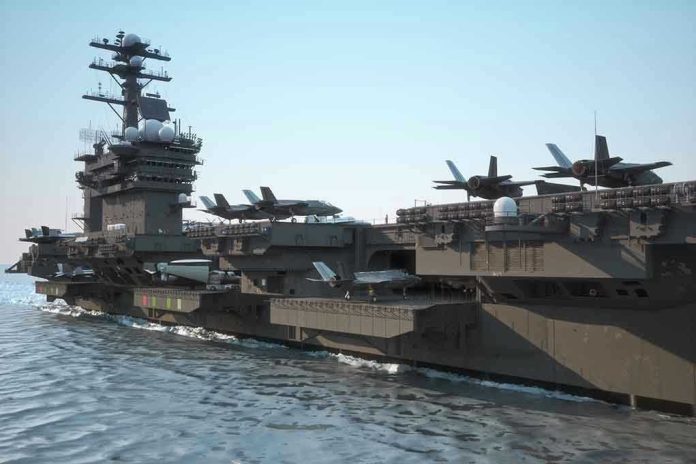
The F/A‑18E/F Super Hornet that rolled toward the edge of USS Harry S. Truman in April 2024 was not coming home from a routine training hop; it was flying combat-related missions over a Red Sea thick with Houthi drones and missiles. The pilot trapped aboard the carrier—the violent “boom and sparks” announcing a hard, punishing arrested landing that damaged equipment and left the jet wounded but recoverable. Surviving the wires was the hard part, or so everyone thought.
Flight deck crews swarmed the crippled Super Hornet with the muscle memory of thousands of previous recoveries. Their job was simple on paper: secure, chock, chain, and move the damaged aircraft away from the landing area so the next jet could come aboard. Instead, as tractors, chains, and hand signals converged, the broken fighter sat on a deceptively dangerous surface—a carrier deck whose non-skid coating had worn down under an unforgiving deployment tempo.
When Steel Becomes Ice and Procedures Start to Fray
A modern Nimitz-class carrier relies on its non-skid the way your pickup relies on its brakes; the coating turns slick steel into something more like asphalt, giving tires and boots a fighting chance. On Truman that spring, command investigations later found, patches of that lifeline had degraded. Under a crippled jet’s weight and under tow, the deck behaved less like sandpaper and more like oiled glass. Conservative common sense says you fix the road before sending the convoy; here, the convoy rolled anyway.
As the deck crew tried to move the Super Hornet, tug, chains, and gravity formed a coalition no safety brief wanted. Communication between bridge, flight deck control, and the sailors on the non-skid did not reach the clarity combat conditions demand. The damaged jet shifted, momentum built, and the aircraft began to slide toward the edge. The crew fought the motion, but physics had already won the argument; the $60 million fighter rolled off the deck and disappeared into the Red Sea. No missile, no drone—just a preventable loss in slow motion.
With a boom and sparks, this $60 million Navy jet's carrier landing unraveled in seconds https://t.co/2ra3AHDJP2
— Insider (@thisisinsider) December 5, 2025
One Deployment, Three Lost Hornets, and a Hard Look in the Mirror
The “boom and sparks” jet was not Truman’s only airborne casualty. On the same deployment, another Super Hornet went overboard after the carrier executed a hard evasive turn to avoid a Houthi ballistic missile, a maneuver that demanded fully functioning brakes the jet did not have. The fighter and its tow tractor rolled off together. A separate incident saw an F/A‑18 involved in a collision, adding to a damage ledger that ultimately reached roughly $164 million.
Command investigations did not blame bad luck or the fog of war. They cited leadership failures, training gaps, procedural lapses, degraded non-skid, and malfunctioning equipment as the common threads binding these events. From a conservative vantage point, that finding cuts two ways: the hardware works when properly maintained and operated, but the human systems meant to safeguard both people and taxpayer money faltered under pressure. Complexity did not excuse what reports flatly labeled preventable.
What the Mishap Reveals About Readiness, Culture, and Priorities
The Red Sea deployment demanded near-constant awareness of Houthi threats while launching and recovering jets in tight cycles. High operational tempo always tests maintenance schedules and training pipelines, yet warships still carry a basic obligation: do not let the routine kill what the enemy could not. When non-skid is allowed to degrade and known equipment issues persist, leadership effectively outsources risk to junior sailors and pilots who have no vote in those tradeoffs.
The Truman investigations now sit as case studies in how modern militaries fail: not through one villainous decision but through many small, tolerated shortcuts. Deck coatings get another cycle instead of replacement; communication standards soften; emergency procedures look clean in PowerPoint but muddy in practice. For taxpayers, the signal is uncomfortable but clear. America can build world-class aircraft and nuclear carriers, yet still lose a $60 million jet to a slippery patch of deck and a breakdown in command alignment.
Sources:
Business Insider – US aircraft carrier hard turn to avoid missile sent jet overboard
$164M lost due to incidents during USS Harry S. Truman’s latest deployment – WTKR