
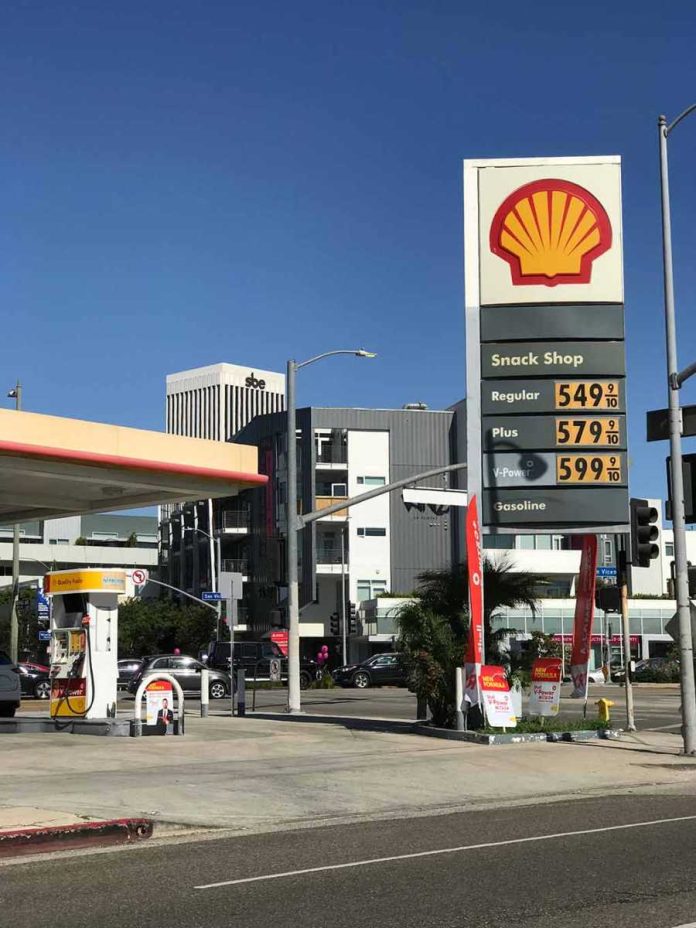
Trump just told the world that high gas prices are “peanuts” compared to a nuclear Iran, and he’s betting that Iran wants out of this war badly enough to make a deal fast.
Story Snapshot
- Trump publicly dismissed oil price concerns, saying stopping Iran from getting nuclear weapons is far more important than what Americans pay at the pump.
- He predicted oil prices will “plummet” once the Iran conflict ends, claiming Tehran wants a deal “so badly” and the war will end “very quickly.”
- Oil markets didn’t wait for a deal — Brent crude jumped nearly 2% immediately after Trump’s warning that the “clock is ticking” for Iran.
- Negotiations remain stalled, with Iran calling U.S. demands “unreasonable” and Trump reportedly ripping up Iran’s latest proposal after reading just one line.
Trump Reframes the Gas Price Debate as a Nuclear Stakes Argument
Most politicians run from high gas prices like the building is on fire. Trump walked straight toward them. Posting on Truth Social, he acknowledged that America, as the world’s largest oil producer, actually profits when prices rise, then pivoted immediately to the argument that none of that matters if Iran acquires a nuclear weapon. His exact framing: stopping “an evil Empire” from going nuclear is “of far greater interest and importance” than any short-term price pain at the pump. That is either an act of extraordinary strategic clarity or a very confident political gamble, depending on whether you believe a deal is actually coming.
The argument has an internal logic that is hard to dismiss. If Iran achieves nuclear capability, the geopolitical risk premium baked into every barrel of oil doesn’t ease — it compounds permanently. Trump is essentially telling Americans that today’s gas prices are a manageable inconvenience, and a nuclear-armed Iran is an unmanageable catastrophe. He also authorized the release of 172 million barrels from the Strategic Petroleum Reserve to cushion prices in the near term, signaling he is not entirely indifferent to the economic pressure households are feeling right now.
The Deal Optimism Is Real, But the Evidence for It Is Thin
Trump said flatly that Iran wants to make a deal “so badly” and that the war will end “very quickly.” Those are confident words. The diplomatic record underneath them is considerably messier. Iran’s side reportedly told negotiators that the U.S. response contained “no serious concessions.” Bloomberg reporting described Iranian terms as “too maximalist” while characterizing U.S. offers as insufficient. Trump himself reportedly tore up Iran’s latest written proposal after reading just the opening line. That is not the body language of two parties sprinting toward a handshake.
Markets, however, are not waiting for signed documents. Brent crude gained 1.9 percent to reach $70 a barrel almost immediately after Trump’s warning that Iran had better “move fast or nothing will be left of them.” That price jump is telling — not because it confirms a deal is near, but because traders are pricing the probability of one. Oil markets have always been exquisitely sensitive to Iran headlines, going back to the swings that followed the 2018 withdrawal from the Iran nuclear deal. The pattern is consistent: Trump speaks, risk premiums move, and the underlying diplomatic reality catches up — or doesn’t — later.
What Trump Gets Right That His Critics Underweight
The mainstream framing of this story emphasizes stalled talks, bellicose threats, and market volatility. That framing is not wrong, but it misses something. Trump’s core assertion — that a nuclear Iran would be permanently destabilizing to global energy markets, regional security, and American strategic interests — is not a fringe position. It is the consensus view of every serious national security analyst across both parties for the past two decades. The disagreement is about method and timeline, not about whether a nuclear Iran would be catastrophic. On that foundational point, Trump is on solid ground, and his critics rarely engage with it directly.
Trump warns US may strike Iran in coming days if no deal. Oil prices and global financial markets on alert.
— Vermouth (@vermoutharc) May 20, 2026
His prediction that oil prices will drop rapidly once the Iran nuclear threat is resolved also deserves more serious treatment than it typically receives. A verified, enforced agreement that removes Iranian nuclear capability would almost certainly reduce the geopolitical risk premium embedded in crude prices. The honest objection is not that the logic is wrong — it’s that the path from here to a verified deal is unclear, enforcement mechanisms are untested, and Iran has a documented history of using negotiations to buy time. Those are legitimate concerns. But dismissing Trump’s price forecast as political noise ignores the straightforward economics behind it.
The Clock Trump Set Is Now Running Against Him Too
Trump told Iran the clock is ticking. The problem is that clock is also ticking on his own credibility. He has publicly predicted a fast resolution, low oil prices, and a deal Iran desperately wants. If negotiations drag on for months with no agreement, every week of elevated gas prices becomes a data point his opponents will use. The Strategic Petroleum Reserve release buys time, but 172 million barrels is not an unlimited buffer. The boldness of Trump’s framing is also its vulnerability: he has staked a specific, measurable outcome — lower oil prices after a deal — on a diplomatic process that, by every available account, is nowhere near finished.
Sources:
[1] YouTube – Donald Trump tells Iran ‘clock is ticking’ as oil prices jump …
[2] Web – Trump says as largest oil producer, US benefits when oil prices rise
[3] Web – Trump’s Iran warning sends oil prices soaring and global markets …
[4] YouTube – Trump reacts to concerns over oil prices as Iran war rages on
[5] YouTube – Oil prices settle higher after Trump says Iran ceasefire “on life …
[6] Web – Oil Prices Hold High as Trump Calls Iran Deal Critical – Gotrade
[7] YouTube – Trump’s Iran blockade announcement sparks oil price surge
[8] Web – United States withdrawal from the Iran nuclear deal – Wikipedia