

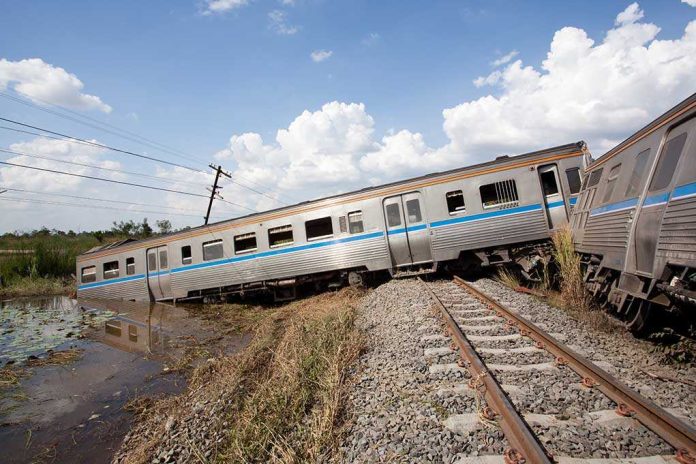
A regional train carrying 186 passengers flew off the tracks in northern France Friday night, and investigators now believe someone may have deliberately put a chunk of rail in its path.
Story Snapshot
- The Rouen-to-Caen train derailed near Cléon in Seine-Maritime, injuring 44 people, one critically.
- Prosecutor Sébastien Gallois said a rail segment found on the track is the leading explanation for the crash.
- Investigators seized the train’s black box and ordered a court-appointed expert to examine the wreck.
- The driver tested negative for drugs and alcohol, ruling out impairment as a cause.
What Happened On The Rouen To Caen Line
The train left Rouen bound for Caen on Friday evening when it derailed near Cléon, a town in the Seine-Maritime region of northern France. Multiple carriages overturned or left the rails. Officials confirmed 186 passengers were aboard when the crash happened, turning an ordinary regional commute into a scene of twisted metal and scattered debris along the tracks.
🚆 French police are investigating whether sabotage caused a train derailment in northwest France, injuring 44 people. A rail fragment found on the track has led investigators to treat malicious intent as the primary line of inquiry for the incident near Rouen. What are your…
— Headlines (@lordnewss) September 13, 2026
Emergency crews responded fast and hard. Between 130 and 140 firefighters rushed to the scene, along with several medical teams. One passenger, hurt badly enough to need a helicopter evacuation, was listed in critical condition. The other 43 injured were treated at area hospitals, a response scale that matches what officials treat as a major transportation incident.
Investigators Point To A Piece Of Rail On The Track
French prosecutor Sébastien Gallois told reporters that a segment of rail was discovered sitting on one of the tracks near the crash site. “Currently, the primary hypothesis is that a segment of rail was found on one of the tracks, which may have led to the derailment,” Gallois said. He added that investigators still don’t know how the piece got there.
That last detail matters. Authorities are not calling this a confirmed act of sabotage. They are calling it the leading theory while they dig for answers. A police spokeswoman described the rail fragment as “probably” linked to the crash, language that keeps the door open without slamming it shut on other explanations.
The Response So Far Has Been Methodical
Investigators moved quickly to lock down evidence. The train’s black box, which records speed, braking, and mechanical data, was confiscated for analysis. A court-appointed technical expert has been brought in to examine the track and the wreckage. Officials also said numerous interviews are planned with crew members, witnesses, and maintenance staff who worked the line before the crash.
One early question got answered fast. The train’s driver, who was hurt in the crash, was tested for drugs and alcohol. Both results came back negative, according to French media coverage. That ruled out driver impairment as a factor and pushed the investigation’s focus squarely onto the track itself and whatever put that rail fragment there.
Early Numbers Shifted As The Picture Came Into Focus
In the chaotic hours right after the crash, casualty figures moved around. Some initial wire reports mentioned roughly 20 people hurt before the confirmed total settled at 44, a normal pattern when emergency responders are still triaging patients across multiple hospitals. The Seine-Maritime prefect later fixed the number at 44 injured, including the one critical case.
Why French Officials Take Rail Sabotage Seriously
France has a recent, well-documented history with rail sabotage. Arsonists struck the country’s high-speed rail network hours before the 2024 Paris Olympics opening ceremony, cutting fiber optic cables at signal boxes along multiple lines and forcing a nationwide investigation into what officials called a coordinated attack on the network’s “nerve centres”. That history shapes how seriously investigators treat any object found deliberately or otherwise on an active track today.
None of that history proves what happened near Cléon. But it explains why French prosecutors moved fast to seize evidence, call in outside experts, and treat sabotage as a real possibility worth running down rather than dismissing. A serious government takes infrastructure threats seriously, and that’s exactly what this response looks like so far.
What Comes Next For The Investigation
The court-appointed expert’s findings, once released, should tell investigators whether that rail fragment was placed, dropped, or dislodged by some mechanical failure. Black box data will show exactly how the train behaved in the seconds before it left the rails. Until those pieces come together, French authorities are right to call this a working theory rather than a closed case.
France: Rouen–Caen train derailment injured 44; one critically injured passenger was airlifted. A mass-casualty plan was activated as police investigated a rail fragment. https://t.co/UB4mGv82K1
— Emergency Responder Reporter (@RedLightsRotors) September 13, 2026
For now, what’s certain is the scale of what happened: nearly 50 people hurt, a critical patient airlifted out, and a busy regional rail line shut down while France works to figure out exactly why a piece of rail ended up somewhere it never should have been.
Sources:
redstate.com, abcnews.com, connexionfrance.com, bbc.com, nampa.org