

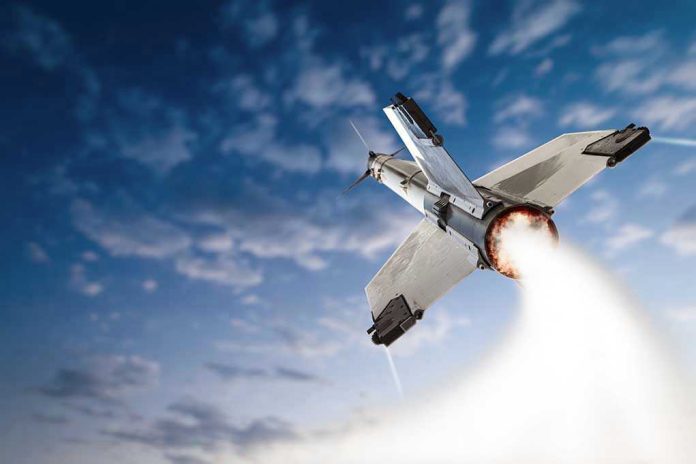
Imagine troops in a remote Pacific outpost receiving 80 tons of ammunition from space in under 90 minutes, outpacing any enemy threat.
Story Snapshot
- U.S. military invests in rocket cargo to deliver C-17-sized loads globally in under 90 minutes, bypassing vulnerable routes.
- Space Force requests $20M in FY25 for Point-to-Point Delivery research, targeting airdrop demos by mid-2020s.
- Commercial firms like SpaceX and Rocket Lab secure over $100M in contracts since 2020 for reusable rocket prototypes.
- Concept counters anti-access/area-denial threats in Indo-Pacific, enabling agile, dispersed forces.
- NASA’s ISS resupply model inspires military adaptation for prolonged endurance in contested wars.
U.S. Transportation Command Ignites Rocket Cargo Vision
In 2020, Gen. Stephen Lyons of USTRANSCOM outlined rocket cargo as a game-changer. He targeted C-17-equivalent payloads—about 80 short tons—anywhere on Earth in under an hour. Traditional airlift and sealift falter against long-range fires threatening ports and bases. Rocket cargo promises speed and survivability. This aligns with American conservative values of military readiness through innovation, not endless foreign entanglements.
Agile Combat Employment disperses forces across small, mobile bases in vast theaters like the Indo-Pacific. Enemy precision strikes render large airfields useless. Rockets bypass denied airspace, delivering via vertical landing or parachute drops. Commercial reusable rockets from SpaceX, Blue Origin, and others make this feasible as launch costs plummet.
Space Force Builds Orbital Logistics Backbone
Space Force launched its Servicing, Mobility and Logistics office in 2023. The SAML portfolio includes Point-to-Point Delivery for airdropped payloads. FY25 budget seeks $20M, with funds supporting engineering designs for operational demos. On-orbit refueling extends this to satellite sustainment and depots. Gen. Chance Saltzman champions dynamic space operations to make assets harder to target.
Over $100M in contracts since 2020 went to SpaceX, Blue Origin, Rocket Lab, Sierra Space, and Anduril. These firms adapt existing rockets for cargo. Inversion Space’s Arc capsule pre-positions supplies in orbit for on-demand deorbit within an hour. Tests, including a Rocket Lab demo in 2026, validate hypersonic reentry and precision delivery.
Commercial Rockets Drive Military Feasibility
Falling launch costs transformed Cold War dreams into near-term reality. Reusable rockets riff off proven tech, avoiding Pentagon-owned fleets. Space Force acts as anchor tenant, providing demand signals to industry. This public-private model echoes conservative principles of leveraging free-market efficiency for national defense, minimizing taxpayer burden on bespoke systems.
NASA’s Cygnus and Dragon routinely deliver tons to the ISS autonomously. Army doctrine adapts this for multidomain operations, enabling prolonged endurance without surface infrastructure. REFORPAC 2025 exercises exposed logistics gaps over Pacific distances, underscoring rocket cargo’s role in contested environments.
Operational Challenges Demand Pragmatic Solutions
Risks persist: launch pads need hardening, overflight permissions complicate global ops, and payloads must match unpredictable needs. Hypersonic capsules evade most SAMs but risk misidentification as threats. Costs, though dropping, exceed traditional airlift for routine hauls. Facts support cautious optimism—demos first, not hasty deployment. Common sense dictates testing against real warfighter requirements before scaling.
Short-term, expect prototypes and integration into exercises. Long-term, rocket cargo forms a fourth logistics domain, surging aid or munitions to austere sites. This bolsters deterrence, letting adversaries guess U.S. reinforcement speed. In Pacific scenarios, it counters A2/AD, sustaining dispersed forces indefinitely.
Sources:
https://airforcetechconnect.org/news/space-force-looks-ramp-space-mobility-logistics-research-fy-25
https://taskandpurpose.com/tech-tactics/us-military-rocket-cargo-space/
https://www.nasa.gov/blogs/spacestation/2025/09/05/nasa-partners-adjust-next-cygnus-resupply-launch/