

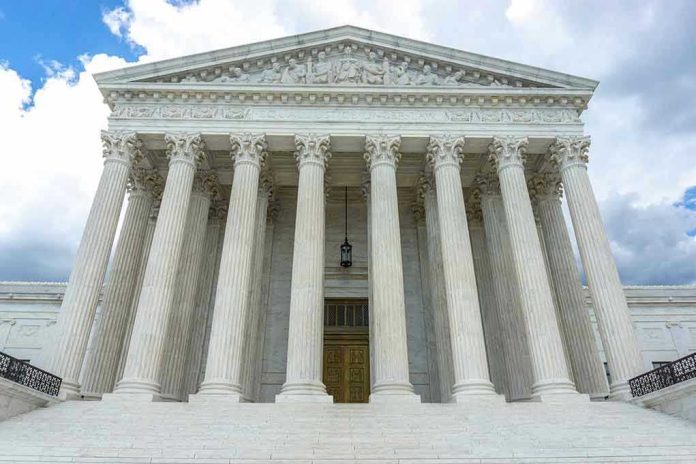
The Supreme Court just quietly reshaped how millions of Texans will be heard in Washington, and most voters will never realize what changed until the results roll in.
Story Snapshot
- The Supreme Court let Texas use a congressional map critics say dilutes Latino voting power while lawsuits continue.
- A lower court had already found likely violations of the Voting Rights Act and the Constitution and tried to block the map.
- The order arrived on the Court’s emergency docket, with no full hearing but enormous stakes for the 2026 elections.
- The decision strengthens GOP advantages now while signaling how far states may go with hardball redistricting in the future.
How a single order locked in Texas power
Texas did what every politically savvy state does after a Census: it took fresh population data and used it to cement partisan power. The Republican-controlled legislature drew a congressional map that protects or expands GOP-leaning districts, even though the state’s population growth has come largely from Latino and other nonwhite communities who tend to favor Democrats. Latino and civil-rights groups sued, arguing that the plan “packs and cracks” Latino voters so their growing numbers do not translate into real political influence.
A three-judge federal court looked closely at those claims and concluded the plaintiffs were likely right, at least on the early record. That panel blocked the map for the 2026 elections and ordered Texas to produce a lawful alternative that gives Latino voters a genuine chance to elect candidates of their choice. Texas immediately asked the Supreme Court for emergency relief, warning of campaign chaos and defending the map as a lawful expression of partisan preference rather than racial discrimination, a key distinction under current doctrine.
Why the Supreme Court stepped in anyway
The Supreme Court responded with a short emergency order that carried massive consequences: Texas can use the challenged map while the litigation plays out. That move effectively overrode the lower court’s detailed finding that the map likely violates the Voting Rights Act and the Constitution. The majority leaned on long-standing concerns about making late changes to election rules, a principle conservatives often invoke to keep existing arrangements in place as deadlines approach, even when serious legal questions remain unresolved.
This was not a full-dress constitutional showdown with lengthy opinions and oral argument; it was a fast, high-impact decision on the Court’s so‑called “shadow docket.” That procedural posture matters because it lets a bare majority set the rules of the game for a major election cycle without laying out a comprehensive theory for future cases. Conservative readers who value stability in election administration may welcome that restraint, but they should also recognize the trade-off: when emergency orders decide maps, voters live under lines that may later be declared unlawful, and courts rarely unwind the political realities those elections create.
Latino growth, limited voice, and conservative common sense
Texas offers a textbook test of whether demographic change must lead to political change. Over the last decade, Latino residents fueled much of the state’s population boom, yet the new map does not create a proportional increase in Latino opportunity districts. Instead, challengers say the lines carve fast-growing communities into several GOP-tilted seats or pack them into a few overwhelmingly Latino districts, ensuring Republican incumbents can campaign on comfortable terrain while Latino voters struggle to turn numbers into seats.
From a conservative, rule-of-law perspective, the key question is not whether Republicans gain, but whether the map crosses the line Congress drew in the Voting Rights Act. Section 2 does not guarantee outcomes for any group; it insists that racial and language minorities have a fair shot when conditions show persistent inequality. If lower courts, after full trials, again find deliberate vote dilution and the Supreme Court still declines to act, voters will reasonably conclude that the statute’s protections exist mostly on paper. That erosion of confidence cuts against the conservative goal of strengthening trust in institutions.
What this means beyond Texas
Texas is not operating in a vacuum. Other Southern and border states are battling over similar allegations that minority communities are shortchanged by maps carefully calibrated to maximize partisan gain. The Court has already said pure partisan gerrymandering is beyond the reach of federal judges, which leaves minority voters relying heavily on the anti-discrimination tools that remain. By allowing Texas’s map to stand for now, the Court sends a signal that only the clearest, most egregious cases of vote dilution are likely to get urgent relief before an election.
Practically, campaigns, donors, and national parties will treat these lines as the governing reality for 2026, shaping which candidates step forward, where money flows, and which communities see serious competition. If Republicans hold or grow their edge under this map, they will gain seniority and committee power that will not easily be undone, even if courts later require line changes. Voters who care about secure borders, energy development, and fiscal restraint may welcome more Republican seats, but they should also ask whether those gains rest on persuasion or on finely tuned district engineering that leaves entire neighborhoods feeling their votes are expendable.
Sources:
Politico: Supreme Court Texas House map coverage
U.S. Supreme Court: Abbott v. League of United Latin American Citizens order