
When federal prosecutors called a Minneapolis protest group “Antifa with a playbook,” the crowd outside the St. Paul courthouse answered with shields, chants, and a face full of chemical spray.
Story Snapshot
- Fifteen Minnesota activists now face sweeping federal charges tied to anti-immigration enforcement protests.
- Officials say this was not protest, but an organized campaign to track, threaten, and attack federal officers.
- Defense lawyers call it political theater built on recycled, shaky “ICE surge” cases and a war on dissent.
- Clashes outside the courthouse show how fast America now jumps from courtroom hearing to street showdown.
The federal indictment that turned protesters into alleged conspirators
The Department of Justice dropped a legal hammer that was years in the making. A 94-page, eight-count indictment names 15 members and associates of an activist network called Direct Action Minnesota and links them to what prosecutors describe as Antifa-aligned direct action against immigration enforcement.[1][5] The charges are not small potatoes. Conspiracy to impede or injure a federal officer, interstate stalking, interstate threats, solicitation to commit a violent crime, multiple counts of assault on federal officers, and destruction of government property all sit on the table.[1] Prosecutors say this was a planned campaign, not a one-night riot.
The document focuses on a string of actions tied to Operation Metro Surge, a federal immigration blitz around the Bishop Henry Whipple Federal Building in Bloomington and later operations that spilled into Wisconsin.[3][5] According to the government, these activists did more than chant and wave signs. They allegedly built “hard” and “soft” blockades, trained with shields, tracked agents’ cars, and shared play-by-play in encrypted chats as they tried to disrupt immigration raids.[3]
Federal officials framed Direct Action Minnesota as something closer to an underground cell than a loose protest crew. U.S. Attorney Daniel Rosen told reporters that the group and its subgroups used encrypted messaging, secret meetings, and “commuting tactics” to identify, follow, and harass individual officers from their workplaces toward their homes.[3]
One defendant, prosecutors say, followed a Homeland Security agent from the Whipple Building across the border into Hudson, Wisconsin, helping anchor the interstate stalking counts.[3]
Another allegedly posted on social media that peaceful protest was over and called on followers to “get your guns and stop these people,” a line prosecutors cite to support the solicitation and threat charges.[3][5] Agents also describe physical clashes during January and March actions: vehicles and blocks of ice used to obstruct and damage federal cars, shields and human chains deployed to resist arrests, a trailer flipped and used as a barricade.[3] On paper, this reads like a blueprint for targeted harassment of officers. That difference matters.
The First Amendment protects ugly speech and loud protest, but it does not protect coordinated stalking, threats, or assaults, especially against officers in the middle of carrying out court-approved operations. From a conservative rule-of-law standpoint, the government’s focus on specific acts against named agents—rather than on vague “extremism”—is the strongest part of its case.
A courthouse hearing, a crowd in the street, and a cloud of chemical spray
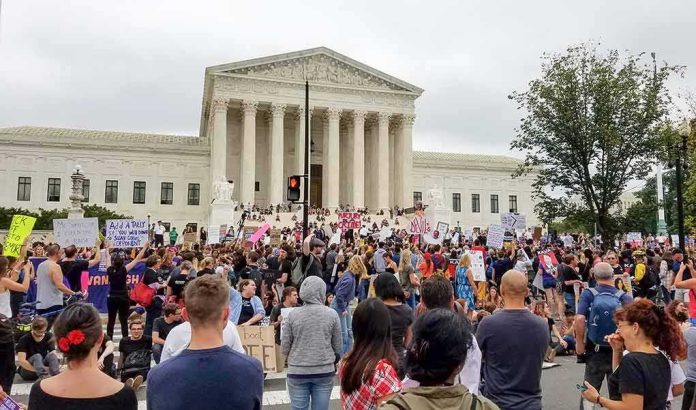
The day the indictment was unsealed, the real theater happened outside the building, not in it. As the fifteen defendants filed into federal court in St. Paul for their first appearances, protesters massed on the sidewalks, chanting against Immigration and Customs Enforcement and denouncing the charges as a political hit.[9]
Federal marshals formed a line between the crowd and the courthouse doors. Things escalated fast. Videos from local outlets show pushing at the barricades, handheld shields in the crowd, and marshals deploying chemical spray to drive people back from the entry area.[9] Commentators on social media framed it as “leftist rioters storming a federal courthouse,” while local TV described a tense but short clash that ended with no new arrests reported on the spot. Inside the courtroom, the tone was cooler. Prosecutors asked the judge to detain some defendants before trial, pointing to the conspiracy allegations and the government’s claim that these activists had already targeted officers at home and on the road.[9]
The judge pushed back. According to reporting from inside the hearing, he found no clear evidence they were flight risks or likely to interfere with the case and ordered their release with conditions, including limits on contact with each other and restrictions on protesting at federal property.[9] That ruling did not bless or reject the charges on the merits, but it cut against the idea that everyone in the dock is a ticking time bomb. The split screen was stark: fiery rhetoric and pepper spray on the sidewalk, legal caution and due process in the courtroom.
**Leftist Rioters Storm Courthouse After Antifa Indictments — Bear Spray Deployed!**
BREAKING: Leftist rioters attempted to attack the federal courthouse in St. Paul after 15 Antifa members were indicted by DOJ. Officers deployed bear spray to stop them forcing doors open.… pic.twitter.com/AYaxe2XxCV
— Juan Coolio (@JuanCoolioX) June 17, 2026
Defense pushback, past failures, and the larger protest crack‑down pattern
Defense lawyers and activists wasted no time painting a different picture. They argue that these charges grow out of the same “ICE surge” enforcement effort where earlier protest cases in Minnesota were dropped for lack of evidence or alleged misconduct by immigration agents.[8] One defense attorney told reporters those past dismissals show a pattern of overreach, claiming previous charges rested on false or shaky information from officers now treated as key witnesses.[8] Supporters say the defendants were trying to protect schools and neighborhoods from aggressive immigration raids, not hunting federal officers for sport.
Their counter-narrative leans hard on politics: a Trump-era Department of Justice, a directive to treat Antifa as a domestic enemy, and a broader national push to slap harsh criminal labels on disruptive protests, especially around immigration.[5][18] There is real context behind that fear. Legal scholars and civil liberties groups have tracked a wave of new laws and cases since 2017 that raise penalties for protest-related offenses, from blocking roads to wearing masks at demonstrations.[15][16][18]
Prosecutors in other states have experimented with “domestic terrorism” and racketeering charges against protesters who target government projects or police training sites.[16] From a common-sense conservative angle, two points can be true at once. First, federal officers deserve strong protection from real stalking, threats, and assaults; if the government can prove those acts beyond a reasonable doubt, accountability is not optional. Second, a federal bureaucracy that has already dropped multiple related protest cases and has been sued over immigration tactics should not get a free pass on scrutiny just because it invokes the word “Antifa.”[8][11] That is exactly why this case matters beyond Minnesota. It will test where the line sits between civil disobedience and crime in an era when protest, political violence, and federal power collide almost weekly.
WATCH: The sole broadcast network evening news report on the Minneapolis Antifa indictments was aired on @CBSEveningNews– a tiny brief.
TONY DOKOUPIL: We turn now to Minnesota, where federal prosecutors have charged 15 people but with not just protesting ICE earlier this year… pic.twitter.com/swAXFhZMS0
— Jorge Bonilla (@BonillaJL) June 17, 2026
Nothing about that test will be clean. The indictment rests heavily on encrypted chats and snippets of social media, yet the public has not seen full message logs, device forensics, or complete video of each clash. We also have not seen cross-examined testimony from the officers who say they were followed, blocked, or hit. That gap leaves space for both sides to shout past each other, and for headlines to do most of the thinking. For readers who care about order, limited government, and basic fairness, the takeaway is simple: demand specific facts, not labels; judge each defendant by his or her own actions, not by a movement tag; and remember that neither “Antifa” nor “federal agents” is magic language that settles guilt or innocence. This case, and the uproar outside that courthouse, are a warning of what happens when the country stops making those distinctions.
Sources:
[1] Web – All Hell Breaks Loose Outside Federal Courthouse in St. Paul After …
[3] Web – 15 in Minneapolis facing charges for anti-ICE actions, feds …
[5] YouTube – Killings of Good and Pretti: Will Agents be Charged?
[8] YouTube – Federal charges against anti-ICE demonstrators spark …
[9] Web – 15 members and associates of Direct Action Minnesota …
[11] Web – Feds charge 15 anti-ICE activists – KAXE
[15] Web – DOJ charges 30 more people in Minnesota anti-ICE church protest
[16] Web – As anti-ICE protest cases falter, prosecutors notch first conviction …
[18] Web – US Protest Law Tracker – ICNL