
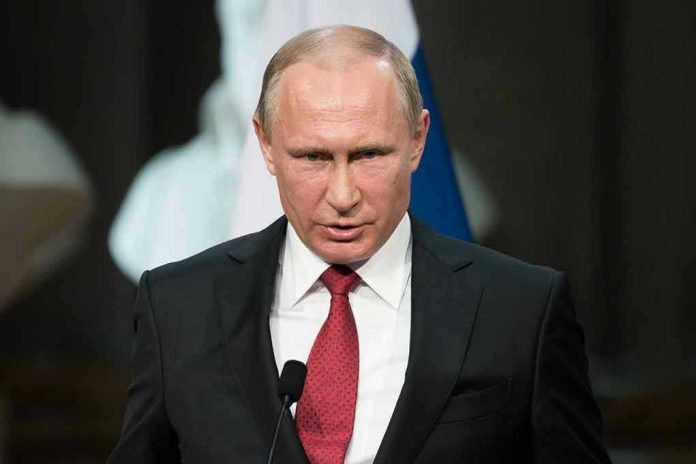
Putin’s vanishing act matters less for the gossip and more for what it signals: Russia’s entire war machine still hinges on one man showing his face.
Quick Take
- Putin has not appeared publicly since February 5, 2026, and the Kremlin has offered no clear explanation.
- Zelensky used the moment at the Munich Security Conference to suggest Putin “doesn’t have too much time,” turning absence into leverage.
- Russian state media has aired footage that appears pre-recorded, a classic tactic for projecting normalcy.
- Diplomacy accelerates toward Geneva talks on February 17–18, while Washington pressure for quick concessions collides with Ukrainian red lines.
A Week Without Putin: Why the Silence Lands Like a Shockwave
Vladimir Putin’s last confirmed public appearance came February 5, 2026, and the gap that followed triggered a predictable frenzy: health rumors, succession chatter, and “palace intrigue” narratives. The harder truth sits in plain sight. A system built around personal control cannot afford unexplained absences during live war and live diplomacy. Even if nothing medical happened, the information vacuum becomes a strategic vulnerability all by itself.
Russian state television tried to fill that vacuum with video of meetings that reportedly looked pre-recorded. That move aims at one thing: preserving the perception of continuity. Strongman politics runs on theater, and the audience includes Russian elites, conscripts’ families, and foreign negotiators reading tea leaves. When the “leader” becomes a question mark, every other message from Moscow starts to sound like it’s coming from an empty podium.
Zelensky’s Timing: Turning an Absence into a Negotiating Weapon
Volodymyr Zelensky’s Munich line that Putin “doesn’t have too much time” landed because it straddled two meanings at once: age and pressure. Zelensky didn’t need a medical file; he needed a headline that punctures the myth of inevitability around Putin. Psychological warfare works best when it uses the opponent’s own habits. Putin has disappeared before, but Zelensky tied this one to looming talks and a grinding war.
American readers should separate the taunt from the policy. Zelensky’s job is to keep Ukraine’s coalition together and keep Moscow off-balance; the remark does that. The conservative, common-sense read is simpler: leaders signal strength when they can, and they disappear when they must. Any government fighting a costly war should expect its adversary to exploit even minor anomalies. Zelensky’s rhetoric reflects war logic, not a proof of diagnosis.
The Kremlin’s Playbook: Control the Image, Minimize the Questions
Putin’s periodic disappearances have become a recurring feature of his rule, always met with denials and a shrug from official channels. That pattern doesn’t confirm illness, but it does confirm priorities. The Kremlin guards information as a weapon, and it treats the leader’s body like a state secret. A closed regime can hide many things, yet it cannot hide the consequences of uncertainty once allies and rivals start pricing risk into decisions.
Speculation spiked again after late-2025 chatter about Putin appearing with “swollen and sore” hands. That detail, by itself, proves nothing; cameras catch odd moments and headlines do the rest. The more meaningful point is how quickly a small visual cue becomes a geopolitical variable. When a country centralizes power so aggressively, even a rumor of fragility affects everything downstream: military confidence, elite loyalty, and the perceived room to compromise.
War Math and Peace Talk Reality: Why This Week Intersects with Geneva
This absence collides with a diplomatic calendar that offers no patience. Talks in Abu Dhabi preceded planned negotiations in Geneva on February 17–18, and the fighting has not paused—reports describe continued drone and missile attacks. Meanwhile, Washington pressure for a deal has increased, including blunt public urging for Zelensky to move quickly. That combination creates a combustible mix: deadlines, battlefield pain, and leaders posturing for leverage.
Data-focused analysts have emphasized that Russia seeks in negotiations what it struggles to secure on the battlefield, pointing to manpower strain and enormous casualty totals cited in public discussion. Reports also describe recruitment bonuses being cut in some regions under budget stress. Those details matter because they frame what Moscow might want most: time, territory, and a narrative of “victory.” When the leader then disappears, even briefly, negotiators must wonder who can actually commit.
The Conservative Lens: Don’t Mistake Rumors for Strategy, or Strategy for Peace
American conservatives tend to distrust wishful thinking dressed up as foreign policy, and that instinct applies here. Health rumors make good clickbait, but policy requires facts and incentives. Putin could be ill, laying low for security, or staging distance to create mystique. Any of those scenarios still produces the same operational question: does Moscow’s chain of command tighten around a stable decision-maker, or does it become more risk-prone to prove strength?
Conservatism also values negotiating from strength, and that’s the trap in the current U.S. pressure campaign. Fast deals can become bad deals when they reward aggression or lock in territorial gains achieved by force. Zelensky’s pushback—saying Ukraine has already made major compromises—speaks to a fear many Americans understand: once you give away leverage, you rarely get it back. Geneva will test whether “peace” means security or simply a pause.
What to Watch Next: Three Signals That Cut Through the Fog
Putin’s reappearance, if and when it happens, will matter less than how it happens. A tightly scripted, heavily edited clip would sustain doubt; a live, unscripted setting would aim to restore authority. Second, watch the Kremlin’s tone: does it mock the rumors, ignore them, or overreact? Overreaction usually reveals sensitivity. Third, watch what Russia asks for at Geneva, because demands reveal confidence more reliably than photo-ops.
The most important unanswered question isn’t whether Putin missed a week because of health, fear, or choreography. The question is whether a war that has consumed years and lives can be steered toward a durable settlement when one side’s legitimacy still rests on a single, carefully managed public image. A system that depends on one face eventually learns the cost of not showing it.