
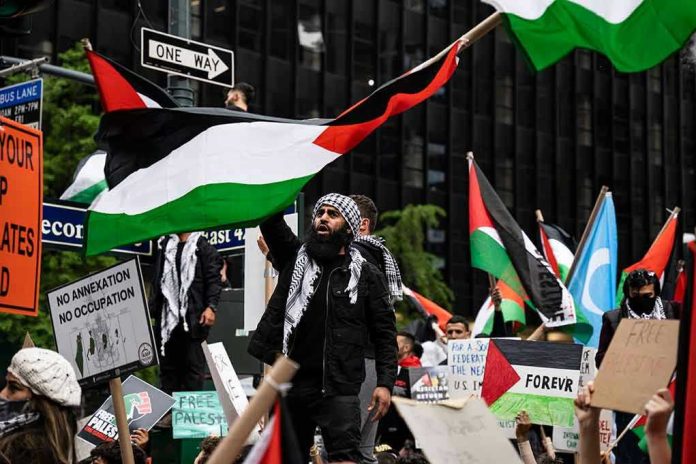
When seventy activists descended on Fifth Avenue’s ZARA store during peak Black Friday shopping hours, they weaponized retail disruption as political theater—a calculated strategy that transforms commercial spaces into battlegrounds for geopolitical messaging.
Quick Take
- Approximately 70 pro-Palestinian protesters stormed a ZARA location on Manhattan’s Fifth Avenue around 12:30 p.m. on Black Friday, November 28, 2025, disrupting shoppers and forcing police intervention
- Four individuals were arrested following the store disruption, with protesters chanting slogans accusing the retailer of funding genocide
- The demonstration extended beyond ZARA, with the group continuing to march down Fifth Avenue and appearing outside the Microsoft store
- The timing during Black Friday—America’s biggest shopping day—amplified visibility and commercial disruption as a deliberate protest tactic
The Strategic Weaponization of Commercial Spaces
Choosing Black Friday wasn’t accidental. Activists understand that maximum disruption during peak shopping hours guarantees media coverage and forces corporations into uncomfortable positions. By entering the store itself rather than remaining on sidewalks, protesters crossed from protected speech into territory that invited police response. This escalation appears calculated—designed to generate arrests that underscore their commitment while creating visual conflict for news cameras. The strategy mirrors established protest playbooks: target recognizable brands, create confrontation, document arrests, amplify messaging through social media.
Corporate Targeting and Accountability Demands
ZARA and Microsoft weren’t random selections. Activists specifically targeted these corporations based on perceived complicity in geopolitical conflicts. The accusation that “ZARA is a genocidal company” reflects broader boycott campaigns questioning corporate supply chains and investment portfolios. Whether these characterizations withstand scrutiny matters less than understanding activist intent: they’re attempting to redefine corporate responsibility beyond traditional business metrics. They’re demanding that fashion retailers and technology companies take explicit political positions aligned with their worldview.
Law Enforcement’s Balancing Act
NYPD faced genuine complexity. First Amendment protections guarantee protest rights, yet commercial disruption and trespassing create legitimate law enforcement concerns. The rapid response and arrests suggest police prioritized clearing the store over extended negotiation. This approach minimizes disruption to other shoppers and retailers but raises questions about proportionality. Four arrests from seventy protesters indicates selective enforcement—suggesting officers focused on those who physically entered the store rather than sidewalk demonstrators.
The Broader Pattern of Activist Escalation
This incident reflects a growing trend: activists increasingly targeting retail and technology sectors as leverage points for geopolitical messaging. Black Friday disruptions have become recurring phenomena in major American cities. What distinguishes this event is its coordination, scale, and explicit corporate targeting. The protesters’ organized nature—wearing coordinated keffiyehs, carrying Palestinian flags, using rehearsed chants—demonstrates sophisticated planning. This wasn’t spontaneous anger; it was choreographed activism designed for maximum impact.
Commercial Disruption as Political Expression
The fundamental tension here involves competing rights. Activists claim moral authority to disrupt commerce in service of political messaging. Retailers claim rights to conduct business without unauthorized occupation. Consumers claim rights to shop unmolested. Law enforcement claims responsibility for maintaining order. These claims collide inevitably when activists deliberately choose disruption as their tactic. The question becomes whether commercial disruption constitutes legitimate protest or crosses into unlawful interference with business operations.
What Happens Next
The four arrested individuals face potential charges ranging from trespassing to disorderly conduct. Legal proceedings will determine consequences, but the real impact extends beyond courtrooms. ZARA and Microsoft now confront activist pressure campaigns. Other retailers will assess security protocols. Future Black Friday events may see increased police presence. Most significantly, this incident establishes precedent: disrupting major retailers during peak shopping periods generates media attention and political pressure, likely encouraging similar tactics by activist groups with different causes.
Sources:
4 arrested after rowdy anti-Israel protest at Manhattan store – AOL News