

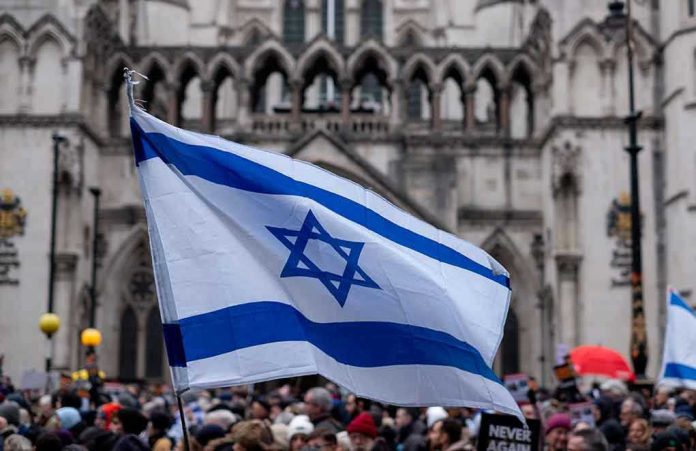
A flag on a roadside pole can do what missiles sometimes can’t: tell the world someone intends to stay.
Story Snapshot
- Israeli military vehicles entered Hadr in Syria’s Quneitra Governorate on March 25-26, 2026 and raised an Israeli flag at the town’s entrance.
- Reports described the flag-raising as more provocative than routine cross-border raids because it signals symbolism, not just tactics.
- Israeli forces reportedly restricted movement by closing most roads into and out of Hadr and setting up a checkpoint on the remaining route.
- Detentions during related operations included shepherds and village elders, while the IDF offered no public explanation for the operation’s purpose.
Hadr and the Power of a Symbolic Move on a Fragile Frontier
Israeli forces reportedly rolled into Hadr, a small town of roughly 5,000 near the UN-monitored buffer area in Quneitra, and raised an Israeli flag at the entrance. That act matters because it is legible to everyone, even people who never read a policy memo: flags claim meaning. Raids can be framed as temporary security measures; a flag planted in a town reads like a message about control, permanence, and who sets the rules.
Accounts tied the flag incident to a broader operation: Israeli forces reportedly closed all but one road leading into and out of Hadr, then established a checkpoint on that remaining road. In practical terms, that turns a town into a managed space where daily life depends on permission. People over 40 recognize the pattern from other conflicts: the checkpoint isn’t merely a tactical tool; it is governance by limitation, conducted one car, one family, one delivery at a time.
Why the Silence From the IDF Amplifies the Provocation
Reports emphasized an unusual detail: no official Israeli statement explaining why the operation occurred or what it aimed to accomplish. Silence can be strategic, but it also invites worst-case interpretation. When a military acts across a border and then declines to clarify, every local actor fills the gap with speculation, rumor, and fear. Common sense says secrecy has a cost: it may protect methods, but it also encourages miscalculation by everyone who must guess the next move.
Operations reportedly extended beyond Hadr to other villages in the area, with detentions that included two shepherds whose fate remained uncertain and two village elders who were later released. Those specifics matter because they show how rapidly “security operations” blur into community pressure. Detaining shepherds hits the most basic level of rural livelihood, and detaining elders touches local authority structures. That combination reads less like a single raid and more like an attempt to manage the environment.
Post-Assad Syria: A Vacuum Where Borders Start Acting Like Opinions
The backdrop to this incident is Syria’s post-December 2025 collapse of centralized authority after the fall of Bashar al-Assad’s regime. A power vacuum changes the logic of border security: instead of dealing with a state, a neighbor confronts a patchwork. That fragmentation can tempt stronger militaries to create “facts on the ground,” especially in terrain long shaped by ceasefire lines and demilitarized arrangements dating back to the 1973 war and the UNDOF buffer zone.
Hadr’s geography also explains why a symbolic act lands so hard. The town sits right along a frontier that already carries layered legal and military meanings: sovereign territory, demilitarized boundaries, and UN observation. When control becomes ambiguous, symbols become sharper. Residents don’t need to know the fine print of international agreements to understand what a new checkpoint implies. If you can’t freely leave, you’re not merely being protected; you’re being administered.
Flags as Fuel: The Incident’s Echo Across Syria’s Internal Fractures
Flag-related confrontations didn’t stay confined to Quneitra. Reporting described detentions in Suweida after some residents refused to raise the Israeli flag during a commemoration for Sultan Pasha al-Atrash at his mausoleum in Al-Qurayya. Activists condemned the arrests as violations of free expression and peaceful assembly. That is the darker loop this story opens: once a flag becomes a loyalty test, local power brokers can use it to punish dissent and sort communities into “with us” and “against us.”
Separate reporting described unrest in northeastern Syria in Qamishli and al-Hasakah, with SDF-linked groups storming security headquarters, vandalizing vehicles, burning Syrian flags, and lowering the Syrian flag from a Qamishli airport building. That matters because it shows the same dynamic in a different key: symbols replace institutions. When central authority weakens, flags and emblems become the shorthand for who rules, who resists, and who can coerce others without consequences.
What This Signals for Security, Sovereignty, and Everyday People
Americans tend to respect clear borders and transparent aims, even when force becomes necessary. A state has a right to defend itself; a citizen has a right to ask what the plan is. In that light, a cross-border operation that includes a flag-raising and movement restrictions, paired with no public explanation, looks less like a discrete defensive action and more like a political message delivered by military means. That ambiguity is where escalation thrives.
Residents of Hadr and nearby villages pay the immediate price: fewer open roads, more stops, more uncertainty about who can be detained and why. The long game is normalization. If checkpoints and symbolic gestures repeat without pushback or diplomacy, people adapt, and “temporary” becomes daily reality. That is how de facto control forms—quietly, routinely, and with just enough confusion that outsiders argue about intent while locals live the consequences.
The unsettled question is what comes next: a one-off signal, a probing operation, or the start of a new pattern in southern Syria. The facts available don’t confirm a declared annexation or formal change in borders, but they do confirm something more immediate and more destabilizing—symbolic escalation in a region already splintering. When multiple factions fight over flags, the story stops being about cloth and poles and becomes a story about who gets to decide the future.
Sources:
Syrian Observatory for Human Rights report on Israeli forces raising the Israeli flag in Hadr
Israeli Forces Raid Syria, Raise Israeli Flag Over Syrian Town of Hadr
Suweida National Guard Detains Residents After Refusal to Raise Israeli Flag
Israeli Forces Raise Flag Over Syrian Town In Latest Raid: ‘Provocative Act’
Security tension following flag incident: official condemnations and calls for calm
Israeli incursions & raising of UN flag in Quneitra countryside