

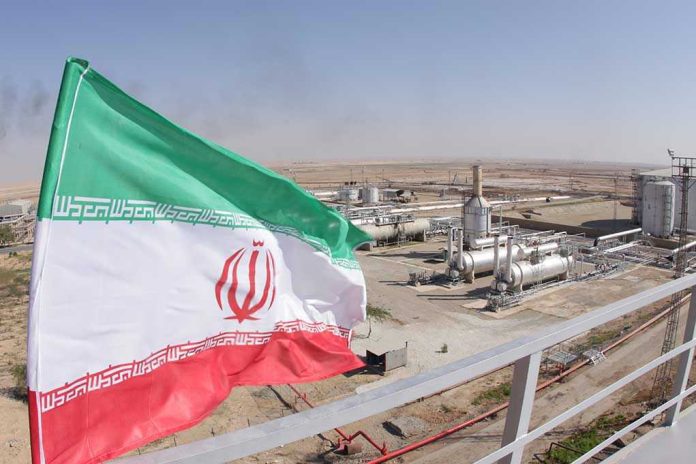
Iran’s warning to American tech workers in the Middle East wasn’t just rhetoric—it was a blueprint for turning everyday digital life into a battlefield.
Quick Take
- The IRGC publicly named roughly 15 American companies as potential targets and urged people near “industrial plants” tied to Americans to leave.
- The threat signals a strategic shift: pressure U.S. influence by striking civilian-linked infrastructure, not just military assets.
- Amazon Web Services reported drone-strike damage to facilities in the UAE and near-misses in Bahrain, showing real-world vulnerability.
- A separate cyberattack on medical tech company Stryker, claimed by a group tied to Iran, highlights the blended physical-cyber playbook.
A Threat Designed to Travel Through Your Phone, Your Cloud, and Your Payroll
Iran’s Islamic Revolutionary Guard Corps put American brand names into the crosshairs, and that detail matters more than the slogans. When a state-linked military force names private companies—Microsoft, Google, Amazon Web Services, Palantir, Oracle, Nvidia, and others—it signals intent to punish the supporting scaffolding of modern power: logistics, cloud computing, sensors, aviation supply chains, and data. The IRGC paired the list with an evacuation-style warning aimed at civilians living or working nearby.
The message wasn’t subtle: withdraw American industry from the region or accept the consequences. That demand reads like coercion dressed up as “legitimate targets,” and it tracks with how Iran has long compensated for America’s conventional military advantages—by threatening what’s easier to hit, harder to defend, and politically awkward to answer. Civilian infrastructure creates dilemmas: hit back too hard and you escalate; absorb the blow and you invite the next one.
Why Tech Companies Became “Military Targets” Overnight
Tech companies aren’t on this kind of list because they sell smartphones. They’re there because data centers and cloud regions run communications, business continuity, and often government-adjacent workloads. In a crisis, cloud uptime can matter as much as fuel supply. The IRGC and aligned outlets framed the expansion as retaliation for U.S. and Israeli strikes and assassinations of senior Iranian security figures. That framing aims to launder a strategic choice—targeting civilian-linked nodes—into a defensive narrative.
The conservative, common-sense lens is straightforward: enemies pick targets that create maximum fear at minimum cost. Naming brands also recruits the global news cycle as a force multiplier. A single drone strike can cause weeks of reputational damage, insurance chaos, staff relocations, and boardroom panic. Tehran doesn’t need to “win” militarily to change behavior; it needs to make executives and host governments question whether keeping American infrastructure on their soil is worth the heat.
Proof of Concept: Drones, Fire Suppression, and a Cloud With Smoke in the Air
Threats feel abstract until a facility takes damage. Amazon Web Services reported drone strikes that caused structural damage and power disruption at two sites in the UAE, along with close proximity to a Bahrain facility. Even if redundancy keeps customer-facing systems stable, physical impact matters: repairs require local access, local security, and time. Fire suppression can create its own destruction through water damage. That is the unglamorous truth about “the cloud”—it lives in buildings.
Iran’s broader pattern has always favored asymmetric tools: drones, missiles, proxies, deniable actors, and now a more explicit pressure campaign on private-sector presence. U.S. officials cited large percentage drops in Iran’s ballistic missile and drone attacks, implying degraded capability. That may be true and still irrelevant to the corporate risk equation. A reduced arsenal can still land a few drones on the right transformer yard, and a “few” is enough to rattle markets and families.
The Second Front: Cyber Operations That Hit Where Hospitals and Manufacturers Can’t Wait
Physical strikes grab headlines, but cyberattacks scale faster and cross borders without airspace. Stryker, a medical technology company, suffered a cyberattack that disrupted global networks tied to its Microsoft environment, and a group linked to Iran claimed responsibility. The lesson isn’t that every system will fall tomorrow; it’s that Iran and aligned groups aim for disruption, not elegance. When a hospital supply chain hiccups, people feel it, and policymakers get pressure from voters who don’t care about the fine points of attribution.
This mix of drones and cyber is the modern coercion package: hit infrastructure, then exploit confusion. Companies respond with emergency protocols, but the real cost shows up in second-order effects—contract delays, compliance burdens, staff refusals to travel, and host-country political stress. A state can’t easily shoot down a phishing campaign, and it can’t evacuate a region’s dependence on cloud services overnight. That’s the strategic trap embedded in the IRGC’s threat.
What Smart Companies and Smart Governments Do Next
Practical defense starts with separating people from blast radius and separating critical workloads from single points of failure. Firms will harden perimeters, diversify sites, and negotiate security guarantees with host nations that don’t want to look helpless. The U.S. government’s job is less about corporate babysitting and more about deterrence clarity: communicate consequences for attacking civilian-linked infrastructure while helping allies improve air defense and counter-drone capabilities around critical industrial zones.
American conservatives should also recognize the policy trap: Washington can’t credibly promise safety for every private facility abroad, but it can set expectations. If companies embed in volatile regions, they must invest like it’s a contested environment, not a tax-advantaged campus. Tehran’s strategy depends on Western complacency and executive optimism. The more predictable and hardened the posture becomes, the less payoff Iran gets from name-and-shame target lists.
The open loop is this: Iran’s list makes it easier for copycats and proxies to choose targets, and it tests whether the West treats attacks on “civilian tech” as a nuisance or as an act that reshapes the rules of conflict. If the answer is muddled, the next list won’t just name companies—it will name the way you live.