

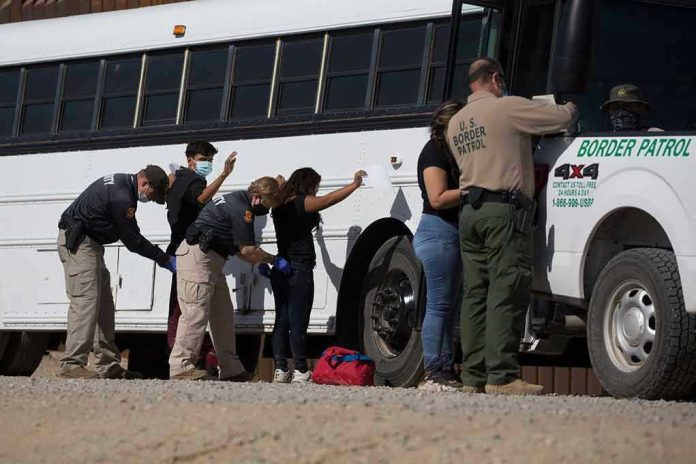
‘A new wave of ICE arrests threatens to sweep the nation, sparking concerns over civil liberties and economic stability.’
Story Highlights
- ICE arrests are projected to significantly increase in 2026 as part of Trump’s immigration enforcement agenda.
- The administration plans to expand workplace raids, targeting industries previously avoided.
- Current enforcement tactics have already exceeded 1,000 arrests per day.
- Concerns arise over civil liberties violations and economic disruption in labor-intensive sectors.
- State and local resistance to federal immigration policies creates operational challenges.
ICE Arrests Set to Surge in 2026
In a recent announcement, Trump’s border chief, Tom Homan, indicated that Immigration and Customs Enforcement (ICE) arrests are expected to “explode greatly” next year. This projection underscores the administration’s intent to intensify its immigration enforcement efforts, expanding beyond the already aggressive tactics employed in 2025. The planned increase aligns with the administration’s broader mass deportation agenda, aiming to ramp up workplace raids and bolster arrest numbers.
Since taking office, the Trump administration has directed ICE to meet daily arrest quotas, significantly elevating the number of detentions. In May 2025, the administration set a target of 3,000 daily arrests, a substantial increase from earlier in the year. Despite achieving over 1,000 arrests per day, ICE has yet to meet these ambitious goals, constrained by legal challenges and resistance from certain state and local governments.
The Impact of Expanded Enforcement Tactics
The administration’s expanded enforcement tactics include deploying a new mapping application to track over 700,000 deportation targets and conducting raids in non-traditional locations such as workplaces. These measures aim to enforce immigration laws more comprehensively and effectively. However, the planned workplace raids raise significant concerns about potential economic disruptions in industries reliant on immigrant labor, such as agriculture and manufacturing.
Critics argue that the quota-driven approach prioritizes quantity over quality, leading to indiscriminate enforcement practices. This has resulted in civil liberties violations, with reports of American citizens detained during operations. The administration’s enforcement strategy has created fear within immigrant communities, discouraging participation in public life and normal activities.
Legal and Political Challenges
Despite the administration’s aggressive approach, it faces significant legal and political challenges. Federal courts have intervened in some cases, ordering ICE to halt certain deportations and requiring detailed reporting on arrest targets. Furthermore, the Supreme Court’s controversial ruling allowing biased immigration policing has sparked debate over constitutional limits and civil rights protections.
State and local governments remain divided on cooperation with federal immigration enforcement. While some jurisdictions fully collaborate with ICE, others have implemented policies to limit cooperation, constraining the administration’s capacity to execute its mass deportation agenda. This division was evident in the 2025 New Jersey governor’s race, where the Republican candidate’s pro-ICE stance failed to secure victory.
Overall, the Trump administration’s immigration enforcement strategy has profound implications for civil liberties, economic stability, and the balance of state-federal power. As ICE prepares to escalate operations in 2026, the administration must navigate these complex challenges to achieve its goals.
Sources:
Report: ICE Directed to Increase Arrests to Meet Daily Quotas
ICE Arrests: Tom Homan Statement