
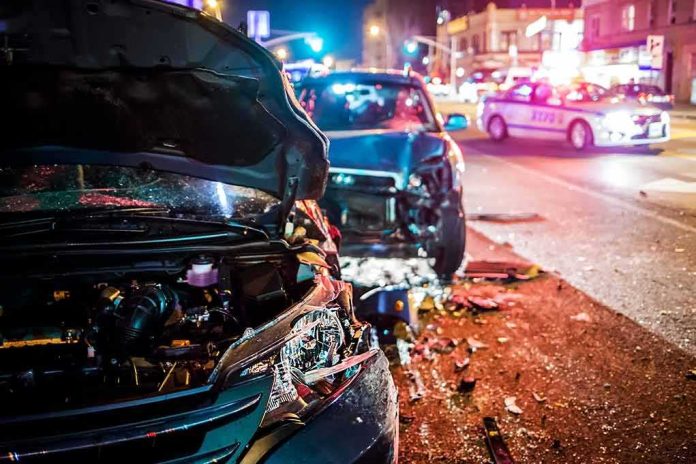
A former top federal prosecutor now stands accused of driving away from a crash she allegedly caused, and that reversal of roles tells a bigger story about power, accountability, and what “rule of law” really means when the cameras are rolling.
Story Snapshot
- Former United States Attorney Jennifer B. Lowery faces a Texas felony charge for allegedly failing to stop and render aid after a crash.[1][3]
- Surveillance video reportedly shows her black sedan remaining at the scene for about two and a half minutes before leaving.[1]
- The injured driver claims she never checked whether he was alive or hurt before driving off.[1]
- The case exposes a tension between media-driven outrage and the slower, stricter standards of criminal law.[1][3]
From Prosecutor To Defendant In A Houston Intersection
Jennifer Bess Lowery once held the title of United States Attorney for the Southern District of Texas, the top federal prosecutor in a vast region that includes Houston.[3] Now, Harris County authorities have charged her with felony failure to stop and render aid after a May crash in Houston that was reportedly caught on surveillance video.[1][3] Local outlets say the footage shows a black sedan colliding with another vehicle and remaining at the scene briefly before leaving.[1] The public reaction has been swift and unforgiving.
ABC13 in Houston reports that court documents accuse Lowery of failing to stop and help after the crash, framing the case as a classic “hit-and-run” narrative with an elite twist: the defendant is a former chief federal law enforcement officer.[1][2] KHOU independently reports that Lowery faces a felony charge in Harris County for allegedly failing to stop and render aid, confirming that this is not just a traffic ticket but a serious state criminal allegation.[3] Those basic facts have fueled a wave of social media commentary that treats the accusation as already proven.
The Law: What “Failure To Render Aid” Really Demands
Texas law requires a driver involved in an injury crash to stop, stay, and provide certain forms of assistance, which can include calling 911, providing information, and, when reasonable, helping the injured person secure medical care. The ABC13 reporting says the surveillance video shows the black sedan staying for only about two and a half minutes before leaving, a span many viewers perceive as obviously too short to satisfy that duty.[1] Yet the law also cares about what the driver knew, could see, and reasonably understood in the moment, details that remain unclear from public records.
The injured driver, identified as Fonseca, gives a stark account that drives public anger. He told ABC13, “She did not even check to see if I was dead,” calling the alleged departure “selfish and cowardly.”[1] That kind of raw victim statement hits people in the gut, especially when paired with slow-motion footage of the crash on television or online.[1][2] Under American conservative values, personal responsibility and basic decency demand that you do not leave a man broken in the street, and many viewers stop their analysis right there. But criminal courts must go further than moral outrage and evaluate evidence element by element.
The Evidence We Have, The Evidence We Do Not
Public reporting so far leans heavily on three pillars: unnamed “court documents,” a summarized surveillance video, and the injured driver’s statements.[1][3] The ABC13 and KHOU stories agree that Lowery was arrested at her home and charged with felony failure to stop and render aid, and that the video appears to show a brief stop followed by departure.[1][3] What the record does not yet show is equally important: the full charging affidavit, detailed police reports, independent eyewitness accounts, or a frame-by-frame timeline of Lowery’s actions during those reported two and a half minutes.[1][3]
Without that underlying material, the public cannot answer crucial questions that criminal law asks before branding someone a felon: Did she clearly see that the other driver was injured? Did she attempt to call 911 or speak to anyone off-camera? Did she reasonably believe that emergency help was already on the way? The available sources do not present defense statements, crash reconstruction, or medical documentation that might cut either for or against her.[1][3] That gap does not exonerate her, but it should make sober observers cautious about promising guilt before trial.
Elite Status, Outrage, And Equal Justice
The former title “United States Attorney” hangs over every sentence of coverage. Both ABC13 and KHOU foreground that Lowery once ran the federal prosecutor’s office in the region, signaling to readers that this is not just another car crash case.[1][3] That framing invites an understandable but dangerous form of status-based outrage: if anyone should know the law and obey it, it is the person who used to enforce it. Many Americans, especially conservatives who champion law and order, see hypocrisy in any suggestion that a former top prosecutor might receive gentler treatment than a blue-collar defendant.
Yet equal justice cuts both ways. If an ordinary Houston driver deserves a presumption of innocence, so does a former federal official, however unpopular the optics might be. The threat here is that a handful of short local news clips and a viral social media reel will write the public verdict long before a jury hears sworn testimony.[1][2][3] That phenomenon reinforces cynicism about institutions: some will assume “the system” will protect her, while others assume “the system” will sacrifice her to prove it is tough on insiders. Both reactions jump past the basic civic discipline of waiting for evidence.
What This Case Reveals About Us
This story taps into more than one woman’s legal trouble at a Houston intersection. It exposes how quickly a familiar narrative—elite official turned alleged lawbreaker—can steamroll nuance. Media reports do their job when they alert the public that a former United States Attorney has been charged with a serious crime, quote the injured driver, and describe the available video.[1][3] But citizens committed to common-sense justice must push further, demanding access to underlying records, full context, and the space for a real defense before deciding what should happen to Lowery.
Whether the evidence ultimately confirms the harshest view of her conduct or reveals a more complicated scene, the core test is the same: will the justice system treat a former federal prosecutor like any other accused driver, neither demonized based on status nor shielded by it? That answer will matter far beyond this one crash, because every American watching is quietly deciding whether “equal justice under law” is still a promise worth believing.
Sources:
[1] Web – Former U.S. Attorney charged with hit-and-run in crash caught on …
[2] YouTube – Former U.S. Attorney charged with hit-and-run in crash caught on …
[3] Web – Former U.S. attorney charged in Houston crash | khou.com