

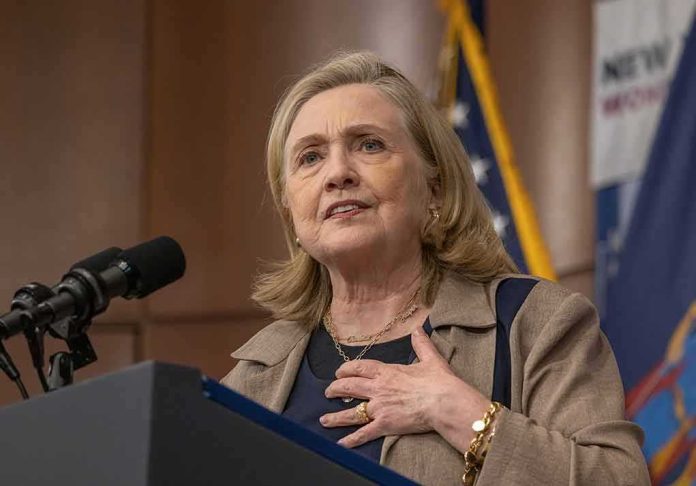
Hillary Clinton warned that post-election power plays could move from courtrooms to certification floors—and even to the ballot vaults themselves.
Story Snapshot
- Clinton predicted legal fights, ballot seizures, and pressure to block certifications.
- Federal agencies report real threats to election workers but no evidence votes were changed.
- Cyber and influence risks exist; technical defenses have ramped up nationwide.
- Critics say Clinton offered predictions without proof of specific plans.
What Clinton Claimed Would Happen After Election Day
Hillary Clinton told a national audience that the real fight would come after polls closed. She said lawsuits would fly, pressure campaigns would target state officials, and efforts would aim to hold or block certifications. She also suggested attempts to “seize ballots” and warned about intimidating voters at polling places, citing Immigration and Customs Enforcement as a possible presence. These are predictions, not documented operations, but she named concrete tactics rather than vague fears.
Clinton’s emphasis fell on process choke points—chain of custody, canvass boards, and certification votes. She framed these as vulnerable to legal maneuver and pressure, not just online chaos. The charge lands because these steps decide outcomes when margins are tight. Yet the record provided does not show orders, dockets, or directives proving a planned ballot seizure or a coordinated certification blockade. Her forecast aims to shape vigilance, but it remains a forecast.
What Official Security Agencies Say About Actual Risks
The Cybersecurity and Infrastructure Security Agency reported years of hands-on work with election systems, from software reviews to penetration testing and incident response. Those details confirm that networks and devices face real probing and that defenses are active and measurable. The Election Assistance Commission says hostile actors keep targeting election infrastructure. It urges continuous hardening, training, and layered security across jurisdictions. This establishes a baseline: risks are real, ongoing, and managed as operations, not theory.
The Federal Bureau of Investigation and the Cybersecurity and Infrastructure Security Agency have said they have no information that cyberattacks prevented elections, changed voter registration records, compromised ballots, or disrupted counting or timely result transmission in the covered cycles. They also caution that access to voter data, much of which is public, does not prove a hacked system or changed votes. This undercuts broad claims that “the election can be hacked and changed” with a few keystrokes.
Threats, Intimidation, and the Line Between Fear and Facts
The Department of Justice’s Election Threats Task Force focuses on violence and intimidation toward election workers. The department states its goal is to ensure workers can do their jobs without threats. That mission validates concern about harassment and pressure on officials, regardless of party. It does not, by itself, prove planned Election Day intimidation by federal agents at polling places. It shows the federal government treats intimidation as a live, prosecutable risk category.
Conservatives should separate three things: free speech about elections, legal challenges allowed by statute, and any act that crosses into intimidation or illegal interference. Lawsuits are part of the system. Pressure that stays within the law is politics. Threats at polling places or interference with ballots cross bright legal lines. Agencies say cyber threats persist, but they have not verified changed votes. That finding favors confidence in local control, paper records, and audits as common-sense guardrails.
How Clinton’s Critics Frame the Claims
Commentators on the right argue Clinton offered a grab bag of fears without evidence. Matt Margolis said she presented the intimidation scenario—such as Immigration and Customs Enforcement near polls—without proof. He also flagged her talk of certification fights as speculation. Matt Vespa cast the set as conspiracy talk, including claims of federal agency misuse and changed results via hacking. This critique hits hardest where Clinton lacked dates, orders, or named officials.
The fair read is this: officials document real risk and rising threats to workers. Cyber probing and influence campaigns exist. But agencies also report no confirmed vote changes by hackers in recent cycles, and the record cited does not show a plan to seize ballots. The prudent path is tough security, transparent audits, and strict enforcement against intimidation—paired with discipline against claims that outrun the facts. That balance protects both confidence and the count.
Bottom Line for Voters and Officials
Voters can trust paper ballots, routine audits, and local checks that catch tampering. Officials should keep testing, logging, and training, because threats hunt for weak links. Parties can use courts, but they must respect certification when evidence falls short. Police should guard polling sites from any real intimidation, whoever tries it. Security without panic, vigilance without rumor—this is the conservative, common-sense way to protect both the process and the public square.
Sources:
redstate.com, justice.gov, news.meaww.com, cisa.gov, warner.senate.gov