

Two counties, two bodies, one red pickup, and a pursuit that ended with a gunshot.
Story Snapshot
- Melissa Pelc-Lohr’s death was ruled a homicide caused by a gunshot wound.
- State Police identified her ex-husband, Norman E. Lohr Jr., as the driver of a related vehicle.
- Troopers located Lohr more than 200 miles away; he fled and a chase followed.
- Deputies later found Lohr dead in the truck; medical officials ruled it a suicide.
What police say happened across Franklin and Wayne counties
New York State Police found 44-year-old Melissa Pelc-Lohr dead at a home on South Woods Road in Moira, Franklin County. An autopsy by forensic pathologist Dr. Michael Sikirica ruled her death a homicide caused by a gunshot wound to the head. Investigators soon focused on a red 2009 Chevrolet Silverado. They identified its operator as her former husband, 47-year-old Norman E. Lohr Jr. The truck became the thread that tied a quiet hamlet to a fast-moving manhunt hours away.
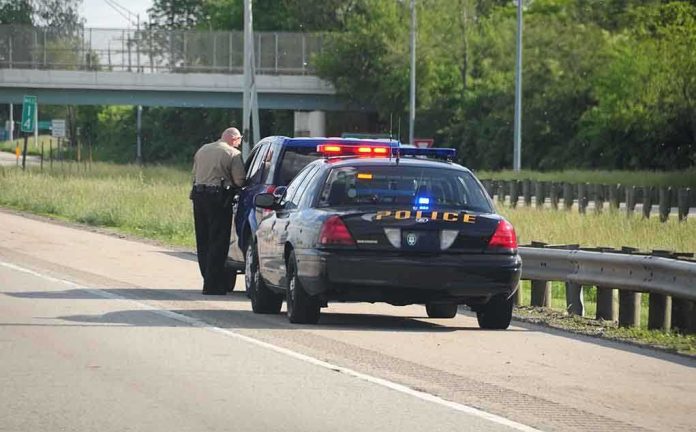
Troopers later spotted the Silverado in Lyons, Wayne County, more than 200 miles from the homicide scene. Officers tried to stop the vehicle. Lohr did not pull over, and a pursuit began along local roads. Deputies used tire-deflation devices to slow the truck. The Wayne County Sheriff’s Office then moved in an armored BearCat to approach the stopped vehicle safely. When officers reached the truck, they found Lohr alone inside with a gunshot wound.
Official findings on both deaths
The medical examiner ruled Pelc-Lohr’s death a homicide due to a gunshot wound. That finding was clear and direct. State Police reported that Lohr died of a gunshot wound inside the Silverado after the chase ended. Reporting cited the Monroe County Medical Examiner’s Office classifying Lohr’s death as a suicide, consistent with a self-inflicted gunshot wound. These are parallel determinations from separate offices in different counties, released within days of the events.
Troopers named Lohr as the driver and sole occupant of the pursuit vehicle that investigators linked to the homicide. Syracuse.com and other local outlets emphasized that State Police had identified Lohr as Pelc-Lohr’s ex-husband and the operator of the red Silverado connected to the case. The agency’s update did not state the identity of the shooter in the homicide. Police said both deaths remained under investigation at the time of their public statements, a normal posture following major incidents.
How a 200-mile thread fits a known pattern
The mooring facts are stark: a woman found shot to death, an ex-spouse located far away in a vehicle tied to the case, a refusal to stop, and a suicide as officers closed in. This arc fits a pattern seen in intimate-partner homicide followed by the perpetrator’s suicide, a tragic sequence that researchers have documented for years. Studies show many homicide-suicides in relationships involve firearms during the suicide phase, and a large share of intimate-partner homicides end with the killer’s suicide. Context does not replace case evidence, but it explains why detectives moved fast.
Common sense and public safety values point to three priorities. First, act early when violence signals surface, especially around separations or threats. Second, give law enforcement clear tools to move quickly when a suspect flees across counties, including access to armored vehicles and tire-deflation gear that save officers and bystanders. Third, center victims with straight answers delivered fast. Police in this case provided names, manners of death, and the broad sequence, which helps a shaken community steady itself.
What matters next for the record
Final case files often arrive long after headlines fade. The most useful pieces include ballistics work, firearm recovery details, and route reconstruction from license-plate readers and dash cameras. These explain how police linked the Silverado to Moira and how the chase unfolded in Wayne County. While the suicide ends any criminal trial, the official record still matters. It preserves facts for the family, guides future training, and helps prevent guesswork in the next emergency.
State Police anchored the timeline with what they could confirm: cause and manner of death for both people, the link to a specific truck, the multi-agency pursuit, and the tactical steps taken to bring it to a controlled stop. Local outlets then added location detail, the distance between scenes, and the medical examiner’s determinations. That is how the public record should build—firm, sourced, and focused on what happened, so the community understands the stakes and the system learns from the pain.
Sources:
nypost.com, 13wham.com, syracuse.com, nny360.com, troopers.ny.gov