

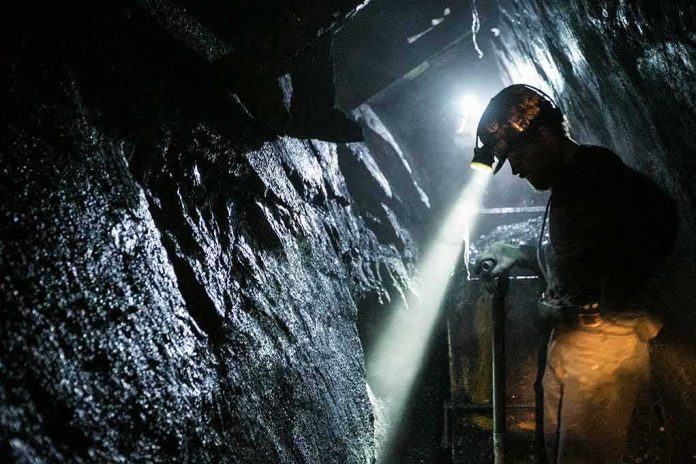
A carbon monoxide alarm screamed a warning inside the Liushenyu Coal Mine before the explosion that killed at least 90 people — and the question nobody in Beijing wants to answer is whether anyone listened.
Story Snapshot
- A gas explosion struck the Liushenyu Coal Mine in Shanxi Province, China, on the evening of May 22, 2026, killing at least 90 workers with nine still missing.
- A carbon monoxide sensor triggered an alarm indicating levels had exceeded safe limits before the blast, raising serious questions about whether warnings were acted upon.
- 247 workers were underground at the time; by the following morning, 201 had been evacuated while rescue operations continued.
- Chinese President Xi Jinping ordered an all-out rescue and thorough investigation, and mine operators were detained for questioning with criminal charges considered likely.
What Happened Inside the Mine That Night
At 7:29 p.m. China Standard Time on May 22, 2026, a gas explosion tore through the Liushenyu Coal Mine in Qinyuan County, Shanxi Province. [1] At that moment, 247 workers were underground. The death toll reported by state media climbed rapidly — from 8, to 50, to 82, and finally to at least 90, with nine workers still unaccounted for as rescue teams continued working through the following day. [5] That kind of cascading casualty count is not just a tragedy; it is a signature of a mine where emergency systems failed to contain the damage quickly enough.
Before the blast, a carbon monoxide sensor underground had already triggered an alarm, and local authorities were notified that levels had exceeded safe limits. [1] That detail matters enormously. A warning system that activates is only useful if someone acts on it. The official record does not yet show the timeline between that alarm and the explosion, and without dispatch logs, evacuation timestamps, and monitoring system records, the gap between warning and catastrophe remains an open and damning question. [1]
Beijing’s Response Signals More Than Routine Concern
Xi Jinping’s public order for an all-out rescue and thorough investigation, echoed by Premier Li Qiang’s call for timely information release and accountability under the law, follows a well-worn script in Chinese industrial disasters. [1] Officials projecting control and compassion in the immediate aftermath is standard operating procedure. What is not standard is the speed with which mine operators were detained for questioning and criminal charges were flagged as likely. [5] That escalation suggests authorities found something in the early hours that moved this beyond a simple accident inquiry.
Shanxi Province is the heart of China’s coal industry, and its mines have a documented history of mass-fatality events. [2] The broader pattern is not subtle: despite decades of regulatory tightening and official campaigns to improve safety, accidents linked to production pressure and enforcement gaps keep occurring. [3] That history does not prove negligence at Liushenyu on this specific night, but it makes the negligence hypothesis far more than speculation. When the same province produces the same type of disaster on a recurring basis, the burden of proof shifts toward those claiming the system worked as designed.
The Information Gap China’s State Media Cannot Fill
Every critical question about this disaster remains unanswered in the public record. Was the carbon monoxide alarm acted upon, or ignored? Were ventilation systems functioning? Did production pressure keep workers underground after the warning? [1] State media, which dominates the early information environment, is structurally oriented toward the rescue narrative rather than the accountability narrative. Xinhua reports the alarm existed; it does not report what the shift supervisor did with that information in the minutes that followed.
A gas explosion at a coal mine in China’s northern Shanxi province killed at least 90 people, state media said on Saturday. It was the country’s deadliest mining accident in recent years.
Read more: https://t.co/zaepkC2VkM
📷: Cao Yang, Xinhua via AP pic.twitter.com/VwmsJKyNSy
— KSL 5 TV (@KSL5TV) May 23, 2026
The mine’s pre-incident inspection records, ventilation logs, sensor calibration history, and regulatory compliance certificates are the documents that would actually answer these questions. [1] Those records sit with Shanxi provincial authorities and the National Mine Safety Administration, and China’s history with industrial accident investigations suggests the full technical findings — if ever released — will arrive long after public attention has moved on. The detained operators may eventually face charges. A final investigation report may eventually surface. But the 90 families who lost someone in that explosion deserve answers on a timeline measured in weeks, not years, and the early evidence suggests the warning system worked far better than the people responsible for responding to it.
Sources:
[1] Web – 2026 Liushenyu coal mine explosion – Wikipedia
[2] Web – 2009 Shanxi mine blast – Wikipedia
[3] YouTube – China Coal Mine Explosion: 80+ Killed, Many Feared Trapped
[5] YouTube – 90 dead after Chinese coal mine blast | ABC NEWS