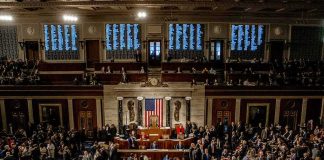

The largest Pentagon budget request in American history just landed on Capitol Hill, and the fight over it reveals something far more complicated than a simple dollar figure.
Story Snapshot
- Defense Secretary Pete Hegseth testified before Congress defending a record $1.5 trillion fiscal year 2027 Pentagon budget request, calling it a “warfighting budget.”
- The Iran war has already cost $29 billion, yet Hegseth declined to specify how much additional funding the conflict will require.
- Democrats challenged the request aggressively, pointing out that roughly $128 billion of previously appropriated reconciliation funds remain unobligated more than a year after passage.
- Hegseth credited administration defense policy with stimulating over $50 billion in private investment, 280 new manufacturing facilities, and 70,000 jobs without taxpayer dollars.
The Biggest Defense Budget Ever Asked For — and Why It Matters Now
Defense Secretary Pete Hegseth walked into a Capitol Hill hearing room and asked Congress for something no Pentagon chief has ever requested before — $1.5 trillion for a single fiscal year. [4] The request, covering fiscal year 2027, arrives while U.S. forces are actively engaged in operations against Iran, a fact that simultaneously strengthens the administration’s urgency argument and hands critics a loaded weapon. When you combine active war costs with the largest peacetime budget ever proposed, the political and fiscal math gets messy fast. [7]
Hegseth framed the request as a “warfighting budget” built around four pillars: rebuilding military readiness, improving quality of life for service members, modernizing equipment and technology, and maintaining dominance over China, Russia, North Korea, and Iran simultaneously. [3] The budget includes investments in drones, the Golden Dome missile defense initiative, and broader force modernization. [2] On paper, those are hard priorities to argue against. In practice, the hearing exposed a significant credibility gap that the administration will need to close before this request moves forward.
The $128 Billion Problem Nobody Wants to Talk About
Here is where the “slush fund” criticism gains real traction. Congress passed $154 billion in reconciliation defense funding, and as of the April 2026 hearing, only approximately $26 billion of it had actually been contracted. [1] Ranking members on the committee pressed Hegseth on why the Pentagon is requesting a historic new sum when more than $128 billion in previously approved money sits largely unobligated. That is not a minor bookkeeping footnote — it is a fundamental question about institutional competence and spending discipline that the administration has not answered convincingly.
The Iran war cost figure adds another layer of complexity. Hegseth confirmed to House lawmakers that operations against Iran have cost $29 billion so far, but he declined to provide a forward-looking funding estimate for the conflict. [7] Asking Congress for $1.5 trillion while simultaneously refusing to quantify the ongoing war’s price tag is a difficult posture to defend. Fiscal conservatives who instinctively support strong defense spending should find that combination genuinely troubling, because blank-check military commitments have a long and expensive history in Washington.
What Hegseth Got Right in That Hearing Room
The private investment numbers Hegseth cited deserve more attention than they received. He testified that since January 20, 2025, Pentagon policy has stimulated over $50 billion in private investment across 150 companies in 39 states, producing 280 new or expanded manufacturing facilities and 70,000 new jobs — all funded by private capital rather than taxpayers. [3] If those figures hold up under scrutiny, they represent exactly the kind of defense industrial base rebuilding that military analysts have warned is critically underdeveloped relative to the threats posed by China’s manufacturing capacity alone.
Pete Hegseth just went to Capitol Hill asking for a record $1.5 trillion Pentagon budget — the largest ever — while admitting the Iran war costs have already climbed to nearly $29 billion despite the ceasefire.
Critics are calling the numbers suspiciously low and pointing out…
— Big Picture News (@AdamI1776) May 14, 2026
The broader strategic argument also has genuine weight. The United States has systematically underinvested in defense modernization for two decades while China doubled its military budget and Russia rebuilt its conventional forces. Hegseth is not wrong that the bill for that neglect is coming due. The legitimate debate is not whether to spend more — most serious defense analysts agree that is necessary — but whether this specific request is structured with enough accountability, transparency, and strategic clarity to justify the number attached to it. Democrats vowing to block the budget entirely are playing politics just as transparently as an administration that won’t disclose war costs. [8] The American military does need serious investment. It also needs serious oversight, and right now Capitol Hill is getting neither from either side of the aisle.
Sources:
[1] YouTube – Hegseth Defends Trump’s $1.5T Pentagon Plan | APT
[2] Web – Trump’s FY27 Budget Proposal Includes $1.5T for Pentagon
[3] Web – $1.5 Trillion Budget Request Prioritizes Service Members …
[4] Web – White House asks for record-breaking $1.5 trillion for defense in new …
[7] Web – Hegseth pushes Trump’s $1.5 trillion defense budget for …
[8] Web – Pete Hegseth faces Congress over Pentagon’s …